Historical Alea Evangelii
The largest known tafl variant (19×19), known from an illustration with a short accompanying text in *Corpus Christi College MS 122* (around 1140) – board, piece count and setup are historically attested, but the rules of play are not preserved. This guide documents a Tablut-based reconstruction after Aage Nielsen's "weak king" scheme: armed king, edge escape, graded king capture (2/3/4 sides).
Short description: The largest known tafl variant (19×19), known from an illustration with a short accompanying text in Corpus Christi College MS 122 (around 1140) – board, piece count and setup are historically attested, but the rules of play are not preserved. This guide documents a Tablut-based reconstruction after Aage Nielsen's "weak king" scheme: armed king, edge escape, graded king capture (2/3/4 sides).
Evidence status: Board, piece count and setup are attested through the manuscript Corpus Christi MS 122. The rules of play, by contrast, are a modern, experimental reconstruction (after Aage Nielsen's Tablut-based scheme) and are not historically attested; even the assignment of the pieces to the sides is disputed in research. The addition "Historical" in the name denotes the model for the board, not the rules.
1. Basic data
| Name | Historical Alea Evangelii (Latin "Alea Evangelii", roughly "game (board) of the Gospels") |
|---|---|
| Game family | Hnefatafl (Nordic tafl game) |
| Category | Board/pieces historically attested (MS 122); rules of play modern, experimental reconstruction (not preserved) |
| Origin / region | Manuscript: Ireland/England |
| Dating | Manuscript Corpus Christi College MS 122, around 1140; rule reconstruction modern |
| Board size | 19×19 squares (project convention; historically a point game, 18×18 squares / 19×19 intersections) |
| Throne | Yes, central restricted square |
| Escape goal | Board edge (edge escape) |
| King | Armed (takes part in captures); graded capture (2 sides far from the throne, 3 next to it, 4 on the throne) |
| Piece ratio | 24 defenders + king against 48 attackers (73 pieces, 1:2) |
2. History and origin
Alea Evangelii is the largest known tafl variant. It is known from an illustration with a short accompanying text in Corpus Christi College MS 122 (Oxford, around 1140), which shows the board (19×19 intersections / 18×18 squares), piece count (24 defenders and the king against 48 attackers) and the basic setup. The manuscript itself contains no rules of play – neither on movement nor on capturing or the victory conditions.
Since no original rules are preserved, all versions of Alea Evangelii playable today are based on modern reconstructions. The version documented here transfers Aage Nielsen's Tablut-based "weak king" scheme, which he also uses for Hnefatafl, Tablut, Brandubh and Ard Ri, onto the MS 122 board: armed king, edge escape (instead of corner escape) and a graded king capture (2 sides far from the throne, 3 next to the throne, 4 on the throne) instead of a strong, Copenhagen-like king. Other researchers have proposed differing reconstructions for the same historically attested board (see section 7).
3. Starting setup and pieces
Legend: K = king · D = defender · A = attacker · . = empty square.
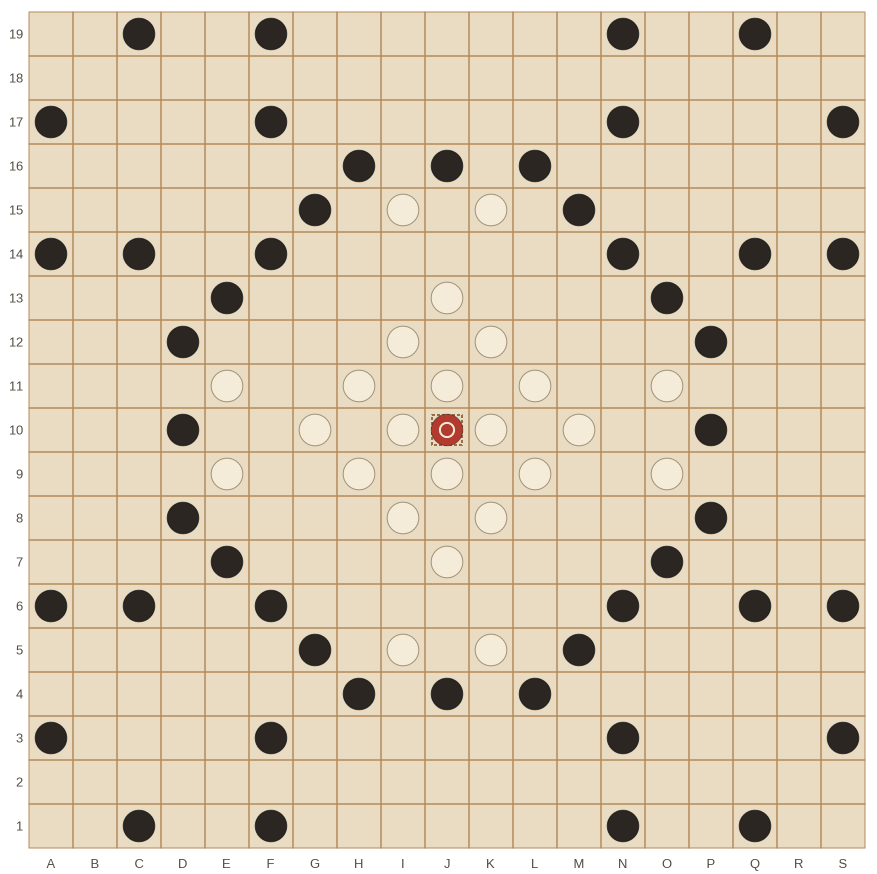
- King
- Defender
- Attacker
- Throne (central square)
The king stands on the central throne, surrounded by 24 defenders (arrangement according to the project's diagram file). 48 attackers stand in groups along the edges and diagonals, following the project's diagram file (a modern rendering of the manuscript illustration). The attackers move first. The assignment of the 73 pieces to the sides is disputed in research (see section 6).
Pieces
| Piece | Side | Count | Special feature |
|---|---|---|---|
| King | Defenders | 1 | Armed (takes part in captures); the only escape piece |
| Defender | Defenders | 24 | Ordinary piece |
| Attacker | Attackers | 48 | Ordinary piece |
4. Objective
The defenders win when:
- the king reaches the board edge (any edge square, not only a corner).
The attackers win when:
- they capture the king, or
- they completely surround the defenders so that these no longer have access to the board edge.
5. Rules of play
5.1 Movement
All pieces move orthogonally (horizontally or vertically) any distance over empty squares. Jumping over or passing other pieces is not allowed.
5.2 Capturing ordinary pieces
A piece is captured when it is flanked on two opposite sides (horizontally or vertically, not diagonally) by an enemy piece or an enemy restricted square. The king may take part in captures. The source adds a note to this rule that a capture only arises on the attacker's active move; whether the same restriction also applies to captures by the defenders remains open there (see section 6).
5.3 Restricted squares
The central square (throne) is a restricted square. The empty throne counts as hostile to all pieces. The board edge itself is not hostile.
5.4 King capture
Far from the throne, the king is captured like an ordinary piece on two opposite sides. If he stands directly next to the throne, the three remaining sides suffice. If he stands on the throne, all four sides must be occupied.
5.5 Move repetition
If the same position occurs for the third time, the side whose move brought the repetition about loses.
5.6 Other cases
A player with no legal move loses the game.
6. Good to know
- Unlike Historical Hnefatafl, Historical Tablut, Historical Brandubh and Historical Ard Ri, Alea Evangelii does not belong to Aage Nielsen's historical core list of the five attested "weak king" games. The transfer of his Tablut-based reconstruction scheme to the MS 122 board used here is an additional extension made in the project, without its own historical evidence for this specific combination.
- The move repetition rule is formulated more generally in the underlying reconstruction: any continued repetition leads to a loss for the defenders, regardless of a fixed number of repetitions. tafl, by contrast, specifically scores the threefold repetition as a defeat for the player who began it. This repetition rule does not come from an Alea Evangelii source; it is carried over from the general weak-king reconstruction scheme (Nielsen). The manuscript MS 122 transmits no rules of play.
- The reconstruction notes on the capture rule that a capture arises "only on the attacker's active move". Whether this restriction also applies to captures by the defenders remains unclear in the source; this guide adopts the wording unchanged, without closing the gap.
- The assignment of the 73 pieces from the MS 122 illustration to the sides is generally disputed in research (among others Murray versus Helmfrid). This guide follows the diagram file stored in the project and makes no decision of its own in this dispute.
- Since no original rules are preserved for Alea Evangelii, the entire rule set documented here is a reconstruction and not a comparison with attested historical rules.
7. Related variants
On the same historically attested board (MS 122), this project documents two further, independent reconstructions, each with its own guide: Alea Evangelii (after Murray) follows the cyningstan/Walker version with a Copenhagen-like strong king and corner escape; Legacy Alea Evangelii is the rule set of the Fellhuhn app with an unarmed king, four-side capture and likewise corner escape. All three guides share board, piece count (73) and basic setup but differ fundamentally in escape goal and king capture; the content of the two other guides is not repeated here.
Within the Nielsen reconstruction family, this version is a transfer of the same Tablut-based scheme as Historical Hnefatafl (11×11), Historical Tablut (9×9), Historical Brandubh and Historical Ard Ri (7×7 each) onto by far the largest board of the family. Tawlbwrdd (11×11) is the Welsh version on a board of its own. According to the current state of research, Linnaeus Tablut remains the only actually handed-down original rule source of the whole tafl family, on which Nielsen's reconstructions ultimately build.
8. Rules of play (original) with source reference
For this variant there is no external historical primary source in its original wording: the manuscript Corpus Christi College MS 122 hands down board, pieces and setup but no rules of play, and the underlying reconstruction (Aage Nielsen's Tablut-based scheme) is likewise available only as a German summary, not in the wording of a primary source. The rule set of the Fellhuhn app is therefore reproduced as the "original" for source comparison. Wording and order are unchanged. (Original in German.)
Source: rule description of the Fellhuhn app.
Notice of rights: This text originates from Fellhuhn (Philippe Schober). It is reproduced with the permission of the developer and is not covered by the CC BY 4.0 licence of this documentation; the rights remain with the authors.
- Schwarz macht den ersten Zug
- Der König ist bewaffnet
- Ein Spieler verliert, wenn er keinen gültigen Zug tätigen kann
- Der König wird von zwei feindlichen Figuren oder feindlichen Feldern geschlagen. Außer er befindet sich auf oder neben seinem Thron
- Der leere Thron gilt als feindlich für alle Figuren
- Der weiße Spieler gewinnt, wenn der König den Rand des Spielfeldes erreicht
- Der weiße Spieler hat verloren, wenn er komplett umstellt wird und keinen Randzugang mehr hat
- Wenn beide Spieler den gleichen Zug jeweils dreimal wiederholen, führt dies zur Niederlage des Spielers der damit angefangen hat
9. Sources
- [Fellhuhn-App] Fellhuhn (Philippe Schober): Hnefatafl (Android app, Google Play), rule description of the variant, used with the express permission of the developer. — https://play.google.com/store/apps/details?id=com.fellhuhn.hnefatafl&hl=de
- [Murray1952] Murray, H. J. R.: A History of Board-Games other than Chess. Oxford: Clarendon Press, 1952, p. 61.
- [MS122] Corpus Christi College, Oxford, MS 122 (around 1140) – illustration of the Alea Evangelii board.
- [cyningstan-alea] Walker, Damian: Alea Evangelii. — http://tafl.cyningstan.com/page/173/alea-evangelii
- [Nielsen-rules] Nielsen, Aage: Hnefatafl Rules (overview). — https://aagenielsen.dk/tafl_rules.php
10. State of the evidence and classification
Board, 73 pieces (24 defenders + king against 48 attackers) and basic setup are historically attested through the illustration with a short accompanying text in Corpus Christi College MS 122 (around 1140) [MS122; Murray1952]. The manuscript, however, hands down no rules of play, and even the assignment of the pieces to the sides is disputed in research (see section 6). Unlike Historical Hnefatafl, Historical Tablut, Historical Brandubh and Historical Ard Ri, Alea Evangelii also does not belong to Aage Nielsen's historical core list of the five attested "weak king" games [Nielsen-rules]; the transfer of his Tablut-based reconstruction scheme to this board used here is an additional extension made in the project, without its own historical evidence. The rules reproduced in this guide therefore come exclusively from the rule set of the Fellhuhn app (section 8), since no external text in its original wording is available for the reconstruction itself. Reconstructions of Alea Evangelii are generally regarded as hard to balance because of the extreme ratio of 73 pieces on such a large board; this observation concerns the Murray/Walker version in particular (see the guide "Alea Evangelii (after Murray)").