History and origin of the tafl games
What this document is about
This document explains what is known about the origins and spread of the tafl family, including Hnefatafl, and distinguishes established evidence from plausible hypotheses and modern reconstructions. It is intended for interested players rather than specialists. Instead of formal footnotes, it identifies the source of each major claim so that readers can check it.
For the exact rules of a particular variant, consult its own rules guide (see Variant lexicon and the Docs tab in the GUI). This document deals with history, not rules.
How claims are classified
Each section uses the following symbols to indicate the strength of the evidence:
- 🔴 Attested by sources – a find, manuscript or text demonstrably exists; the name, board or number of pieces is attested.
- 🟡 Expert assessment – an interpretation of the available evidence that is widely accepted among researchers, but is not itself direct evidence.
- 🟠 Modern reconstruction – a version played today that fills gaps in the historical sources with plausible but unattested assumptions.
This distinction is central to this document: for the tafl games, historical evidence and complete rules rarely survive together. Either something is attested (usually only the name, board and number of pieces, sometimes individual aspects of the rules), or there is a fully worked-out set of rules (usually a reconstruction).
The most important correction: Tablut is not the origin
A widespread but unsupported assumption is: "Tablut was the first tafl game from which all the others are derived."
This cannot be supported. What is established is rather this: Tablut – the Sámi game that the Swedish naturalist Carl von Linné observed and recorded in 1732 – is, according to the current state of research, the only variant with an almost completely surviving rule text, but at the same time the latest attested branch of the whole family. All other known variants (Hnefatafl in Scandinavia, Tæfl in England, Brandub in Ireland, Tawlbwrdd in Wales, Alea Evangelii likewise in England) are attested earlier; this order of the surviving evidence allows us to infer neither that they descend from Tablut nor how the traditions are related to one another (🔴, Murray 1952, p. 56).
Two entirely different relationships are often confused here:
- Historical descent: according to Murray's model (a scholarly hypothesis, not a direct find), Tablut is a late-attested branch of the family – not an ancestor of the other variants.
- The modern reconstruction method: because comparatively detailed rules survive only for Tablut, researchers use them as a model when reconstructing the rules of the other variants (which are attested only by board and pieces). This is an aid of modern game research – not a historical relationship.
Tablut was documented by Linné in 1732, considerably later than several other recorded tafl traditions. Its comparatively detailed rules make it an important reference for modern reconstructions, but the date of the surviving account does not establish when the game originated or how the regional traditions were related.
A common root instead of a chain
"Family tree" is a somewhat misleading word for the tafl games (🟡): it suggests that one game gave rise to the next, as a parent does a child. According to Murray's model – a scholarly hypothesis not secured by any direct find – it is rather one game with many regional names and board sizes, which spread from a common root. Aage Nielsen's merging of the historical variants is likewise a reconstruction and theory, not independent archaeological evidence.
The English board-game historian H. J. R. Murray described Tafl (pronounced "tabl") as the earlier name and Hnefatafl as the later name of a board game played by Scandinavian peoples before AD 400. According to Murray, the Norsemen carried it to Iceland, Britain and Ireland, and it spread as far as Wales (🔴, paraphrased from Murray 1952, p. 56).
This yields the following picture (🟡):
- a common root – early Scandinavian tafl, before AD 400,
- geographical spread by the Norsemen into broadly contemporary regional forms (Iceland, England, Ireland, Wales and Sápmi/Lapland),
- not a simple sequence in which one variant gave rise to the next.
A family tree of the tafl games is therefore closer to a map of geographical spread, with one root, than to a conventional genealogy.
Where did tafl originate?
Murray proposes that tafl developed from the Roman ludus latrunculorum (Greek petteia), citing the shared method of capturing pieces by flanking them on opposite sides (🟡, Murray 1952, p. 54). This hypothesis is plausible and widely accepted among researchers, but there is no direct archaeological evidence for the transition itself. The decisive innovation compared with the symmetrical Roman game is asymmetry: a king with a small band against a force twice as large, with opposing goals.
The attested branches of the family
The following features are used here to identify members of the tafl family: two unequal sides, a single king on the defending side, roughly twice as many attackers as defenders, a central throne square, capture by flanking and opposing objectives (the king escapes, or the king is captured).
| Variant | Origin | Board | Pieces | Most important evidence |
|---|---|---|---|---|
| Hnefatafl / Tafl | Scandinavia, Iceland | 11×11, 13×13 | King + band against double the number | Icelandic sagas; finds at Gokstad (13×13), Birka |
| Tæfl | Anglo-Saxon England (before 1066) | various | – | Old English glossaries |
| Alea Evangelii | England; according to MS 122 the court of King Æthelstan (10th c.; transmitted via Dub Innse, Bishop of Bangor; Robinson 1923, p. 70) | 19×19 | 1 + 24 against 48 | Illustration with a short accompanying text in Corpus Christi College MS 122, written around 1140; no complete rule text survives |
| Brandub | Ireland | 7×7 | 5 against 8 (13 pieces) | Tale Acallam na Senórach; a poem; the Ballinderry board attests only a 7×7 grid (name and piece ratio come from the literature) |
| Tawlbwrdd | Wales | 11×11 | 12 against 24 | Manuscript by Robert ap Ifan, 1587; laws of Hywel Dda |
| Tablut | Sápmi (Lapland) | 9×9 | 8 + 1 against 16 | Carl von Linné, 1732 (printed in Smith, 1811) – the most detailed surviving rule description according to the current state of research |
The surviving accounts differ considerably in detail. Linnaeus's description of Tablut is comparatively extensive, whilst Robert ap Ifan's account of Tawlbwrdd also records aspects of capture and play. For other traditions, the surviving evidence is partly limited to names, finds or literary references. Where only name, board and piece count are attested, the concrete movement and capture rules are 🟠 modern reconstructions oriented on Tablut.
What does not belong to the family
According to the current state of research, two frequently named candidates do not belong to the tafl games:
- Fidchell (Irish) / Gwyddbwyll (Welsh): according to the prevailing view more closely related to the symmetrical ludus latrunculorum type than to tafl – both sides had the same number of pieces, which contradicts the asymmetry typical of tafl (🟡, MacWhite 1945).
- Ard Ri ("High King"): Ard Ri is used here as the modern name of a 7×7 reconstruction. No historical source for this game name or rule set has been found in the sources consulted (Walker: documentary evidence is non-existent). The standard setup widespread today appears in Parlett 1999 (page not checked); it is therefore regarded as a modern formation, not as a historically attested variant (🟠, Walker, cyningstan.com).
Timeline of surviving evidence
- Before AD 400: according to Murray, tafl was played in Scandinavia (🔴, Murray 1952, p. 56); early Viking Age asymmetric sets of pieces (🟡, no secure date).
- 9th–11th centuries (Viking Age): heyday; finds at Gokstad (9th century), Ballinderry (10th century) and Birka.
- 10th century / around 1140: Alea Evangelii (concept 10th c., the surviving manuscript written around 1140).
- 11th–12th century: chess displaces tafl in large parts of Europe; the game retreats to peripheral regions.
- 1587: Tawlbwrdd in Wales – last attestation as a game still being played in the west.
- 1732: Tablut in Sápmi – the last living game tradition and, according to current research, the only one with an almost complete surviving rules text.
Striking: the later a branch is attested, the more detailed its rules are documented. The date of the record is not a date of origin, however.
The family tree as a diagram
The diagram below summarises these relationships. Solid lines represent the proposed historical spread; dashed lines represent modern rule reconstruction based on Tablut, which is a research method and not a historical relationship. The same diagram is available separately as geschichte_der_tafl_spiele.mermaid.
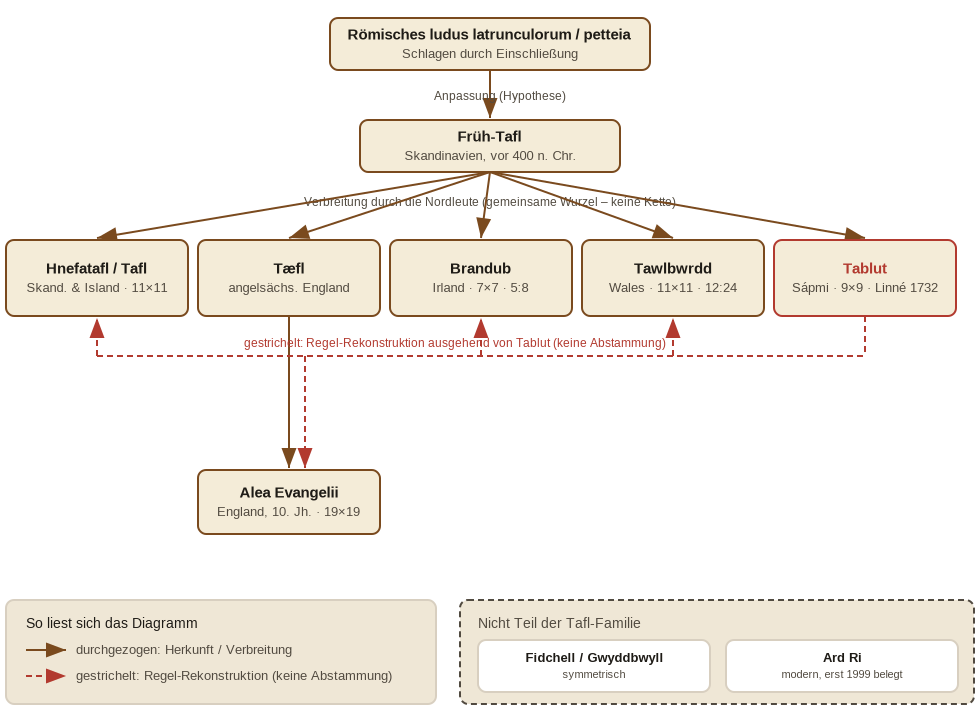
Board sizes: stages of development or contemporaneous regional forms?
Attested tafl boards range from 7×7 up to Alea Evangelii with 19×19 squares. It would be natural to assume that smaller boards are older (or younger) than large ones. The finds do not support this, however (🟡):
- Boards of several sizes are attested in broadly the same period, the 9th to 10th century: 7×7 (Ballinderry, Ireland), 13×13 (Gokstad, Norway), 15×15 (Coppergate/York, England) and the 19×19 concept of Alea Evangelii.
- There is no recognisable progression from small to large boards or vice versa.
Surviving boards and written accounts suggest considerable variation in board size; the evidence establishes neither a universal chronological sequence of board sizes nor a single pattern of regional descent. According to Murray's interpretation, the sizes would be above all contemporaneous, regionally preferred variants of the same game principle, not chronological stages of development (🟡, Murray 1952, pp. 58–61). Individual finds (Ballinderry, Gokstad, Birka, Coppergate) each attest only themselves, not the whole distribution of sizes.
The constant feature is not board size but the balance of forces: attackers outnumber defenders by roughly two to one.
An important qualification: the Vimose find (Denmark, around AD 400, 18×18), classified as a tafl board in 1952, is now more commonly associated with the Roman ludus latrunculorum (🟡). On this interpretation, the earliest securely attested large board is Alea Evangelii from the 10th century.
Alea Evangelii: playing on intersections rather than squares
The Alea Evangelii manuscript depicts a grid with pieces placed on its intersections rather than inside its squares, as in Go. Murray describes it as "18×18 squares", corresponding to 19×19 intersections (361 points) (🔴, Murray 1952, p. 61). Transferred to the square-based boards otherwise usual for tafl, this gives a board of 19×19 squares. In tafl, Alea Evangelii is therefore treated as a 19×19 board.
Further specialist literature
More recent specialist literature also supports the interpretation outlined above. The British Hnefatafl author Damian Walker, who runs cyningstan.com, presents a similar account in his two books (🟡):
- Hnefatafl declined in popularity before printing became widespread. Unlike chess, it was never standardised, and players agreed on the rules before each game, with regional variations. Only two historical written rules texts survive: a very incomplete account of Tawlbwrdd (1587) and an almost complete account of Tablut (Walker 2015).
- Walker, too, does not list Ard Ri as a historical variant, and he, too, derives the common root from Petteia/Latrunculi (Walker 2015).
A particularly well-documented example: how translation made the king stronger
Tablut, the most detailed surviving rule description, illustrates the difference between evidence and later interpretation. Carl von Linné recorded the rules in Latin in 1732. Rule 9 reads in the Latin original, in sense: "If one can enclose an opposing piece between two of one's own pieces hostile to it, it is captured and must be removed – likewise the king." (🔴, Linné 1732, after the Ahrling edition 1889; the 1913 edition reads "etiam Rex", Linné 1913, p. 155).
The English editor Smith, however, translated this passage in 1811 as "except the king" – the king excepted. Smith's translation thereby departs from rule 9 in this part: Linné's account applies ordinary two-sided capture to the king as well, with special conditions at and next to the throne (🔴, after comparison with the Latin text and Walker 2014). The sources consulted say nothing about Smith's intention or about consequences for the balance of play. The Latin wording is to be quoted by edition (Ahrling 1889: "item Rex", edition 1913: "etiam Rex"; the page in the Ahrling edition has not been checked).
At a glance: attested or reconstructed?
| Variant | Name attested? | Board/pieces attested? | Rules of play |
|---|---|---|---|
| Hnefatafl (umbrella term) | 🔴 yes | 🔴 yes | 🟠 reconstructed |
| Tablut | 🔴 yes (1732) | 🔴 yes | 🔴 almost completely preserved |
| Brandub | 🔴 yes | 🔴 yes | 🟠 reconstructed |
| Tawlbwrdd | 🔴 yes (1587) | 🔴 yes | 🟠 reconstructed |
| Alea Evangelii | 🔴 yes (manuscript) | 🔴 yes | 🟠 reconstructed |
| Ard Ri | 🟠 no historical source known – modern formation | 🟡 only in general terms (small boards in Scotland) | 🟠 modern |
| Fidchell / Gwyddbwyll | 🔴 yes (name) | 🟡 probably not tafl (symmetrical) | unknown |
Open questions
Research into the origins of tafl remains incomplete. Open questions include:
- Direct archaeological evidence for the proposed transition from latrunculi to tafl is lacking.
- The single surviving manuscript cannot establish whether Alea Evangelii was an independent English branch or a scholarly creation without a continuing tradition of play.
- Researchers disagree on the precise allocation of the 73 pieces of Alea Evangelii between the two sides.
Sources
- Murray, H. J. R.: A History of Board-Games Other Than Chess. Oxford: Clarendon Press, 1952.
- MacWhite, Eoin: Early Irish Board Games. In: Éigse, 1945.
- Parlett, David: The Oxford History of Board Games. Oxford University Press, 1999.
- Linné, Carl von: Iter Lapponicum (1732), cited after the edition by Ahrling, 1889.
- Robinson, Joseph Armitage: The Times of Saint Dunstan (Ford Lectures 1922). Oxford: Clarendon Press, 1923. (p. 70 cited after Walker 2014; original not consulted.)
- Smith, James Edward (ed.): Lachesis Lapponica, volume 2. London, 1811.
- Walker, Damian: An Introduction to Hnefatafl, 2nd edition, 2015.
- Walker, Damian: Reconstructing Hnefatafl, revised edition, 2014.
- Walker, Damian: various specialist articles on cyningstan.com, including Hnefatafl's Mysterious Origins, Archaeological Finds, Ard Ri: Historic or Modern?, Alea Evangelii, Fithcheall and Gwyddbwyll: Hnefatafl or Not? (http://tafl.cyningstan.com/).
- Helmfrid, Sten: Hnefatafl – the Strategic Board Game of the Vikings (https://tafl.lyckans-talisman.se/).
Further documents
strategie_und_taktik.md
variantenuebersicht.md
glossar.md