Old Hnefatafl
Aage Nielsen's 11×11 variant based on Fetlar. The king is equally strong but can also be captured at the board edge. Draw forts and repetitions are not permitted.
Short description: Aage Nielsen's 11×11 variant based on Fetlar. The king is equally strong but can also be captured at the board edge. Draw forts and repetitions are not permitted.
1. Basic data
| Name | Altes Hnefatafl (Old Hnefatafl) |
|---|---|
| Game family | Hnefatafl (Nordic tafl game) |
| Category | Modern rule variant of Fetlar Hnefatafl (no historical evidence despite the name) |
| Origin / author | Aage Nielsen (Denmark), formulated as a distinction from Fetlar |
| Dating | Modern |
| Board size | 11×11 squares |
| Throne | Yes, central king square |
| Escape goal | Corner square |
| King | Unarmed in tafl (source: armed); "strong" (captured on 4 sides), additionally capturable on the board edge as well |
| Piece ratio | 12 defenders + king against 24 attackers (1:2) |
2. History and origin
Despite the German name "Altes Hnefatafl" ("Old Hnefatafl"), this is not a historical reconstruction but a modern rule variant that Aage Nielsen formulated as a distinction from Fetlar Hnefatafl. Nielsen describes it directly via the comparison: Old Hnefatafl follows the same rules as Fetlar, with two exceptions – the king is additionally capturable on the board edge as well (next to a corner, two attackers suffice for this), and draw forts as well as repetitions of moves are not allowed.
3. Starting setup and pieces
Legend: K = king · D = defender · A = attacker · . = empty square.
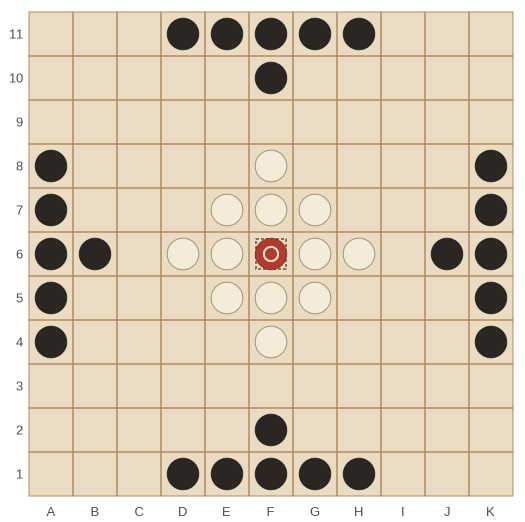
- King
- Defender
- Attacker
- Throne (central square)
The king stands on the central throne, surrounded by 12 defenders in a cross shape. 24 attackers stand in four groups at the midpoints of the edges. The attackers move first.
Pieces
| Piece | Side | Number | Special feature |
|---|---|---|---|
| King | Defenders | 1 | "Strong" (captured on 4 sides), additionally capturable on the board edge as well; unarmed in tafl, armed in the source; only escape piece |
| Defender | Defenders | 12 | Ordinary piece |
| Attacker | Attackers | 24 | Ordinary piece |
This variant has no special pieces.
4. Objective
The defenders win when:
- the king reaches a corner square.
The attackers win when:
- they capture the king, or
- they enclose the king and all remaining defenders in a closed ring (as in Fetlar Hnefatafl, see section 7).
5. Rules of play
5.1 Movement
All pieces may move any number of unobstructed squares horizontally or vertically. Pieces may not jump over other pieces.
5.2 Capturing ordinary pieces
A piece is captured when it is flanked on two opposite sides by two opposing pieces, or by one opposing piece and a hostile royal square.
5.3 King squares
King squares are the throne and the four corner squares; they may only be entered by the king. The throne is always hostile to attackers, but to defenders only when it is empty. The corner squares are always hostile to both sides. The board edge itself is otherwise not hostile – with the exception for the king described in 5.4.
5.4 Capturing the king
In this implementation, the king is unarmed (unlike in the source; see section 6) and is captured on four sides. When adjacent to the throne, three attackers suffice. Unlike in Fetlar Hnefatafl, the king can also be captured on the board edge; next to a corner, two attackers suffice because the corner acts as a hostile side.
5.5 Encirclement victory
If the king and all remaining defenders are enclosed by a closed ring of attackers, the attackers win – identical to the rule of the same name in Fetlar Hnefatafl. Details and examples: the bundled program documentation.
5.6 Repetition of moves
Draw forts and repetitions of moves are not allowed. If the same position occurs for the third time, the side whose move brought the repetition about loses.
5.7 Further cases
A player with no legal move loses the game.
6. Good to know
- Nielsen's Old Hnefatafl, like Fetlar, has an armed king; tafl makes him unarmed – a clear deviation from the source.
- The essential rule difference from Fetlar is deliberate: whereas Fetlar expressly permits draw forts on the edge as a draw, Old Hnefatafl makes exactly these edge positions attackable through the king who is additionally capturable on the edge, and at the same time forbids repetitions.
7. Related variants
Old Hnefatafl is a direct rule variant of Fetlar Hnefatafl: movement, ordinary capturing, king squares and the basic four-sided capture rule for the king are taken over identically (see the rules guide "Fetlar Hnefatafl"); the only difference in content is the king who is additionally capturable on the edge as well as the ban on draw forts and repetitions. Copenhagen Hnefatafl is a further variant with a strong king on the 11×11 board that builds on Fetlar independently of Old Hnefatafl (shieldwall capture, exit fort). Berserk Hnefatafl also shares the strong king and the 11×11 board, but differs through special pieces (see the respective rules guides).
8. Rules of play (original) with source attribution
A verbatim original text is not available, only a short German definition via a distinguishing sentence relative to Fetlar as well as rule references. The rule set of the Fellhuhn app is therefore reproduced as the "original" for comparison with the source. Wording and order are unchanged. Original in German.
Source: Rule description of the Fellhuhn app.
Notice of rights: This text originates from Fellhuhn (Philippe Schober). It is reproduced with the permission of the developer and is not covered by the CC BY 4.0 licence of this documentation; the rights remain with the authors.
- Schwarz macht den ersten Zug
- Der König ist unbewaffnet
- Ein Spieler verliert, wenn er keinen gültigen Zug hat
- Der König wird von vier feindlichen Figuren oder Feldern geschlagen
- Der Rand des Spielfelds gilt als feindlich für den König
- Der leere Thron gilt als feindlich für alle Figuren
- Eckfelder gelten für alle als feindlich
- Weiß gewinnt, wenn der König ein Eckfeld erreicht
- Weiß verliert bei vollständiger Umstellung
- Dreifache Zugwiederholung → Niederlage des Verursachers
9. Sources
- [Fellhuhn-App] Fellhuhn (Philippe Schober): Hnefatafl (Android app, Google Play), rule description of the variant, used with the express permission of the developer. — https://play.google.com/store/apps/details?id=com.fellhuhn.hnefatafl&hl=de
- [Nielsen-rules] Nielsen, Aage: Hnefatafl Rules (overview, section "Strong King → Old Hnefatafl 11x11"). — https://aagenielsen.dk/tafl_rules.php
- [Nielsen-fetlar] Nielsen, Aage: Rules of Fetlar Hnefatafl 11x11 (base rules to which Old Hnefatafl refers). — https://aagenielsen.dk/fetlar_rules_en.php
10. State of the evidence & classification
🟠 modern variant (source available). "Old Hnefatafl" is defined by Aage Nielsen in the section "Strong King" as a rule version of its own: the same rules as Fetlar, but with a king who can be captured on the edge (next to a corner two attackers suffice) and without permitted draw forts/repetitions. It is a modern rule design, not a historical reconstruction [Nielsen-rules; Nielsen-fetlar]. Deviation in tafl: Nielsen's Old Hnefatafl has an armed king, whereas tafl runs it with an unarmed king in this variant (see section 6).