Market Hnefatafl
Aage Nielsen's deliberately simplified 9×9 Tablut version for demonstrations at markets, fairs and board game events. Its minimal rules, with no throne or other restricted squares, make it accessible to beginners.
Short description: Aage Nielsen's deliberately simplified 9×9 Tablut version for demonstrations at markets, fairs and board game events. Its minimal rules, with no throne or other restricted squares, make it accessible to beginners.
1. Basic data
| Name | Market Hnefatafl (also: Simple Historical Hnefatafl 9×9 / Simple Tablut) |
|---|---|
| Game family | Hnefatafl (Nordic tafl game) |
| Category | Modern (didactic simplification of Tablut) |
| Origin / author | Aage Nielsen, Denmark |
| Dating | First used in 2018 (Classic Board Game Café, Denmark; Ringsted Medieval Festival) |
| Board size | 9×9 squares |
| Throne / restricted squares | None; the central square has no special function |
| Escape goal | Edge of the playing field (edge escape) |
| King | Armed, but "weak" – captured like an ordinary piece from two sides |
| Piece ratio | 8 defenders + king against 16 attackers (1:2) |
2. History and origin
Aage Nielsen designed this rule set as a deliberately minimalist version of historical Tablut for demonstrations at market stalls, at fairs and at board game events. It was first used in 2018 at the Classic Board Game Café in Denmark and at the Ringsted Medieval Festival. The aim of the simplification is to make the game as accessible as possible: throne, anvil and other restricted-square rules are dispensed with entirely, so that beginners can learn the basic mechanics of capturing and escaping without additional rules.
3. Starting setup and pieces
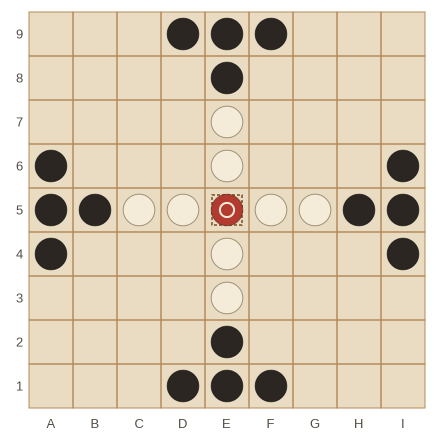
Legend: K = king · D = defender · A = attacker · . = empty square.
- King
- Defender
- Attacker
- Throne (central square)
The king stands in the centre, surrounded by 8 defenders in a cross shape. 16 attackers stand in four groups of four pieces each at the middles of the sides of the edge. White (the defenders) moves first.
Pieces
| Piece | Side | Count | Special feature |
|---|---|---|---|
| King | Defenders | 1 | Armed; the only escape piece; no special throne rule, since there is no restricted square |
| Defender | Defenders | 8 | Ordinary piece |
| Attacker | Attackers | 16 | Ordinary piece |
4. Objective
The defenders win when:
- the king reaches a square on the board edge.
The attackers win when:
- the king is captured before he escapes.
5. Rules of play
5.1 Movement
All pieces move orthogonally any distance over empty squares; diagonal moves and jumping over other pieces are not allowed. Since there is no restricted square, the central square may also be entered and passed through by any piece.
5.2 Capturing
A piece is captured when it comes orthogonally between two enemy pieces, provided the trap arises through the active move of the flanking side. Moving voluntarily between two enemies is safe. Captured pieces are removed from the board immediately.
5.3 Capturing the king
This simplified version has no king-capture rule of its own: the king is captured, like any other piece, on two opposite sides. Since there is no throne, all special rules for positions on or next to a central square are also omitted.
5.4 Move order
White (the defenders) moves first; after that both sides move alternately. This deliberately deviates from the first-move convention of historical Tablut, where the attackers begin.
5.5 Further cases
The short rule set does not explicitly address repetition or other special cases, such as a player having no legal move. This guide leaves those questions open rather than introducing additional assumptions. If the side to move has no legal move, the game ends in a draw. This is a stipulation of tafl; the source says nothing on the point.
6. Good to know
- Market Hnefatafl uses the same starting setup picture as historical Tablut (Nielsen setup), but dispenses entirely with the throne and the anvil rule – the only capture rule is the simple two-sided capture, which applies equally to the king and to ordinary pieces.
- The first-move rule "White first" deliberately deviates from the classic Tablut convention and is one of the few explicit deviations of this otherwise extremely reduced version.
7. Related variants
Market Hnefatafl is a simplified derivation of historical Tablut (see "Linnaeus Tablut" and "Historical Tablut"), but unlike these dispenses entirely with throne and anvil rules. Simple Tafl uses the same simplification logic on a larger 11×11 board. Sea Battle Tafl 9×9 is likewise free of restricted squares, but differs through an unarmed escape piece and four-sided capture.
8. Rules of play with source reference
For this variant there is neither a verbatim quoted external original text nor a rule set of the Fellhuhn app. All that exists is a German paraphrase, provided with rule numbers, of Aage Nielsen's external short rule set. The following section reproduces this paraphrase as close to the wording as possible; it is not a verbatim translation of the English original but a summary with numbers assigned to the source. The paraphrase below was rendered into English from the German paraphrase of this documentation.
Source (paraphrased): Nielsen, Aage: Rules for Simple Tablut in English. — https://aagenielsen.dk/tablutmarketregler_engelsk.pdf
Own summary after Nielsen, Aage: Rules for Simple Tablut in English, not the original text.
- White moves first, then alternately. (Rule 2)
- All pieces move orthogonally, any distance, as long as the path is free. Since there are no restricted squares, the central square can be freely entered and passed through. (Rule 3)
- A piece is captured when it comes orthogonally between two enemies; only if the trap is closed by the opposing move. Moving voluntarily between two enemies is safe; captured pieces are removed. (Rule 4)
- The capture of the king is not expressly named with a rule number of its own in the short rule set; it falls under the general two-sided capture rule. (Rules 4 and 6)
- The defenders win when the king reaches an edge square. (Rule 5)
- The attackers win when the king is captured before he escapes. (Rule 6)
9. Sources
- [Nielsen-rules] Nielsen, Aage: Hnefatafl Rules (overview), section "Market Hnefatafl / Simple Historical Hnefatafl 9x9" and "Simple Tafl". — https://aagenielsen.dk/tafl_rules.php
- [Nielsen-market-pdf] Nielsen, Aage: Rules for Simple Tablut in English. — https://aagenielsen.dk/tablutmarketregler_engelsk.pdf
- [Nielsen-market-de] Nielsen, Aage: Regeln für einfaches Tablut auf Deutsch. — https://aagenielsen.dk/tablutmarketregler_tysk.pdf
10. State of the evidence & classification
This is a modern, didactically deliberately reduced version of historical Tablut without a historical attestation of its own. All the sources named are reachable; the market PDF rule set itself is deliberately kept minimalist. An important limitation: the original rules exist only paraphrased with rule numbers, not verbatim; section 8 of this document is accordingly marked as a paraphrase and not as a verbatim quotation. On repetition of moves and on further special cases the source makes no statement – this gap is stated openly here instead of being closed by assumptions of its own.