Legacy Tablut
The Fellhuhn app's rule set on the historically attested 9×9 Tablut board. The app's modern rules have no external source: an unarmed king, four-sided capture, corner escape and a board edge hostile to both sides. Only the board size and piece count connect this version to historical Tablut.
Short description: The Fellhuhn app's rule set on the historically attested 9×9 Tablut board. The app's modern rules have no external source: an unarmed king, four-sided capture, corner escape and a board edge hostile to both sides. Only the board size and piece count connect this version to historical Tablut.
Evidence status: Rule set of the Fellhuhn app without an external or historical source. Only the board and piece count are historically attested.
1. Basic data
| Name | Legacy Tablut |
|---|---|
| Game family | Hnefatafl (Nordic tafl game) |
| Category | Rule set of the Fellhuhn app; board and piece count historically attested (Tablut) |
| Origin / region | Rule set: modern (Fellhuhn app); board reference: Sápmi / Lapland (Sámi) |
| Dating | Rule set modern; historical board reference 1732 (Linné Tablut) |
| Board size | 9×9 squares |
| Throne | Yes, central square |
| Escape goal | Corner square |
| King | Unarmed (does not take part in captures); capture from 4 sides |
| Piece ratio | 8 defenders + king against 16 attackers (1:2) |
2. History and origin
Legacy Tablut takes over the board size, throne position and piece count (8 defenders and the king against 16 attackers) of the historically attested Sámi Tablut (see "Linnaeus Tablut"). The rules of play themselves, however, do not follow the historical original but an independent, more modern rule set of the Fellhuhn app: instead of the historical edge escape with an armed king capturable from two sides, Legacy Tablut uses corner escape with an unarmed king and four-sided capture – a rule scheme that is more reminiscent of other modern corner-escape variants than of historical Tablut. No external source is known for this specific rule set.
3. Starting setup and pieces
Legend: K = king · D = defender · A = attacker · . = empty square.
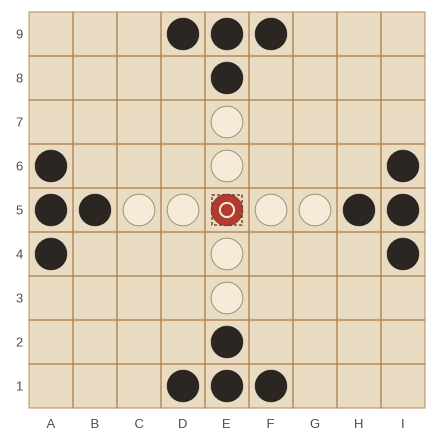
- King
- Defender
- Attacker
- Throne (central square)
The king stands on the central throne, surrounded by 8 defenders in a cross shape. 16 attackers stand in four groups of four pieces each at the midpoints of the four sides. The attackers move first.
Pieces
| Piece | Side | Count | Special feature |
|---|---|---|---|
| King | Defenders | 1 | Unarmed (does not take part in captures); the only escape piece |
| Defender | Defenders | 8 | Ordinary piece |
| Attacker | Attackers | 16 | Ordinary piece |
4. Objective
The defenders win when:
- the king reaches a corner square.
The attackers win when:
- the king is captured from four sides, or
- the defenders are completely surrounded and no longer have access to the edge.
5. Rules of play
5.1 Movement
All pieces move orthogonally any distance over empty squares; diagonal moves and jumping over other pieces are not allowed.
5.2 Capturing ordinary pieces
A piece is captured when it is flanked on two opposite sides by an enemy piece or a hostile square. Moving voluntarily between two opposing pieces is safe; a capture occurs only when a player completes the enclosure with their own move.
5.3 Capturing the king
The king is unarmed and is captured from four sides – by enemy pieces or hostile squares. The board edge itself counts as hostile for the king and can serve as one of the four flanking "partners".
5.4 Hostile squares
The empty throne is hostile to all pieces; so are the four corner squares.
5.5 Victory and defeat
If the king reaches a corner square, the defenders win. If the defenders are completely surrounded without any access to the edge remaining for them, the attackers win.
5.6 Repetition of moves
If the same position occurs for the third time, the side whose move brought the repetition about loses.
5.7 Further cases
If a side can no longer make a legal move, it loses the game.
6. Good to know
- Legacy Tablut does take over the board and piece count from historical Tablut, but deviates from it in practically all decisive rules: where historical Tablut has an armed king with two-sided capture and edge escape, Legacy Tablut uses an unarmed king with four-sided capture and corner escape. Anyone looking for a historically faithful version should play "Linnaeus Tablut" or "Historical Tablut" instead.
7. Related variants
"Linnaeus Tablut" contains the historically attested original rule version on the same board. "Historical Tablut" is Nielsen's reconstruction of these original rules. "Foteviken Tablut" is a further version of the Fellhuhn app with its own detail rules (among others base camps), but keeps edge escape and the armed king – unlike Legacy Tablut. The Legacy rule set itself (unarmed king, four-sided capture, corner escape, hostile edge) is identical to that of the sister variants from the Fellhuhn app Legacy Brandubh, Legacy Hnefatafl, Legacy Tawlbwrdd and Legacy Alea Evangelii on other board sizes; within the Legacy scheme all belong to the group of corner-escape variants with a weak king.
8. Rules of play (rule set of the Fellhuhn app) with source reference
For "Legacy Tablut" there is no external or historical source. The following section therefore reproduces the rule set of the Fellhuhn app implemented in tafl unchanged; it is at the same time the authoritative "original" version of this variant. Original in German.
Source: Rule description of the Fellhuhn app.
Notice of rights: This text originates from Fellhuhn (Philippe Schober). It is reproduced with the permission of the developer and is not covered by the CC BY 4.0 licence of this documentation; the rights remain with the authors.
- Schwarz macht den ersten Zug
- Der König ist unbewaffnet
- Ein Spieler verliert, wenn er keinen gültigen Zug tätigen kann
- Der König wird von vier feindlichen Figuren oder feindlichen Feldern geschlagen
- Der Rand des Spielfelds gilt als feindlich für den König
- Der leere Thron gilt als feindlich für alle Figuren
- Eckfelder gelten für alle als feindlich
- Der weiße Spieler gewinnt, wenn der König ein Eckfeld erreicht
- Der weiße Spieler hat verloren, wenn er komplett umstellt wird und keinen Randzugang mehr hat
- Wenn beide Spieler den gleichen Zug jeweils dreimal wiederholen, führt dies zur Niederlage des Spielers, der damit angefangen hat
9. Sources
- [Fellhuhn-App] Fellhuhn (Philippe Schober): Hnefatafl (Android app, Google Play), rule description of the variant, used with the express permission of the developer. — https://play.google.com/store/apps/details?id=com.fellhuhn.hnefatafl&hl=de
- [Linné1913] Linné, Carl von: Iter Lapponicum. Uppsala 1913, pp. 155–156 (attests board and piece count of historical Tablut).
- [LinnaeusTablut] Sister document with the attested original rules: "Linnaeus Tablut".
10. State of the evidence & classification
For the specific rule set of Legacy Tablut there is no external or historical source; it is a modern rule set of the Fellhuhn app. Only the board size and piece count are historically attested, via the underlying Tablut tradition (see "Linnaeus Tablut"). The actual rules of play (unarmed king, four-sided capture, corner escape, hostile edge) differ substantially from historical Tablut and should not be understood as historical.