Legacy Tawlbwrdd
Rule set of the Fellhuhn app on the historically attested 11×11 Tawlbwrdd board (Welsh Hnefatafl form). Board, throne and piece count (12 defenders + king against 24 attackers) come from the account of Robert ap Ifan (1587); the movement, capture and victory rules, by contrast, come exclusively from the Fellhuhn app itself and have no external or historical source. Features: unarmed king, four-sided capture, corner escape, hostile edge only for the king.
Short description: Rule set of the Fellhuhn app on the historically attested 11×11 Tawlbwrdd board (Welsh Hnefatafl form). Board, throne and piece count (12 defenders + king against 24 attackers) come from the account of Robert ap Ifan (1587); the movement, capture and victory rules, by contrast, come exclusively from the Fellhuhn app itself and have no external or historical source. Features: unarmed king, four-sided capture, corner escape, hostile edge only for the king.
Evidence status: Rule set of the Fellhuhn app. The rule set takes only board, throne and piece count from Robert ap Ifan (1587). That ap Ifan also records aspects of capture does not account for the rules of this rule set: the movement and victory rules are a modern implementation by the Fellhuhn app whose origin is not documented.
1. Basic data
| Name | Legacy Tawlbwrdd |
|---|---|
| Game family | Hnefatafl (Nordic tafl game), Welsh form |
| Category | Rule set of the Fellhuhn app ("Legacy"); board and pieces historically attested, rules not historically attested |
| Origin / authors | Rule set: Fellhuhn app (modern); board reference: Wales (Robert ap Ifan) |
| Dating | Rule set: modern (Fellhuhn app); historical board reference: 1587 |
| Board size | 11×11 squares |
| Throne | Yes, central square |
| Escape goal | Corner square |
| King | Unarmed (does not take part in captures); captured on 4 sides |
| Piece ratio | 12 defenders + king against 24 attackers (1:2) |
2. History and origin
Tawlbwrdd (Welsh tawl "throw" + bwrdd "board") is the Welsh name for a Hnefatafl game on an 11×11 board. Its existence is attested by Robert ap Ifan (1587, National Library of Wales, Peniarth MS 158), who describes and sketches an 11×11 board with a king and 12 defenders against 24 attackers as well as a throne in the centre. He gives the piece count, setup and the principle of capturing, but says nothing about movement or victory rules.
The "Legacy" rule set described here takes from this historical evidence only board, throne and piece count. The actual rules of play (movement rules, capture conditions, victory conditions) are an independent, modern rule definition by the Fellhuhn app itself, without an external or historical source. They differ markedly from the Tawlbwrdd rules after the cyningstan.com leaflet that are also documented in the project (layouts of Lewis, R. C. Bell and Serif Cross): there the king is armed but weakly captured (two sides) and escapes to any edge square; here the king is unarmed, is captured on four sides and escapes only to a corner square.
3. Starting position and pieces
Legend: K = king · D = defender · A = attacker · . = empty square.
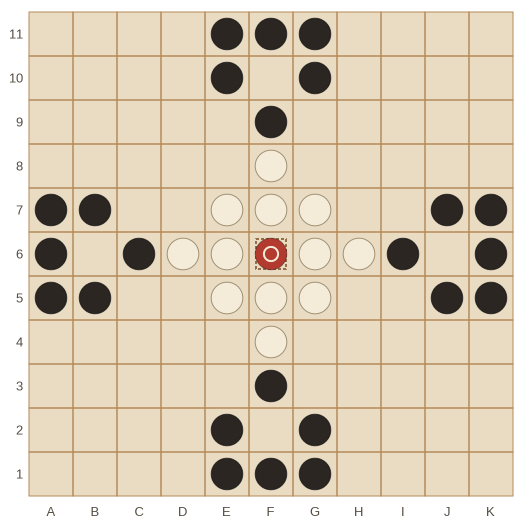
- King
- Defender
- Attacker
- Throne (central square)
The king stands on the central throne, surrounded by 12 defenders in a cross formation. 24 attackers stand in irregular groups near the edges of the board. The attackers move first. This starting setup corresponds to the R. C. Bell pattern, which is also used in the project for the independent guide "Tawlbwrdd (R. C. Bell layout)" (see section 7).
Pieces
| Piece | Side | Count | Special feature |
|---|---|---|---|
| King | Defenders | 1 | unarmed (does not take part in captures); the only escape piece |
| Defender | Defenders | 12 | Ordinary piece |
| Attacker | Attackers | 24 | Ordinary piece |
4. Objective
The defenders win when:
- the king reaches a corner square (escape).
The attackers win when:
- they capture the king, or
- they completely surround the defenders so that they have no edge access left.
5. Rules of play
5.1 Movement
All pieces move orthogonally (horizontally or vertically) any distance over empty squares. Jumping or passing over other pieces is not allowed.
5.2 Capturing ordinary pieces
A piece (except the king) is captured when it is flanked on two opposite sides (horizontally or vertically) by an enemy piece or a hostile square.
5.3 King capture
The king is unarmed: he does not take part in captures. He himself is captured when he is enclosed on four sides by enemy pieces or hostile squares. The board edge counts as hostile specifically for the king here (unlike for the other pieces).
5.4 Hostile squares
The empty throne is hostile to all pieces. The four corner squares are hostile to all pieces.
5.5 Move repetition
If the same position occurs for the third time, the side whose move brought the repetition about loses.
5.6 Further cases
A player with no legal move loses the game.
6. Good to know
- This variant combines features that mostly occur separately in other rule sets documented in the project: an unarmed king (as in classic "weak king" variants), but a four-sided capture (as in Copenhagen, where the king is captured in a more protected way precisely because of his arming).
- The board edge is expressly hostile only to the king here, not to the other pieces – a special rule that is explicitly excluded in the Copenhagen rules (section 5.4 of the corresponding guide), where the edge is hostile to no one.
- The attackers' victory condition "complete surrounding without edge access" is conceptually similar to the Copenhagen encirclement rule, but is not defined more precisely in the present source (e.g. whether an unbroken ring is required or whether the absence of any edge contact is already enough). This guide adopts the wording of the source unchanged, without replacing the missing precision by an assumption from other rule sets.
- This rule set is "rule-identical" with the likewise documented variant Legacy Hnefatafl, which uses the same R. C. Bell starting pattern. This was adopted unchanged for this guide, without duplicating the content of the other file or verifying it independently.
7. Related variants
Legacy Tawlbwrdd shares board and piece count with the three cyningstan leaflet guides Tawlbwrdd (Lewis layout, alternative), Tawlbwrdd (R. C. Bell layout) and Tawlbwrdd (Serif Cross layout after Lewis 1940) – the starting setup is even identical to the R. C. Bell layout, but the rule set differs fundamentally (there: armed, weakly captured king, edge escape; here: unarmed king captured on four sides, corner escape). Legacy Tawlbwrdd is moreover rule-identical with the variant Legacy Hnefatafl (same starting pattern) and also shares the same Legacy rule set with Legacy Tablut, Legacy Brandubh and Legacy Alea Evangelii (each with a different board size). The variant Legacy Berserk Hnefatafl uses the same 11×11 board, but supplements the Legacy rule set there with special pieces and a berserker rule. The year "1940" in the name of the Serif Cross variant is not attested; the source gives only the layout label "Lewis" (see its guide).
8. Rules of play (original) with source reference
For this rule set of the Fellhuhn app there is no external, historically or editorially independent original text as with the other guides in this directory. As the closest equivalent, the following section reproduces unchanged the bullet list that corresponds to the rule description of the Fellhuhn app. Original in German.
Source: Rule description of the Fellhuhn app.
Notice of rights: This text originates from Fellhuhn (Philippe Schober). It is reproduced with the permission of the developer and is not covered by the CC BY 4.0 licence of this documentation; the rights remain with the authors.
Rule set of the Fellhuhn app
- Schwarz macht den ersten Zug
- Der König ist unbewaffnet
- Ein Spieler verliert, wenn er keinen gültigen Zug tätigen kann
- Der König wird von vier feindlichen Figuren oder feindlichen Feldern geschlagen
- Der Rand des Spielfelds gilt als feindlich für den König
- Der leere Thron gilt als feindlich für alle Figuren
- Eckfelder gelten für alle als feindlich
- Der weiße Spieler gewinnt, wenn der König ein Eckfeld erreicht
- Der weiße Spieler hat verloren, wenn er komplett umstellt wird und keinen Randzugang mehr hat
- Wenn beide Spieler den gleichen Zug jeweils dreimal wiederholen, führt dies zur Niederlage des Spielers der damit angefangen hat
9. Sources
- [Fellhuhn-App] Fellhuhn (Philippe Schober): Hnefatafl (Android app, Google Play), rule description of the variant, used with the express permission of the developer. — https://play.google.com/store/apps/details?id=com.fellhuhn.hnefatafl&hl=de
- [aagenielsen-tawlbwrdd] Nielsen, Aage: Tawlbwrdd (Robert ap Ifan 1587), summary. — https://aagenielsen.dk/tawlbwrdd_summary.php
10. State of the evidence and classification
For the Legacy rule set itself no external or historical source exists; it is a modern rule description of the Fellhuhn app. Only board, throne and piece count (12:24) are taken from the account of Robert ap Ifan (1587) [aagenielsen-tawlbwrdd] – the same source situation that also underlies the other Tawlbwrdd guides in this directory. The movement, capture and victory rules are independent of this and were adopted exclusively from the rule description of the Fellhuhn app; there is no external source for the rule set, the historical connection exists only via name and board size of the Tawlbwrdd variant.