Tawlbwrdd (R. C. Bell layout)
Welsh tafl variant on an 11×11 board, documented by Robert ap Ifan (1587) in board size, piece count and aspects of the initial placement; the exact setup used here follows a modern reconstruction. The movement and capture rules reproduced here come from a modern rules leaflet from cyningstan.com and are a reconstruction, not a historically attested original rule set. This setup variant follows the layout transmitted by R. C. Bell.
Short description: Welsh tafl variant on an 11×11 board, documented by Robert ap Ifan (1587) in board size, piece count and aspects of the initial placement; the exact setup used here follows a modern reconstruction. The movement and capture rules reproduced here come from a modern rules leaflet from cyningstan.com and are a reconstruction, not a historically attested original rule set. This setup variant follows the layout transmitted by R. C. Bell.
1. Basic data
| Name | Tawlbwrdd (R. C. Bell layout) |
|---|---|
| Game family | Hnefatafl (Nordic tafl game), Welsh form |
| Category | Board, piece count and aspects of the setup recorded by ap Ifan; exact setup and movement and victory rules modern reconstruction (cyningstan.com leaflet) |
| Origin / authors | Board/pieces: Wales (Robert ap Ifan, 1587); this setup variant: R. C. Bell; rule text: cyningstan.com |
| Dating | Board/pieces: 1587; rule text: modern, exact date not given |
| Board size | 11×11 squares |
| Throne | not mentioned in the rules (no special square described) |
| Escape goal | any square on the board edge (not only a corner square) |
| King | takes part in captures; but is captured like an ordinary stone (2 opposite sides) |
| Piece ratio | 12 defenders + king against 24 attackers (1:2) |
2. History and origin
Tawlbwrdd (Welsh tawl "throw" + bwrdd "board") is the Welsh name for a Hnefatafl game on an 11×11 board. Its existence is attested above all by Robert ap Ifan (1587, National Library of Wales, Peniarth MS 158), who describes and sketches an 11×11 board with a king and 12 defenders against 24 attackers as well as a throne in the centre. He gives the piece count, setup and the principle of capturing, but says nothing about movement or victory rules. An older tradition in the Laws of Hywel Dda (recorded around 1250) allows, through statements of material value, an inference of an earlier form with a king and 8 against 16 pieces, without describing this form directly.
Since movement and victory rules have not survived historically, all Tawlbwrdd rule sets in circulation today are modern reconstructions. The rules reproduced in this guide come from a leaflet from cyningstan.com; the setup follows the layout transmitted by R. C. Bell (layout name according to the source: "Tawlbwrdd Layout von R. C. Bell"). Robert Charles Bell was a British games historian who published numerous reconstructed setups for tafl games in his two-volume standard work on historical board games; according to Walker (cyningstan.com) this layout was proposed by R. C. Bell in 1969 (R. C. Bell, Board and Table Games from Many Civilizations, Oxford University Press, 1969; the page of the diagram has not been checked).
3. Starting position and pieces
Legend: K = king · D = defender · A = attacker · . = empty square.
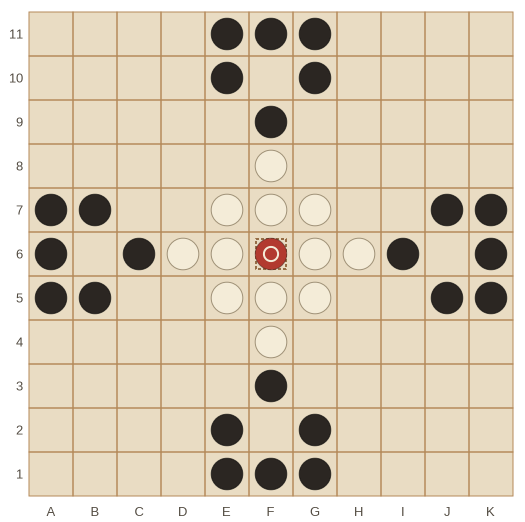
- King
- Defender
- Attacker
- Throne (central square)
The king stands on the central square, surrounded by 12 defenders in a cross formation. 24 attackers stand in groups near the edges of the board, distributed here markedly more irregularly than in the other layout variants. The attackers move first.
Pieces
| Piece | Side | Count | Special feature |
|---|---|---|---|
| King | Defenders | 1 | takes part in captures; is captured like an ordinary stone; the only escape piece |
| Defender | Defenders | 12 | Ordinary piece |
| Attacker | Attackers | 24 | Ordinary piece |
4. Objective
The defenders win when:
- the king reaches any square on the board edge (not only a corner square).
The attackers win when:
- they capture the king.
5. Rules of play
5.1 Movement
All pieces move orthogonally (horizontally or vertically) any distance over empty squares. Pieces may not jump over one another and may not land on an occupied square.
5.2 Capturing ordinary pieces and the king
A piece is captured when it is flanked on two opposite sides (horizontally or vertically, not diagonally) by two enemy pieces. The king takes part in captures and is himself captured by exactly the same rule as any other piece – that is, by flanking on two opposite sides, not by a special four-sided rule.
5.3 Multiple capture
If a single move flanks two or three enemy pieces at the same time, each on two opposite sides, all those pieces are captured in that move.
5.4 Further cases
The source gives no rules on the throne or corner squares as special squares, on repetition of moves, or on situations in which a side can no longer make a legal move. This guide does not invent additional rules for such cases but expressly records the gap here. If the side to move has no legal move, the game ends in a draw. This is a stipulation of tafl; the source says nothing on the point.
6. Good to know
- Unlike many other tafl rule sets (such as Copenhagen or Brandubh), the king here already reaches any square on the edge as an escape goal, not only the four corner squares.
- The king is at the same time "armed" (he may help with capturing) and "weakly captured" (he is captured like an ordinary stone with only two opposite sides, not, as in Copenhagen, with four sides). This combination differs from most other variants documented in the project.
- The source mentions neither a throne nor corner squares as special squares, although the king stands on the central square in the starting setup. It remains open whether this square should actually be treated like an ordinary square in the original rule set, or whether the source is simply incomplete on this.
- The line "Short overview" in the original text of the leaflet reads only "King armed, ..." and breaks off with ellipsis points. This is noted as a possibly incomplete source; the missing remainder is not supplied.
- Of the three documented Tawlbwrdd variants, the setup of this layout is the most irregular: the attacker groups are not positioned symmetrically along the middle of the sides, but in offset groups of five in the corner and edge areas.
7. Related variants
This guide shares its rules of play (sections 4–5, 8) with the two other Tawlbwrdd leaflet layouts documented in the project, Tawlbwrdd (Lewis layout, alternative) and Tawlbwrdd (Serif Cross layout after Lewis 1940) – all three differ only in the starting setup (section 3), not in the rule set. In addition there is Legacy Tawlbwrdd, a rule set of the Fellhuhn app on the same 11×11 Tawlbwrdd board with markedly different rules (unarmed king, four-sided capture, corner escape instead of edge escape) – whose starting setup is moreover identical to the R. C. Bell setup shown here. The year "1940" in the name of the Serif Cross variant is not attested; the source gives only the layout label "Lewis" (see its guide).
8. Rules of play (original) with source reference
The original wording of the rules is not reproduced here. The authoritative text is the leaflet Tawlbwrdd leaflet by cyningstan.com: http://tafl.cyningstan.com/data-download/699/tawlbwrdd-leaflet
The rule version of this guide (sections 4–5 above) is the project's own wording based on this source.
9. Sources
- [cyningstan-tawlbwrdd] cyningstan.com: Tawlbwrdd leaflet. — http://tafl.cyningstan.com/data-download/699/tawlbwrdd-leaflet
- [aagenielsen-tawlbwrdd] Nielsen, Aage: Tawlbwrdd (Robert ap Ifan 1587), summary. — https://aagenielsen.dk/tawlbwrdd_summary.php
- [cyningstan-literary] Literary Sources. — http://tafl.cyningstan.com/page/146/literary-sources
10. State of the evidence and classification
Robert ap Ifan's account (1587) documents for Tawlbwrdd an 11×11 board, the piece count (12:24), the throne position and a verbal description of the initial placement [aagenielsen-tawlbwrdd]; it does not attest the exact coordinates of the setup used here. The movement, capture and victory rules of this guide, by contrast, come exclusively from the modern cyningstan leaflet [cyningstan-tawlbwrdd] and are a reconstruction without direct historical evidence. The specific attribution of this setup variant to R. C. Bell is attested only via the layout name of the source; the publication in question is probably R. C. Bell, Board and Table Games from Many Civilizations (Oxford University Press, 1969); the page of the diagram has not been checked. The source remains incomplete in several places (see section 6, "Good to know"): information on the throne/corner squares, move repetition and blockade is missing, and the short description ("Short overview") breaks off mid-sentence. These gaps were not filled with assumptions from other rule sets (e.g. Copenhagen) but deliberately left open.