Tyr 11×11
A modern "battlefield" variant by Luk Martens, played on an 11×11 board without a throne. It features a weak, armed king (captured on two sides), the berserker rule and edge escape. The version played here also includes jumping commanders, a feature assigned to the related variant Odin in the source (see section 6).
Short description: A modern "battlefield" variant by Luk Martens, played on an 11×11 board without a throne. It features a weak, armed king (captured on two sides), the berserker rule and edge escape. The version played here also includes jumping commanders, a feature assigned to the related variant Odin in the source (see section 6).
Evidence status: Modern new design (Luk Martens), no historical evidence. The jumping commanders are a construct of the Fellhuhn app: the original Tyr has no special pieces.
1. Basic data
| Name | Tyr 11×11 |
|---|---|
| Game family | Hnefatafl (Nordic tafl game) |
| Category | Modern variant (no historical evidence) |
| Origin / author | Luk Martens ("MasterLuke", Belgium); published via Aage Nielsen |
| Dating | Date of publication not attested |
| Board size | 11×11 squares |
| Throne | No, no restricted square |
| Escape goal | Edge of the board (edge escape) |
| King | Armed, weak (captured from 2 sides) |
| Piece ratio | 12 defenders + king against 24 attackers (1:2); of these, 4 (defenders) and 8 (attackers) respectively are marked as commanders |
2. History and origin
Tyr was designed by Luk Martens ("MasterLuke") and published via Aage Nielsen's rule collection. It forms the common basis of a series of "battlefield" variants – Tyr, Thor, Odin and Loki – that build on one another: the canonical Tyr gets by entirely without special pieces, whereas Thor, Odin and Loki introduce additional pieces such as commanders, "Variegated Men" and guards (see section 7).
Unlike siege variants with a central throne, the starting setup is scattered across the board, which gives the game a more open character than classic tafl variants. The berserker rule is also characteristic: a piece that captures may continue moving in the same turn as long as it keeps capturing.
3. Starting setup and pieces
Legend: K = king · D = defender · A = attacker · B = commander (defender) · C = commander (attacker) · . = empty square.
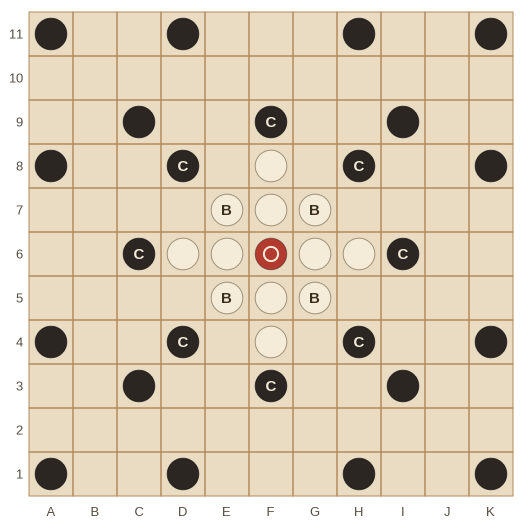
- King
- Defender
- Attacker
- B
- C
- Throne (central square)
The king stands in the centre of the board; this square is not a restricted square, merely his starting place. Defenders and commanders group around him in a loose cross, while the attackers are scattered across the whole board. The attackers move first.
Pieces
| Piece | Side | Count | Special feature |
|---|---|---|---|
| King | White | 1 | Armed, weak (captured from 2 sides); only escaping piece; may end a berserker run with his escape |
| Defender | White | 8 | Ordinary piece |
| Commander | White | 4 | Jumps over one ordinary opposing piece (see 5.3) |
| Attacker | Black | 16 | Ordinary piece |
| Commander | Black | 8 | Jumps over one ordinary opposing piece (see 5.3) |
4. Objective
White (defenders) wins when:
- the king reaches a square on the board edge.
Black (attackers) wins when:
- the king is captured.
5. Rules of play
5.1 Movement
All pieces move orthogonally (horizontally or vertically) any distance over empty squares. Ordinary jumping over other pieces is not allowed.
5.2 Capturing ordinary pieces
A piece is captured when it is flanked on two opposite sides (horizontally or vertically) by an enemy piece. Multiple captures (two or three pieces at once) are also possible. Moving voluntarily between two opposing pieces is safe. The king may take part in captures.
5.3 Commander jump
In addition to ordinary movement, a commander may jump over a single ordinary opposing piece; he captures it in doing so only if he wedges it between himself and a piece of his own – otherwise he jumps without capturing. Detailed explanation with ASCII examples and jump restrictions (among others no jumping over the king or other commanders): the bundled program documentation.
5.4 King capture
The king is captured when he is flanked on two opposite sides by attackers – he counts as a "weak" king. Since there is no throne, there are no special throne rules for capturing the king.
5.5 Berserker rule
If a piece captures, it may continue moving in the same turn as long as it captures again; the king may also end such a run with his escape (reaching the edge). Detailed explanation with ASCII examples: the bundled program documentation.
5.6 Move repetition
If a threefold repetition of moves occurs, the side that caused it loses.
5.7 Further cases
A player with no legal move loses the game.
6. Good to know
- Nielsen's/Martens' original Tyr gets by entirely without special pieces (pure 12:24 balance of forces, all stones ordinary). The version described here with jumping commanders thus corresponds structurally more to the related follow-up variant "Odin" (or "Thor") than to the canonical Tyr.
- According to the source, commanders were only introduced with the follow-up variants Thor and Odin, not with Tyr itself.
7. Related variants
Tyr 11×11 and Tyr 15×15 share the same core rules and differ only in board size. Within the series designed by Luk Martens, the variants Thor, Odin and Loki build on Tyr and add further special pieces (commanders in Thor/Odin, additionally "Variegated Men" in Odin/Loki, guards only in Loki) – the version at hand with commanders corresponds structurally to these follow-up variants. The independent "Legacy Tyr" variants (13×13, 15×15, 19×19) also bear the name Tyr, but use their own set of special pieces (commander, knight, mercenary) and do not constitute a direct continuation of the Martens series. Berserk Hnefatafl is the origin of the berserker rule and commanders, but is likewise played on 11×11 with a strong king, throne and corner escape instead of edge escape.
8. Rules of play (original) with source reference
For this variant there is no verbatim quotation of the external source (Luk Martens' Tyr/Odin rules PDF or Aage Nielsen's overview page) – the rules there are only available paraphrased with passage references. As an exception, the rule set actually implemented therefore serves as the documented starting text; it is reproduced here unchanged (see section 10 for classification).
Source: Rule description of the Fellhuhn app.
Notice of rights: This text originates from Fellhuhn (Philippe Schober). It is reproduced with the permission of the developer and is not covered by the CC BY 4.0 licence of this documentation; the rights remain with the authors.
(Original in German)
Regelsatz (Fellhuhn-App)
- Schwarz macht den ersten Zug
- Der König ist bewaffnet
- Nach einem Schlag darf die schlagende Figur erneut ziehen, wenn dies zu erneutem Schlag führt (Berserker)
- Wenn der König eine Figur schlägt, darf er erneut ziehen, sofern dies zu seiner Flucht führt
- Ein Spieler verliert, wenn er keinen gültigen Zug hat
- Der König wird von zwei feindlichen Figuren oder Feldern geschlagen
- Weiß gewinnt, wenn der König den Rand erreicht
- Der Kommandant kann über gewöhnliche feindliche Figuren springen
- Dreifache Zugwiederholung → Niederlage des Verursachers
9. Sources
- [Martens-tyr] Martens, Luk ("MasterLuke"): Rules 'Tyr' Variant (Tyr–Odin Tafl game variants). — https://aagenielsen.dk/tyr_odin_rules.pdf
- [Nielsen-rules] Nielsen, Aage: Hnefatafl Rules (overview), section "Tyr, Thor, Odin and Loki Hnefatafl". — https://aagenielsen.dk/tafl_rules.php
- [Fellhuhn-App] Fellhuhn (Philippe Schober): Hnefatafl (Android app, Google Play), rule description of the variant, used with the express permission of the developer. — https://play.google.com/store/apps/details?id=com.fellhuhn.hnefatafl&hl=de
10. State of the evidence and classification
Modern variant without historical evidence. The external primary sources [Martens-tyr] and [Nielsen-rules] describe the canonical Tyr without special pieces; a verbatim original quotation is not available, however, and the rules are only available paraphrased. The rule set actually played (section 8) deviates from the canonical Tyr in that it contains jumping commanders – a feature that, according to the source, only belongs to the follow-up variants Thor/Odin (see section 6). For this rules guide, the rule set actually implemented was treated as authoritative for sections 3 to 5; the deviation from the canonical naming is documented here transparently.