Legacy Tyr 13×13
Independent rule set ("Legacy") of a 13×13 variant without a throne, with edge escape, a weak king (capturable from two sides), the berserker rule and three different special pieces (commander, knight, mercenary). The name is modelled on Aage Nielsen's "Tyr", but deviates clearly from it (see section 6).
Short description: Independent rule set ("Legacy") of a 13×13 variant without a throne, with edge escape, a weak king (capturable from two sides), the berserker rule and three different special pieces (commander, knight, mercenary). The name is modelled on Aage Nielsen's "Tyr", but deviates clearly from it (see section 6).
Evidence status: Rule set of the Fellhuhn app without an external or historical source; the name is modelled on Tyr only. The special pieces (commander, knight, mercenary) are a construct of the Fellhuhn app and appear in no model in this form.
1. Basic data
| Name | Legacy Tyr 13×13 |
|---|---|
| Game family | Hnefatafl (Nordic tafl game) |
| Category | Independent rule set ("Legacy"); no historical or external evidence |
| Origin / author | Independent rule definition; name model: Aage Nielsen's "Tyr/Odin" series by Luk Martens |
| Dating | Modern rule set |
| Board size | 13×13 squares |
| Throne | No, no restricted square |
| Escape goal | Edge of the board (edge escape) |
| King | Armed, weak (captured from 2 sides) |
| Piece ratio | 16 defenders + king against 32 attackers (1:2), including special pieces |
2. History and origin
For this specific rule set there is no external or historical source. The name "Tyr" is modelled on Aage Nielsen's variant of the same name by Luk Martens (see "11×11 Tyr" and "15×15 Tyr"), but deviates clearly from it in content: the namesake Tyr deliberately gets by without special pieces, whereas "Legacy Tyr 13×13" introduces no fewer than three different types of special pieces with commander, knight and mercenary. Structurally the rule set thus resembles Nielsen's follow-up variants Odin and Loki, which likewise have special pieces with a side-changing mechanic, more than the canonical Tyr.
3. Starting setup and pieces
Legend: K = king · D = defender · A = attacker · R = knight (defender) · C = commander (attacker) · N = mercenary (defender) · V = mercenary (attacker) · . = empty square.
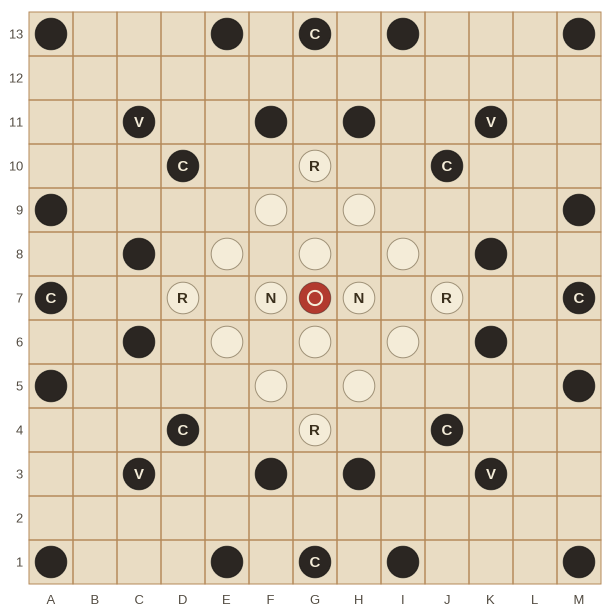
- King
- Defender
- Attacker
- C
- N
- R
- V
- Throne (central square)
The king stands in the centre of the board; this square is not a restricted square, merely his starting place. Defenders, knights and mercenaries surround him in a cross shape, while the attackers together with their commanders and mercenaries are spread across the edge areas. The attackers move first.
Pieces
| Piece | Side | Count | Special feature |
|---|---|---|---|
| King | White | 1 | Armed, weak (captured from 2 sides); only escaping piece |
| Defender | White | 10 | Ordinary piece |
| Knight | White | 4 | Jumps over an ordinary opposing piece and captures it in doing so (see 5.3) |
| Mercenary | White | 2 | Changes sides when flanked instead of being captured; can only be captured by two enemy mercenaries (see 5.3) |
| Attacker | Black | 20 | Ordinary piece |
| Commander | Black | 8 | Jumps over an ordinary opposing piece without capturing in doing so (see 5.3) |
| Mercenary | Black | 4 | Changes sides when flanked instead of being captured; can only be captured by two enemy mercenaries (see 5.3) |
4. Objective
White (defenders) wins when:
- the king reaches the edge of the board.
Black (attackers) wins when:
- the king is captured (from two sides).
5. Rules of play
5.1 Movement
All pieces move orthogonally (horizontally or vertically) any distance over empty squares.
5.2 Capturing ordinary pieces
A piece is captured when it is flanked on two opposite sides by an enemy piece.
5.3 Special pieces
- Knight: Jumps over an adjacent opposing piece and always captures it in doing so.
- Commander: Likewise jumps over an adjacent opposing piece, but in the Legacy Tyr family does not normally capture it in doing so.
- Mercenary: Changes sides when flanked on both sides instead of being captured; can normally be captured only by two opposing mercenaries together.
Detailed explanation with ASCII examples: the bundled program documentation.
5.4 King capture
The king is captured when he is flanked on two opposite sides by hostile pieces – this is a weak king. The program has no hostile squares in this variant. Since there is no throne, there are no special throne rules for capturing the king.
5.5 Berserker rule
After a capture, the same piece may continue moving in the same turn as long as it captures again; the chain ends when no further capture is possible. If the king captures, he may also end the run with his escape. Detailed explanation with ASCII examples: the bundled program documentation.
5.6 Move repetition
If the same position occurs for the third time, the side whose move brought the repetition about loses.
5.7 Further cases
A player with no legal move loses the game.
6. Good to know
- The name "Tyr" follows Nielsen's naming convention, but unlike the canonical Tyr (no special pieces), this rule set uses three types of special piece. The mercenary mechanic (change of sides instead of removal from the board) resembles Nielsen's Odin and Loki variants more.
- For this rule set there is no external or historical source.
7. Related variants
Legacy Tyr 13×13 forms, together with Legacy Tyr 15×15 and Legacy Tyr 19×19, a series of the same rule set on boards of different sizes – movement, capture and special-piece rules are identical in each case, only board size and piece count differ. To the original Tyr by Luk Martens/Aage Nielsen, played without special pieces (see "11×11 Tyr", "15×15 Tyr"), there is only a loose relationship of names. Legacy Berserk Hnefatafl also uses the berserker rule and special pieces, but plays with a throne, corner escape, a king capturable from four sides and without mercenaries.
8. Rules of play (original) with source reference
For this rule set there is no external or historical source. The following section therefore reproduces the rule set actually implemented unchanged; it is thus itself the "original text" of this variant (see section 10 for classification).
Source: Rule description of the Fellhuhn app.
Notice of rights: This text originates from Fellhuhn (Philippe Schober). It is reproduced with the permission of the developer and is not covered by the CC BY 4.0 licence of this documentation; the rights remain with the authors.
(Original in German)
Regelsatz (Fellhuhn-App)
- Schwarz macht den ersten Zug
- Der König ist bewaffnet
- Nach einem Schlag kann die schlagende Figur erneut ziehen, wenn dies zu einem erneuten Schlag führt
- Wenn der König eine Figur schlägt, darf er erneut ziehen, so dies zu seiner Flucht führt
- Ein Spieler verliert, wenn er keinen gültigen Zug tätigen kann
- Der König wird von zwei feindlichen Figuren oder feindlichen Feldern geschlagen
- Der weiße Spieler gewinnt, wenn der König den Rand des Spielfeldes erreicht
- Der Kommandant kann über gewöhnliche feindliche Figuren springen
- Der Ritter kann über gewöhnliche feindliche Figuren springen und sie dadurch schlagen
- Söldner wechseln die Seite anstatt von normalen Figuren geschlagen zu werden
- Söldner können nur durch zwei andere, feindliche Söldner geschlagen werden
- Wenn beide Spieler den gleichen Zug jeweils dreimal wiederholen, führt dies zur Niederlage des Spielers, der damit angefangen hat
9. Sources
- [Fellhuhn-App] Fellhuhn (Philippe Schober): Hnefatafl (Android app, Google Play), rule description of the variant, used with the express permission of the developer. — https://play.google.com/store/apps/details?id=com.fellhuhn.hnefatafl&hl=de
- [Nielsen-tafl] Nielsen, Aage: Hnefatafl Rules (overview, including Tyr/Thor/Odin/Loki). — https://aagenielsen.dk/tafl_rules.php
- [Nielsen-tyr-odin] Nielsen, Aage: Tyr/Odin rules (PDF). — https://aagenielsen.dk/tyr_odin_rules.pdf
10. State of the evidence and classification
Independent rule set without an external or historical source. The historical connection is limited to the tafl game family as such; "Tyr" is borrowed as a designation from Aage Nielsen's modern series of variants, without this variant adopting their rules. The essential difference: Nielsen's Tyr has no special pieces, whereas "Legacy Tyr 13×13" has three (commander, knight, mercenary). Since no external source is available, the rule set actually implemented was used in full as the basis of this rules guide.