Legacy Alea Evangelii
The Fellhuhn app's rule set on the largest historically attested tafl board, Alea Evangelii (19×19 under the project's convention). A single medieval manuscript attests the board, piece count (73 pieces: a king, 24 defenders and 48 attackers) and setup. The movement, capture and victory rules come solely from the app and have no external or historical source. Features include an unarmed king, four-sided capture, corner escape and a board edge hostile only to the king.
Short description: The Fellhuhn app's rule set on the largest historically attested tafl board, Alea Evangelii (19×19 under the project's convention). A single medieval manuscript attests the board, piece count (73 pieces: a king, 24 defenders and 48 attackers) and setup. The movement, capture and victory rules come solely from the app and have no external or historical source. Features include an unarmed king, four-sided capture, corner escape and a board edge hostile only to the king.
Evidence status: Rule set of the Fellhuhn app without an external or historical source. Only the board, piece count and setup are historically attested (MS 122); the rules are a modern implementation by the Fellhuhn app.
1. Basic data
| Name | Legacy Alea Evangelii |
|---|---|
| Game family | Hnefatafl (Nordic tafl game) |
| Category | Rule set of the Fellhuhn app ("Legacy"); board and pieces historically attested, rules not historically attested |
| Origin / authors | Rule set: Fellhuhn app (modern); board reference: courtly circle of King Æthelstan / Bangor (Irish-Welsh area) |
| Dating | Rule set: modern (Fellhuhn app); historical board reference: manuscript around 1140 (Corpus Christi College, MS 122) |
| Board size | 19×19 squares (project convention, see section 6) |
| Throne | Yes, central square |
| Escape goal | Corner square |
| King | Unarmed (does not take part in captures); captured on 4 sides |
| Piece ratio | 24 defenders + king against 48 attackers (1:2) |
2. History and origin
Alea Evangelii (Latin "game (board) of the Gospels") is not an originally popular designation but a learned Christian allegory. Its origin is assigned to the courtly circle of King Æthelstan (reigned 924–939); the manuscript that attests this game traces the tradition back to Bishop Dub Innse of Bangor (died 953), who ascribes it to a Frank and to the scholar Israel (presumably Israel the Grammarian, c. 900–970).
Alea Evangelii is attested by exactly one manuscript: Oxford, Corpus Christi College, MS 122, fol. 5v, written around 1140 in Bangor. The diagram shows a board with 19×19 lines (18×18 squares, 361 intersections) and 73 pieces (1 king, 24 defenders, 48 attackers) as well as an explanatory allegorical text. No further evidence exists. The manuscript works with a point game – the pieces stand on the intersections, not in the squares – which is why Murray speaks of an 18×18-square board, corresponding to the same 361 points. Transferred into the square-based style of play otherwise usual for tafl games, this yields a 19×19-square board; following this project convention, Alea Evangelii is treated here as a 19×19 board.
The "Legacy" rule set described here takes over from this historical finding only the board, throne, piece count and setup. The actual rules of play (type of movement, capture conditions, victory conditions) are an independent, modern rule definition of the Fellhuhn app itself, without an external or historical source. They differ markedly from the guide Alea Evangelii (after Murray), also documented in the project, which is based on a different, likewise modern rule reconstruction (armed king) of the same historical board (see section 7).
3. Starting setup and pieces
Legend: K = king · D = defender · A = attacker · . = empty square.
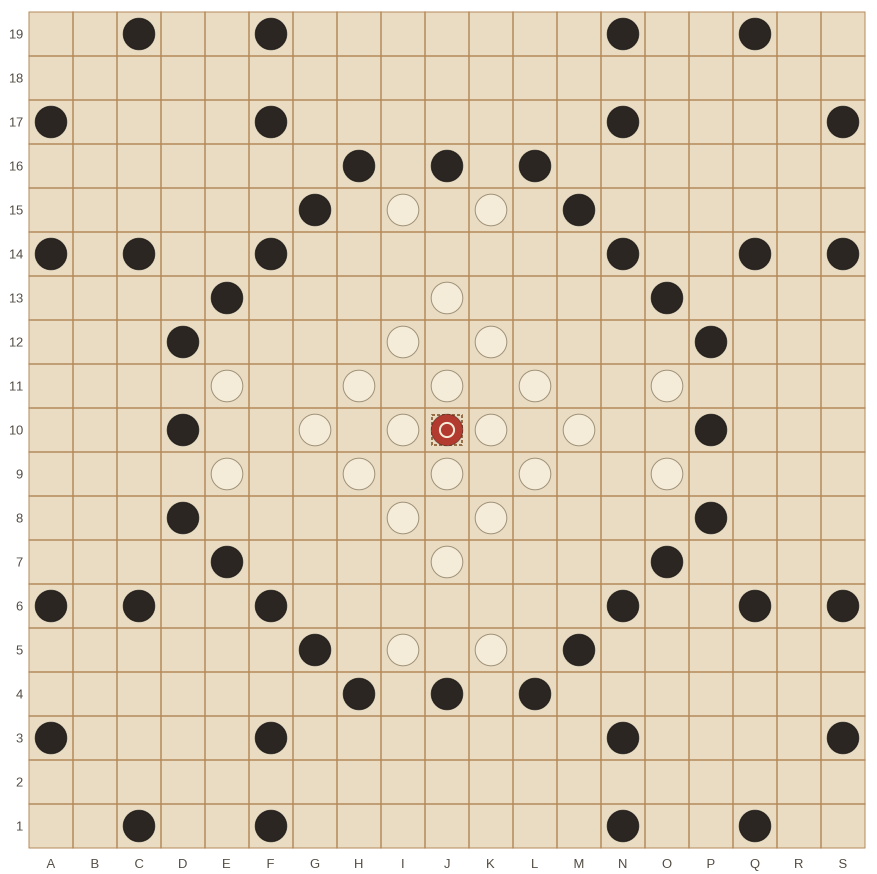
- King
- Defender
- Attacker
- Throne (central square)
The king stands on the central throne (J10), surrounded by 24 defenders (arrangement according to the project's diagram file). 48 attackers stand in groups along the edges and diagonals. The attackers move first. The assignment of the 73 pieces to the sides is disputed in research (see section 6).
Pieces
| Piece | Side | Count | Special feature |
|---|---|---|---|
| King | Defenders | 1 | unarmed (does not take part in captures); the only escape piece |
| Defender | Defenders | 24 | Ordinary piece |
| Attacker | Attackers | 48 | Ordinary piece |
4. Objective
The defenders win when:
- the king reaches a corner square (escape).
The attackers win when:
- they capture the king, or
- they completely surround the defenders so that no edge access remains for them.
5. Rules of play
5.1 Movement
All pieces move orthogonally (horizontally or vertically) any distance over empty squares. Jumping over or passing other pieces is not allowed.
5.2 Capturing ordinary pieces
A piece (except the king) is captured when it is flanked on two opposite sides (horizontally or vertically) by an enemy piece or an enemy square.
5.3 King capture
The king is unarmed: he does not take part in captures. He himself is captured when he is enclosed on four sides by enemy pieces or enemy squares. The board edge counts as hostile specifically for the king (unlike for the other pieces).
5.4 Hostile squares
The empty throne is hostile to all pieces. The four corner squares are hostile to all pieces.
5.5 Move repetition
If the same position occurs for the third time, the side whose move brought the repetition about loses.
5.6 Other cases
A player with no legal move loses the game.
6. Good to know
- The manuscript MS 122 describes a point game (18×18 squares / 19×19 intersections, 361 points). The project transfers this into the square-based style of play otherwise usual for tafl and therefore treats Alea Evangelii as a 19×19 square board – a deliberate project convention, not a direct one-to-one transfer of the manuscript.
- The assignment of the pieces to the sides of the 73 pieces (which group is king/defenders and which attackers) has not been settled uniformly in research; there are differing readings (among others Murray 1955 versus Helmfrid). This guide follows the diagram file stored in the project and makes no decision of its own in this dispute.
- This variant combines features that in other rule sets documented in the project mostly occur separately: an unarmed king, but a four-side capture – unlike, for example, Copenhagen, where it is precisely the armed king that is captured with stronger protection (four sides), whereas unarmed kings in other variants usually need only two sides.
- The board edge is explicitly hostile only to the king here, not to the other pieces.
- The victory condition "complete encirclement without edge access" for the attackers is not defined more precisely in the present source (e.g. whether an unbroken ring is required). This guide adopts the source's wording unchanged, without replacing the missing precision by an assumption from other rule sets.
7. Related variants
Legacy Alea Evangelii shares board, piece count and setup with the guide Alea Evangelii (after Murray), likewise documented in the project – there, however, the rules are based on a different reconstruction (armed king who may capture like an ordinary defender; differing king capture and repetition rules after the cyningstan.com leaflet). Both guides thus treat the same historically attested board (MS 122) with two independent, mutually contradicting rule reconstructions; the content of the Murray guide is not repeated here.
Within the Legacy rule sets of the Fellhuhn app, Legacy Alea Evangelii is moreover rule-identical to Legacy Tablut, Legacy Brandubh, Legacy Hnefatafl and Legacy Tawlbwrdd (each a smaller board, otherwise the same rule set). From the likewise 19×19 variant Legacy Tyr 19x19, by contrast, Legacy Alea Evangelii differs fundamentally: Legacy Tyr 19x19 has no throne, an armed king with two-side capture, edge escape as well as special pieces and a berserker rule.
8. Rules of play (original) with source reference
For this rule set of the Fellhuhn app there is no external, historically or editorially independent original text as for the other guides in this directory. As the closest equivalent, the following section reproduces unchanged the bullet list that corresponds to the rule description of the Fellhuhn app. (Original in German.)
Source: rule description of the Fellhuhn app.
Notice of rights: This text originates from Fellhuhn (Philippe Schober). It is reproduced with the permission of the developer and is not covered by the CC BY 4.0 licence of this documentation; the rights remain with the authors.
Regelsatz der Fellhuhn-App
- Schwarz macht den ersten Zug
- Der König ist unbewaffnet
- Ein Spieler verliert, wenn er keinen gültigen Zug tätigen kann
- Der König wird von vier feindlichen Figuren oder feindlichen Feldern geschlagen
- Der Rand des Spielfelds gilt als feindlich für den König
- Der leere Thron gilt als feindlich für alle Figuren
- Eckfelder gelten für alle als feindlich
- Der weiße Spieler gewinnt, wenn der König ein Eckfeld erreicht
- Der weiße Spieler hat verloren, wenn er komplett umstellt wird und keinen Randzugang mehr hat
- Wenn beide Spieler den gleichen Zug jeweils dreimal wiederholen, führt dies zur Niederlage des Spielers der damit angefangen hat
9. Sources
- [Fellhuhn-App] Fellhuhn (Philippe Schober): Hnefatafl (Android app, Google Play), rule description of the variant, used with the express permission of the developer. — https://play.google.com/store/apps/details?id=com.fellhuhn.hnefatafl&hl=de
- [MS122] Oxford, Corpus Christi College, MS 122, fol. 5v (diagram 19×19 lines / 73 pieces, around 1140).
- [cyningstan-alea] Walker, Damian: Alea Evangelii. — http://tafl.cyningstan.com/page/173/alea-evangelii
- [Wikipedia-alea] Alea evangelii. — https://en.wikipedia.org/wiki/Alea_evangelii
10. State of the evidence and classification
For the Legacy rule set itself there is no external or historical source; it is a modern rule description of the Fellhuhn app. Only the board and piece count (73: 1+24:48) are historically attested, via the manuscript MS 122 [MS122], the only surviving manuscript known for it – even the assignment of the pieces to the sides is disputed in research (see section 6). The manuscript hands down a point game (18×18 squares / 19×19 intersections); treating it as a 19×19 square board is a deliberate project convention. The movement, capture and victory rules are independent of this historical finding and were taken exclusively from the rule description of the Fellhuhn app; there is no external source for the rule set, and the historical reference exists only via board and pieces through MS 122.