Alea Evangelii
The largest known tafl variant (19×19), known from an illustration with a short accompanying text in *Corpus Christi College MS 122* (around 1140) – board, piece count and setup are historically attested, but the rules of play are not preserved. This guide documents the modern rule reconstruction from cyningstan.com (Damian Walker): armed king, corner escape, capture on 2–4 sides depending on proximity to the throne.
Short description: The largest known tafl variant (19×19), known from an illustration with a short accompanying text in Corpus Christi College MS 122 (around 1140) – board, piece count and setup are historically attested, but the rules of play are not preserved. This guide documents the modern rule reconstruction from cyningstan.com (Damian Walker): armed king, corner escape, capture on 2–4 sides depending on proximity to the throne.
Evidence status: Board, piece count and setup are attested through the manuscript Corpus Christi MS 122. The rules of play are a modern, experimental reconstruction (after Damian Walker, cyningstan) and are not historically attested; even the assignment of the pieces to the sides is disputed in research.
1. Basic data
| Name | Alea Evangelii (Latin "dice game of the Gospels") |
|---|---|
| Game family | Hnefatafl (Nordic tafl game) |
| Category | Board/pieces historically attested (MS 122); rules of play modern reconstruction |
| Origin / authors | Board/pieces: England/Ireland (manuscript); rule text: cyningstan.com (Damian Walker) |
| Dating | Manuscript Corpus Christi College MS 122, around 1140; rule text modern (date not given) |
| Board size | 19×19 squares (project convention; historically a point game on 18×18 squares / 19×19 intersections) |
| Throne | Yes, central square |
| Escape goal | Corner square |
| King | Armed (takes part in captures); captured on 2 sides away from the throne (3 next to the throne, 4 on the throne) |
| Piece ratio | 24 defenders + king against 48 attackers (1:2) |
2. History and origin
Alea Evangelii is the largest known tafl variant. It is known from an illustration with a short accompanying text in Corpus Christi College MS 122 (Oxford, around 1140), which shows the board, piece count (24 defenders and the king against 48 attackers) and the basic setup. The manuscript, however, contains no rules of play – neither on movement nor on capturing or the victory conditions.
Since no original rules are preserved, all versions of Alea Evangelii playable today are based on modern reconstructions. This guide documents the version from cyningstan.com (Damian Walker), which resembles the rule scheme that also underlies modern tournament rule sets such as Copenhagen Hnefatafl (armed king, corner escape, graded king capture). Other researchers have proposed differing reconstructions for the same historically attested board (see sections 6 and 7).
3. Starting setup and pieces
Legend: K = king · D = defender · A = attacker · . = empty square.
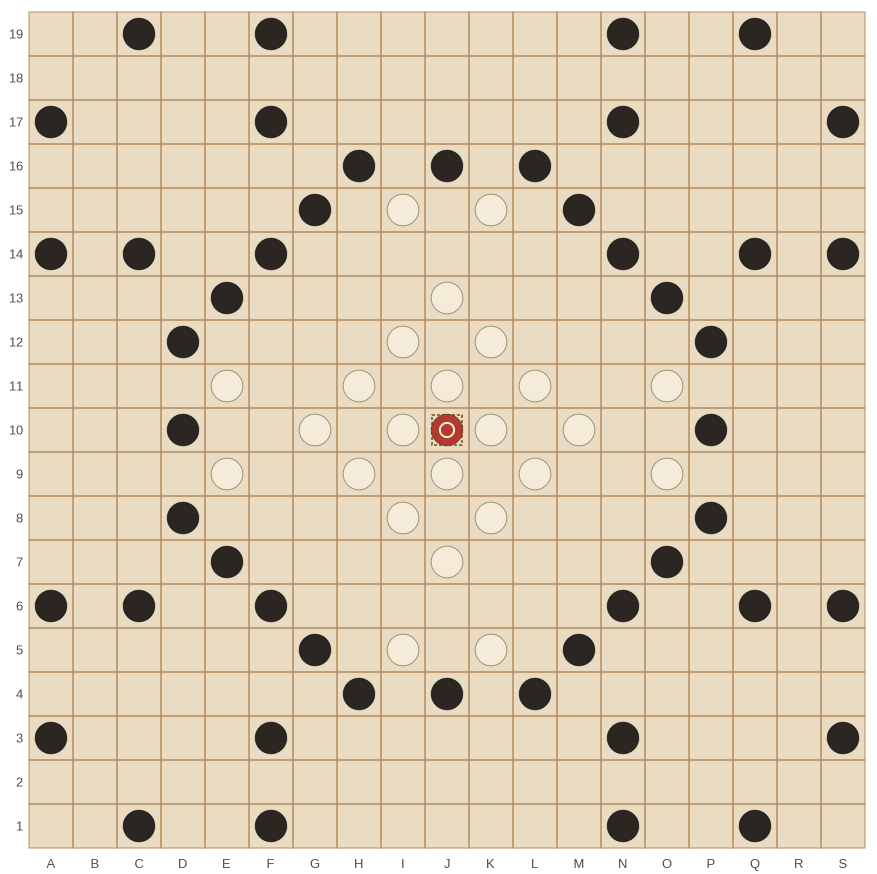
- King
- Defender
- Attacker
- Throne (central square)
The king stands on the central throne. 24 defenders surround him in an elaborate cross formation, 48 attackers stand in groups along the edges, following the project's diagram file (a modern rendering of the manuscript illustration).
Pieces
| Piece | Side | Count | Special feature |
|---|---|---|---|
| King | Defenders | 1 | Armed (takes part in captures); the only escape piece |
| Defender | Defenders | 24 | Ordinary piece |
| Attacker | Attackers | 48 | Ordinary piece |
4. Objective
The defenders win when:
- the king reaches one of the four corner squares.
The attackers win when:
- they capture the king.
The game ends in a draw if a position is repeated, if one side is completely immobilised, or if both players agree on a draw.
5. Rules of play
5.1 Movement
All pieces move orthogonally (horizontally or vertically) any distance over empty squares. Jumping over or passing other pieces is not allowed.
5.2 Capturing ordinary pieces
A piece is captured when it is flanked on two opposite sides (horizontally or vertically, not diagonally) by enemy pieces. Two or three non-adjacent pieces can be captured simultaneously by the same move if each of them is flanked against an opponent of its own. A piece that moves voluntarily between two enemy pieces is not captured by doing so.
5.3 Restricted squares
The central square (throne) may be entered only by the king; all other pieces may merely pass through it while it is empty. The four marked corner squares may likewise be entered only by the king – his reaching a corner also ends the game.
Both kinds of square are hostile, i.e. they can take the role of one of the two flanking sides when capturing: the central square acts as a hostile square for both sides as soon as the king has left it. The corner squares act as a hostile square for both sides at all times.
5.4 King capture
If the king stands on the central square, he is captured when he is enclosed on all four sides by attackers. If he stands directly next to the central square, the three remaining sides suffice. Anywhere else on the board he is treated like an ordinary piece and may himself take part in captures.
5.5 Other cases
The game ends in a draw if a position is repeated, if one side is completely immobilised, or if both players wish it. Further cases (e.g. a player without a legal move) are not treated separately by the source.
6. Good to know
- For the MS 122 board there are several independent modern rule reconstructions, all using the same historically attested setup but differing considerably in the rules of play: the version documented here (cyningstan/Walker) follows a Copenhagen-like scheme with a strong king and corner escape. Another reconstruction, which instead follows Linné's Tablut scheme (edge escape, graded 2/3/4-side capture), is documented separately under "Historical Alea Evangelii".
- Because of the extreme ratio of 73 pieces (24 defenders + king against 48 attackers) on such a large board, Alea Evangelii is regarded among players as particularly hard to balance, regardless of the rule version chosen.
- The short description "Short overview" in the original text (see the source link in section 8) reads only "King armed, ..." and breaks off with an ellipsis. In the German version of this document this is reproduced unchanged without supplementing the missing remainder.
7. Related variants
On the same historically attested board there is also Legacy Alea Evangelii, a rule set of the Fellhuhn app with an unarmed king and differing detail rules. Both versions share board and piece count but differ considerably in the rules of play.
8. Rules of play (original) with source reference
The original wording of the rules (cyningstan.com, Damian Walker) is not reproduced in this English version. The version above is the project's own wording. The original text can be found at:
Source: cyningstan.com (Damian Walker): Rules of Alea Evangelii 19x19. http://tafl.cyningstan.com/data-download/701/alea-evangelii-leaflet
9. Sources
- [cyningstan-alea-leaflet] cyningstan.com (Walker, Damian): Rules of Alea Evangelii 19x19. — http://tafl.cyningstan.com/data-download/701/alea-evangelii-leaflet
- [cyningstan-alea] Walker, Damian: Alea Evangelii. — http://tafl.cyningstan.com/page/173/alea-evangelii
- [Murray1952] Murray, H. J. R.: A History of Board-Games other than Chess. Oxford: Clarendon Press, 1952, p. 61.
- [MS122] Corpus Christi College, Oxford, MS 122 (around 1140) – illustration of the Alea Evangelii board.
10. State of the evidence and classification
Board, piece count (73) and basic setup are historically attested through the illustration with a short accompanying text in Corpus Christi College MS 122 [MS122; Murray1952]. The manuscript, however, hands down no rules of play. The rules reproduced in this guide come exclusively from the modern reconstruction by cyningstan.com [cyningstan-alea-leaflet] and are not a historical source but one of several possible modern interpretations of the same board (see section 6).
The original text is itself incompletely preserved at one point: the line "Short overview" ends with "King armed, ..." and breaks off with an ellipsis. In the German version this gap was adopted unchanged, not supplemented or completed.