Historical Ard Ri
7×7 tafl variant without a throne and without restricted squares; the king escapes to the board edge instead of to a corner. The name "Ard Ri" is modern (no historical source known) and is used here for a throneless, Tablut-based reconstruction on a small board.
Short description: 7×7 tafl variant without a throne and without restricted squares; the king escapes to the board edge instead of to a corner. The name "Ard Ri" is modern (no historical source known) and is used here for a throneless, Tablut-based reconstruction on a small board.
Evidence status: Modern formation without medieval evidence. No historical source is known for the name "Ard Ri"; setup and rules are a modern, Tablut-based construction and not a historical game. The addition "Historical" in the name is not evidence.
1. Basic data
| Name | Historical Ard Ri (Scottish Gaelic àrd rìgh, "high king") |
|---|---|
| Game family | Hnefatafl (Nordic tafl game) |
| Category | Modern formation without medieval evidence |
| Origin / region | Attributed: Scotland |
| Dating | Name/variant modern (in the sources consulted from approx. 1999) |
| Board size | 7×7 squares |
| Throne | No (no throne, no restricted squares) |
| Escape goal | Board edge (edge escape) |
| King | Armed (takes part in captures); captured on 2 sides |
| Piece ratio | 4 defenders + king against 8 attackers (1:2) |
2. History and origin
The name "Ard Ri" is first traceable in the sources consulted in David Parlett (1999); no medieval source has been found. It is a modern formation within the tafl family, described as a throneless variant of the Tablut-based scheme: unlike most tafl games it has no central square and no restricted squares, so that the king, instead of reaching a corner, simply has to escape to the board edge.
The version documented here, adapted to the 7×7 board, follows Aage Nielsen's reconstruction. It is thus to be distinguished from the larger "Ard Ri" setup popularised by Parlett (king + 8 defenders against 16 attackers) – the board used here instead corresponds to a Brandubh-like 4-against-8 setup on 7×7.
3. Starting setup and pieces
Legend: K = king · D = defender · A = attacker · . = empty square.
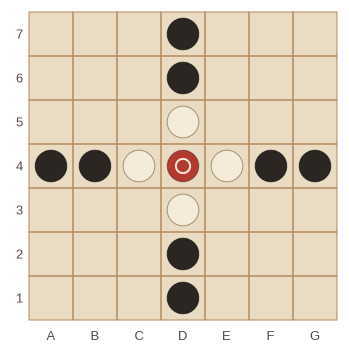
- King
- Defender
- Attacker
- Throne (central square)
The king stands on the central square, surrounded by 4 defenders in a cross shape. 8 attackers stand in pairs at the four side centres of the edge. There is no restricted square – the central square is an ordinary square that any piece can enter. The attackers move first.
Pieces
| Piece | Side | Count | Special feature |
|---|---|---|---|
| King | Defenders | 1 | Armed (takes part in captures); only escaping piece |
| Defender | Defenders | 4 | Ordinary piece |
| Attacker | Attackers | 8 | Ordinary piece |
4. Objective
The defenders win when:
- the king reaches the board edge (any edge square, not only a corner).
The attackers win when:
- they capture the king.
5. Rules of play
5.1 Movement
All pieces move orthogonally (horizontally or vertically) any distance over empty squares. Jumping over other pieces is not allowed.
5.2 Capturing ordinary pieces
A piece is captured when it is flanked on two opposite sides (horizontally or vertically, not diagonally) by an enemy piece. Since there are no restricted squares in this variant, flanking by two enemy pieces is the only capture mechanism. A capture only occurs if the flanking side actively closes the trap with its own move – moving voluntarily between two enemy pieces is safe. The king may take part in captures.
5.3 No restricted squares
This variant has no throne and no restricted squares. No square is hostile towards either side, and no square is subject to restrictions on entering. The board edge itself is not hostile either.
5.4 Capturing the king
The king is captured like an ordinary piece on two opposite sides. A special capture rule for the throne does not apply, since no throne exists.
5.5 Repetition of moves
If the same position occurs for the third time, the defenders lose (the attackers win).
5.6 Further cases
If a side can no longer make a legal move, it loses the game. If a game can no longer be decided regularly because of a hopeless final position, it ends in a draw.
6. Good to know
- The name "Ard Ri" is attested in the sources consulted only from David Parlett (1999) on; a medieval attestation for board, pieces or rules under this name is entirely lacking.
- The 7×7 board with 4 defenders against 8 attackers used here deviates from the larger "Ard Ri" setup popularised by Parlett (king + 8 against 16 pieces).
7. Related variants
Historical Brandubh uses the same board size (7×7), but with a throne, hostile corner squares and corner escape instead of edge escape. The larger, throne-based version of the same reconstructed tafl scheme is Historical Tablut (9×9). Within this game family, according to the current state of research, only Linnaeus Tablut provides an actually handed-down original rule source; all other versions – including the one described here – are reconstructions, which Aage Nielsen assigns by rule mechanics to the group of "weak king" games.
8. Rules of play (original) with source reference
There is no external historical primary source for Historical Ard Ri – the name itself is regarded as modern (no historical source known). The following text is the complete rule set of the Fellhuhn app, reproduced unchanged except for one exception (the originally contained line "Weiß verliert bei vollständiger Umstellung ohne Randzugang" was removed because it contradicted §4 and the rule set and there is no historical source for it) (original in German):
Source: Rule description of the Fellhuhn app, implemented after Aage Nielsen's reconstruction.
Notice of rights: This text originates from Fellhuhn (Philippe Schober). It is reproduced with the permission of the developer and is not covered by the CC BY 4.0 licence of this documentation; the rights remain with the authors.
- Schwarz macht den ersten Zug
- Der König ist bewaffnet
- Ein Spieler verliert, wenn er keinen gültigen Zug tätigen kann
- Der König wird von zwei feindlichen Figuren/Feldern geschlagen
- Der weiße Spieler gewinnt, wenn der König den Rand des Spielfelds erreicht
- Eine Einkesselung der weißen Seite führt nicht zum Sieg: Es gilt nur der Königsfang (Einkesselungsregel im Regelsatz deaktiviert, siehe §4)
- Dreifache Zugwiederholung durch beide Spieler → Niederlage des Spielers, der damit begonnen hat
9. Sources
- [Fellhuhn-App] Fellhuhn (Philippe Schober): Hnefatafl (Android app, Google Play), rule description of the variant, used with the express permission of the developer. — https://play.google.com/store/apps/details?id=com.fellhuhn.hnefatafl&hl=de
- [Parlett1999] Parlett, David: The Oxford History of Board Games. Oxford University Press, 1999 (first mention of "Ard Ri").
- [Nielsen-hist] Nielsen, Aage: Historical Hnefatafl Rules (setup "Ardri 7×7"). — https://aagenielsen.dk/historical_hnefatafl_rules.php
- [Nielsen-rules] Nielsen, Aage: Hnefatafl Rules (overview). — https://aagenielsen.dk/tafl_rules.php
- [cyningstan-ardri] Walker, Damian: Ard Ri. — http://tafl.cyningstan.com/page/174/ard-ri
10. State of the evidence and classification
Ard Ri is a modern formation without medieval evidence for name, board, pieces or rules. In the sources consulted, the name cannot be traced before Parlett (1999). The 7×7 version documented here follows Aage Nielsen's Tablut-based "weak throne" scheme (more precisely: entirely without a throne), with no claim to an archaeological or literary attestation. The comparison of the implementation of the Fellhuhn app is therefore made purely against the modern Nielsen/Parlett convention, not against a historical source.