Legacy Berserk Hnefatafl
Rule set of the Fellhuhn app for a tactically rich 11×11 variant with special pieces (knight, commanders) and the berserker rule (multiple captures/continued movement). Modelled on Aage Nielsen's Berserk Hnefatafl, but an independent implementation by the Fellhuhn app.
Short description: Rule set of the Fellhuhn app for a tactically rich 11×11 variant with special pieces (knight, commanders) and the berserker rule (multiple captures/continued movement). Modelled on Aage Nielsen's Berserk Hnefatafl, but an independent implementation by the Fellhuhn app.
Evidence status: Rule set of the Fellhuhn app after a modern model (Berserk Hnefatafl); no historical evidence. The special pieces are an implementation by the Fellhuhn app.
1. Basic data
| Name | Legacy Berserk Hnefatafl (rule set of the Fellhuhn app) |
|---|---|
| Game family | Hnefatafl (Nordic tafl game) |
| Category | Rule set of the Fellhuhn app ("Legacy"); modern variant scheme (model: Berserk) |
| Origin / author | Rule set: Fellhuhn app (modern) · Model: Berserk Hnefatafl (Aage Nielsen, 2011) |
| Dating | Rule set modern (Fellhuhn app); model 2011 |
| Board size | 11×11 squares |
| Throne | Yes, central king square |
| Escape goal | Corner square |
| King | Armed; can jump over ordinary enemies; captured on 4 sides, with an additional special capture by commanders (see 5.6) |
| Piece ratio | 12 defenders (of which 1 knight) + king against 24 attackers (of which 4 commanders) (1:2) |
2. History and origin
Legacy Berserk Hnefatafl is a rule set of the Fellhuhn app for which no external or historical source exists. It follows Aage Nielsen's Berserk Hnefatafl (2011) closely – in particular in the special pieces (knight, commanders), the jumping moves and the berserker rule – but differs from it in certain details (see section 6). The historical connection exists only via the underlying 11×11 Hnefatafl board.
3. Starting position and pieces
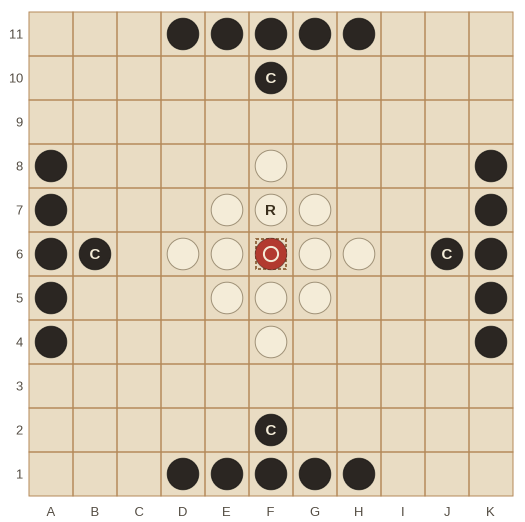
Legend: K = king · D = defender · A = attacker · R = knight (defender) · C = commander (attacker) · . = empty square.
- King
- Defender
- Attacker
- C
- R
- Throne (central square)
The king stands on the central throne, surrounded by 12 defenders in a cross shape, including 1 knight on F7 (directly north above the king). 24 attackers stand in four groups at the middle of the sides of the edge, including 4 commanders on B6, F2, F10 and J6 (each four squares from the centre of the board on the axes). The attackers move first.
Pieces
| Piece | Side | Count | Special feature |
|---|---|---|---|
| King | Defenders | 1 | Armed; can jump over ordinary enemies; the only escape piece |
| Knight | Defenders | 1 | Jumps over an adjacent ordinary enemy and captures it in doing so |
| Defender | Defenders | 11 | Ordinary piece |
| Commander | Attackers | 4 | Jumps over an adjacent ordinary enemy (without capturing); can capture the king together with a second commander or a corner square, also next to the throne |
| Attacker | Attackers | 20 | Ordinary piece |
4. Objective
The defenders win when:
- the king reaches a corner square.
The attackers win when:
- they capture the king.
5. Rules of play
5.1 Movement
All pieces may move any number of unobstructed squares horizontally or vertically.
5.2 Jumping move
The king and commander may jump over an adjacent ordinary enemy without automatically capturing it; the knight always captures in doing so. Unlike in Berserk Hnefatafl, the king's jump is not limited to king squares here (see section 6). Detailed explanation with ASCII examples: the bundled program documentation.
5.3 Berserker rule
After a capture, the same piece may continue moving if this leads to another capture. If the king captures a piece, he may likewise continue moving, provided this leads to his escape. Detailed explanation with ASCII examples: the bundled program documentation.
5.4 Capturing ordinary pieces
A piece is captured when it is flanked on two opposite sides by an enemy piece or a hostile square.
5.5 Throne and corner squares
The empty throne counts as hostile for all pieces; the four corner squares count as hostile for both sides.
5.6 King capture
The king is captured on four sides (by enemy pieces or hostile squares). Two commanders (or one commander together with a corner square) can capture the king, also next to the throne. On the board edge the king can only be captured by two commanders.
5.7 Move repetition
If the same position occurs for the third time, the side whose move brought the repetition about loses.
5.8 Further cases
A player with no legal move loses the game.
6. Good to know
- In Nielsen's Berserk the king may only jump from a king square or onto a king square; in the Legacy rule set this restriction is not provided – a noticeable tactical difference.
- The basic mechanics (special pieces, berserker rule, four-sided king capture, special commander capture) otherwise correspond to Nielsen's Berserk.
- As with Berserk itself, the rule set scores the threefold repetition as a loss for the player who caused it, whereas Nielsen's source generally forbids perpetual repetition (loss for White).
7. Related variants
Legacy Berserk Hnefatafl is the counterpart in the Fellhuhn app to Aage Nielsen's Berserk Hnefatafl and adopts its basic idea (special pieces, berserker rule) almost completely; the essential difference is the unrestricted king jump (see section 6 as well as the rules guide "Berserk Hnefatafl"). Legacy Tyr 13/15/19 likewise share the berserker rule and special pieces, but use no throne, instead edge escape, a king that can be captured from only two sides and, additionally, mercenaries. Legacy Hnefatafl and Legacy Tawlbwrdd use the same 11×11 board, but without special pieces and with a weak king.
8. Rules of play (original) with source reference
No external or historical source exists for this specific "Legacy" rule set. The rule set of the Fellhuhn app is therefore reproduced as the "original" for comparison with the source. Wording and order are unchanged. Original in German.
Source: Rule description of the Fellhuhn app.
Notice of rights: This text originates from Fellhuhn (Philippe Schober). It is reproduced with the permission of the developer and is not covered by the CC BY 4.0 licence of this documentation; the rights remain with the authors.
- Schwarz macht den ersten Zug
- Der König ist bewaffnet
- Nach einem Schlag kann die schlagende Figur erneut ziehen, wenn dies zu einem erneuten Schlag führt
- Wenn der König eine Figur schlägt, darf er erneut ziehen, so dies zu seiner Flucht führt
- Ein Spieler verliert, wenn er keinen gültigen Zug tätigen kann
- Der König wird von vier feindlichen Figuren oder feindlichen Feldern geschlagen
- Der König kann von zwei gegnerischen Kommandanten (oder einem Kommandanten und einer Ecke) geschlagen werden, auch neben dem Thron
- Der leere Thron gilt als feindlich für alle Figuren
- Eckfelder gelten für alle als feindlich
- Der weiße Spieler gewinnt, wenn der König ein Eckfeld erreicht
- Der König kann nicht am Rand des Spielfelds geschlagen werden, außer von zwei Kommandanten
- Der König kann über gewöhnliche feindliche Figuren springen
- Der Kommandant kann über gewöhnliche feindliche Figuren springen
- Der Ritter kann über gewöhnliche feindliche Figuren springen und sie dadurch schlagen
- Wenn beide Spieler den gleichen Zug jeweils dreimal wiederholen, führt dies zur Niederlage des Spielers der damit angefangen hat
9. Sources
- [Fellhuhn-App] Fellhuhn (Philippe Schober): Hnefatafl (Android app, Google Play), rule description of the variant, used with the express permission of the developer. — https://play.google.com/store/apps/details?id=com.fellhuhn.hnefatafl&hl=de
- [Nielsen-berserk] Nielsen, Aage: Berserk Hnefatafl rules (2011). — https://aagenielsen.dk/berserk_rules.php
10. State of the evidence and classification
Rule set of the Fellhuhn app without an external or historical source; the historical connection exists only via board and family (11×11 Hnefatafl). The special pieces (knight, commanders) and the berserker rule are modern new designs after the model of Nielsen's Berserk Hnefatafl (2011), not tradition. The piece ratio (12 defenders + king against 24 attackers) is derived from the general 11×11 Hnefatafl piece set, not separately attested for this variant.