Federation Brandubh
Modern tournament rules for Irish Brandubh (7×7), published as "World Tafl Federation Brandubh" (David Zolli; English version by Adam Bartley). The game features an armed king and corner escape.
Short description: Modern tournament rules for Irish Brandubh (7×7), published as "World Tafl Federation Brandubh" (David Zolli; English version by Adam Bartley). The game features an armed king and corner escape.
1. Basic data
| Name | Federation Brandubh (= World Tafl Federation Brandubh / "Brandubh2") |
|---|---|
| Game family | Hnefatafl (Nordic tafl game) |
| Category | Modern tournament rules on a historically attested board |
| Origin / authors | David Zolli ("branan"), adopted by the World Tafl Federation; underlying game: Irish Brandubh |
| Dating | Rule set modern (21st century); Brandubh itself attested in the early Middle Ages |
| Board size | 7×7 squares |
| Throne | Yes, central square |
| Escape goal | Corner square |
| King | Armed (takes part in captures); captured on 2 sides (3 sides next to the throne, 4 sides on the throne) |
| Piece ratio | 4 defenders + king against 8 attackers (1:2) |
2. History and origin
Brandubh (Irish brandub[h], "black raven") is attested as a game name in Old Irish sources; the small 7×7 board with 8 attackers against 4 defenders and the king is regarded as historically secure. However, no handed-down rules of play exist.
The rule set described here was formulated by David Zolli under the name "World Tafl Federation Brandubh" (also "Brandubh2") in order to give Brandubh a modern, playable and self-consistent set of rules based on the Copenhagen scheme. According to the source [Zolli-brandubh2] it is published as "World Tafl Federation Brandubh"; according to Zolli it was adopted by the World Tafl Federation and published on its site; beyond that, no documented information on its distribution is available here.
3. Starting setup and pieces
Legend: K = king · D = defender · A = attacker · x = restricted square (corner) · . = empty square.
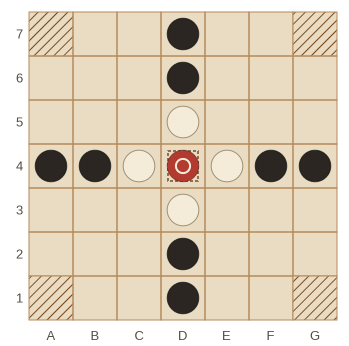
- King
- Defender
- Attacker
- Throne (central square)
- Restricted square (corner)
The king stands on the central throne, surrounded by 4 defenders in a cross shape. 8 attackers stand in pairs at the four side centres of the edge. The attackers move first.
Pieces
| Piece | Side | Count | Special feature |
|---|---|---|---|
| King | Defenders | 1 | Armed (takes part in captures); only escaping piece |
| Defender | Defenders | 4 | Ordinary piece |
| Attacker | Attackers | 8 | Ordinary piece |
4. Objective
The defenders win when:
- the king reaches one of the four corner squares.
The attackers win when:
- they capture the king.
5. Rules of play
5.1 Movement
All pieces may move any number of empty squares horizontally or vertically. They may not jump over other pieces.
5.2 Capturing ordinary pieces
An ordinary piece is captured when it is flanked on two opposite sides (horizontally or vertically, not diagonally) by an enemy piece or a hostile square. A capture occurs only when a player completes the enclosure with their own move – moving voluntarily between two enemy pieces is safe. Two or three pieces can also be captured at the same time if, through the same move, each is flanked against a separate enemy of its own. The king may take part in captures.
5.3 Restricted squares
Restricted squares are the throne (central square) and the four corner squares. Only the king may enter them; all other pieces may merely pass through an empty restricted square without stopping there.
Restricted squares count as hostile, meaning they can serve as one of the two flanking sides in a capture:
- The throne is never hostile to the king himself. Towards the attackers it is always hostile. Towards the defenders it is hostile only if the king is not standing on it.
- The corner squares are always hostile towards both sides – including the king.
5.4 Capturing the king
If the king stands on the throne, he is captured when enclosed on all four sides (orthogonally) by attackers. If he stands directly next to the throne, the remaining three sides suffice – the (then empty) throne itself automatically counts as the fourth, hostile side (see restricted-square rule, section 5.3). On any other square he is captured like an ordinary piece on two opposite sides.
5.5 Repetition of moves
Continued repetitions of the position are forbidden. If a position is repeated for the third time, the defenders automatically lose – regardless of which side brought about the repetition. This rule is not contained in the quoted original text (section 8); it is an addition by the implementation in tafl.
5.6 Further cases
If a side can no longer make a legal move, it loses the game. A complete game is usually played over two sets with a change of sides.
6. Good to know
- In this variant the throne does not follow the simple Copenhagen pattern "hostile except to the king": it is never hostile to the king, always to the attackers, and to the defenders only when the throne is unoccupied – a fine adjustment that is easily lost in simplified summaries.
- The secondary source Cyningstan (Damian Walker) describes a different reconstruction for the historical Brandub, in which the king is captured on only two sides even on the throne [cyningstan-brandub]. The Federation version documented here, by contrast, follows the four-sided capture on the throne.
7. Related variants
Federation Brandubh uses the same historically attested 7×7 board and piece ratio (4 defenders + king against 8 attackers) as other Brandubh versions, but differs from them in the details of the capture and throne rules (see section 6). Also related are Ard Ri, a Scottish 7×7 tafl with a denser starting setup, and Magpie, likewise on a 7×7 board, but there with a "strong", slower king who may only move one square per move.
8. Rules of play (original) with source reference
The original wording is not reproduced here until the rights holders have been consulted. The version of the rules above, in the project's own words, applies. The source can be found at the following links (see section 9):
- Source: World Tafl Federation Brandubh rules (Brandubh2) – http://tafl.cyningstan.com/data-download/697/brandub-leaflet
- English version (David Zolli): https://aagenielsen.dk/brandubh2_rules_en.pdf
9. Sources
- [Zolli-brandubh2] Zolli, David ("branan"): World Tafl Federation Brandubh rules (Brandubh2), English version. — https://aagenielsen.dk/brandubh2_rules_en.pdf (German version: Marian Luck, https://aagenielsen.dk/brandubh2_rules_de.pdf); also published as "Rules of Brandubh 7x7" at http://tafl.cyningstan.com/data-download/697/brandub-leaflet (typesetting of the leaflet edition: Damian Walker/Cyningstan; the rules originate from Zolli/WTF)
- [Nielsen-rules] Nielsen, Aage: Hnefatafl Rules (overview, section "Brandubh 7x7"). — https://aagenielsen.dk/tafl_rules.php
- [cyningstan-brandub] Walker, Damian: Brandub (historical context, alternative reconstruction with 2-sided capture also on the throne). — http://tafl.cyningstan.com/page/171/brandub
10. State of the evidence and classification
Modern tournament rules on a historically attested board (Brandub, 10th century, Ireland). The primary source [Zolli-brandubh2] is unambiguous and authoritative; the rules in the version above follow it. The secondary source [cyningstan-brandub] differs in one detail (king capture on the throne: 2 instead of 4 sides) – here the primary source was consistently treated as authoritative.