Historical Brandubh
Aage Nielsen's Tablut-based reconstruction of the Irish 7×7 tafl. Name and piece ratio come from Irish literature and a 7×7 grid is archaeologically attested by the Ballinderry board; the exact movement and capture rules, however, do not survive and are therefore derived from the common tafl scheme.
Short description: Aage Nielsen's Tablut-based reconstruction of the Irish 7×7 tafl. Name and piece ratio come from Irish literature and a 7×7 grid is archaeologically attested by the Ballinderry board; the exact movement and capture rules, however, do not survive and are therefore derived from the common tafl scheme.
Evidence status: Name, board and piece ratio are historically attested; the movement and capture rules are not preserved and are a modern reconstruction (Aage Nielsen). The addition "Historical" in the name denotes board and name, not the rules.
1. Basic data
| Name | Historical Brandubh (Ir. brandub[h], "black raven") |
|---|---|
| Game family | Hnefatafl (Nordic tafl game) |
| Category | Name and piece ratio attested in literature, 7×7 grid archaeologically attested; rules reconstructed |
| Origin / region | Ireland |
| Dating | Early medieval (name attested in Old Irish sources); reconstruction by Aage Nielsen (modern) |
| Board size | 7×7 squares |
| Throne | Yes, central square |
| Escape goal | Corner square |
| King | Armed (takes part in captures); captured on 2 sides away from the edge, on 3 next to the throne, on 4 on the throne; on an ordinary edge square (not adjacent to the throne) practically safe in tafl (see section 5.4) |
| Piece ratio | 4 defenders + king against 8 attackers (1:2) |
2. History and origin
The name brandub (Irish, "black raven") and the piece ratio (4 defenders and the king against 8 attackers, 13 pieces) come from Irish literature (MacWhite 1945). The Ballinderry board (National Museum of Ireland, inv. 1932:6533; found in 1932, settlement period late 9th to 11th century) provides archaeological evidence for a 7×7 grid (49 holes) with marked centre and corner positions. The object alone attests neither the name nor the number of pieces or any rules; reading the objective as corner escape is a museum-based, modern interpretation. No rules of play survive.
Aage Nielsen reconstructs Brandubh as the Irish version of a common, Tablut-based tafl game, to which Ard Ri, Tablut, Tawlbwrdd and Hnefatafl also belong. Characteristic of this reconstruction is an armed king who is captured on two sides, with a stricter capture rule near the throne. The rules described below are accordingly to be understood as a reasoned reconstruction and not as a historically well attested original text.
3. Starting setup and pieces
Legend: K = king · D = defender · A = attacker · x = restricted square (corner) · . = empty square.
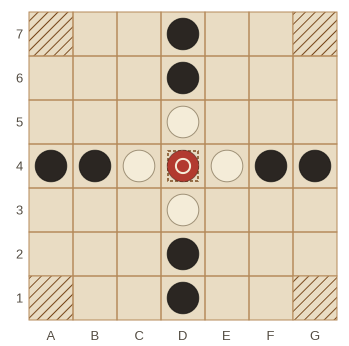
- King
- Defender
- Attacker
- Throne (central square)
- Restricted square (corner)
The king stands on the central throne, surrounded by 4 defenders in a cross shape. 8 attackers stand in pairs at the four side centres of the edge. The attackers move first.
Pieces
| Piece | Side | Count | Special feature |
|---|---|---|---|
| King | Defenders | 1 | Armed (takes part in captures); only escaping piece |
| Defender | Defenders | 4 | Ordinary piece |
| Attacker | Attackers | 8 | Ordinary piece |
4. Objective
The defenders win when:
- the king reaches a corner square.
The attackers win when:
- they capture the king.
5. Rules of play
5.1 Movement
All pieces may move any number of empty squares horizontally or vertically. They may not jump over other pieces.
5.2 Capturing ordinary pieces
An ordinary piece is captured when it is flanked on two opposite sides (horizontally or vertically, not diagonally) by an enemy piece or a hostile restricted square. A capture occurs only when a player completes the enclosure with their own move – moving voluntarily between two enemy pieces is safe. The king may take part in captures.
5.3 Restricted squares
Restricted squares are the throne (central square) and the four corner squares. For these squares the source expressly describes only their effect when capturing (see below); whether entering these squares is restricted to the king is not clearly specified. In tafl only the king may enter these squares; other pieces may merely pass through the empty throne.
Restricted squares count as hostile, meaning they can serve as one of the two flanking sides in a capture:
- The throne is always hostile towards attackers, towards defenders only when it is empty.
- The corner squares are always hostile towards both sides.
The board edge itself is not hostile.
5.4 Capturing the king
The king is captured like an ordinary piece on two opposite sides. If he stands directly next to the throne, it is enough if the three remaining sides around him are occupied – the throne itself already counts as the fourth, hostile side. If he stands on the throne itself, he must be enclosed on all four sides.
On an ordinary edge square that is not adjacent to the throne, tafl applies a separate, very high threshold: there the king cannot, de facto, be captured in the normal way. This is no free pass to victory – the escape condition of this variant still expressly requires a corner square (see section 4); an ordinary edge square is not enough for it. The rule text of the Fellhuhn app in section 8 does not expressly mention this special case; see section 10 for the classification.
5.5 Repetition of moves
If the same position occurs for the third time, the defenders lose (the attackers win).
5.6 Further cases
If a side can no longer make a legal move, it loses the game. If a game can no longer be decided regularly because of a hopeless final position, it ends in a draw.
6. Good to know
- For historical Brandubh only the name and the piece ratio (4 defenders + king against 8 attackers, from Irish literature) and a 7×7 grid (the Ballinderry board) are attested. All movement, capture and victory rules are derived from the Tablut-based scheme and are thus reconstructed, not preserved. Whether corner escape or another escape rule actually applied historically is not known.
7. Related variants
Historical Ard Ri uses the same 7×7 board size, but dispenses entirely with a throne and restricted squares and uses edge escape instead of corner escape. The larger versions of the same reconstructed tafl scheme are Historical Tablut (9×9) and Historical Hnefatafl (11×11). Within this game family, according to the current state of research, only Linnaeus Tablut provides an actually handed-down original rule source; all other versions – including the one described here – are reconstructions, which Aage Nielsen groups together as the "weak king" games.
8. Rules of play (original) with source reference
There is no external historical primary source with a verbatim original text for Historical Brandubh. The following list is the complete rule set of the Fellhuhn app, reproduced unchanged (original in German):
Source: Rule description of the Fellhuhn app, implemented after Aage Nielsen's reconstruction.
Notice of rights: This text originates from Fellhuhn (Philippe Schober). It is reproduced with the permission of the developer and is not covered by the CC BY 4.0 licence of this documentation; the rights remain with the authors.
- Schwarz macht den ersten Zug
- Der König ist bewaffnet
- Ein Spieler verliert, wenn er keinen gültigen Zug tätigen kann
- Der König wird von zwei feindlichen Figuren/Feldern geschlagen
- Der leere Thron gilt als feindlich für alle Figuren
- Eckfelder gelten für alle als feindlich
- Der weiße Spieler gewinnt, wenn der König ein Eckfeld erreicht
- Der weiße Spieler hat verloren, wenn er komplett umstellt wird
- Dreifache Zugwiederholung durch beide Spieler → Niederlage des Spielers, der damit begonnen hat
9. Sources
- [Fellhuhn-App] Fellhuhn (Philippe Schober): Hnefatafl (Android app, Google Play), rule description of the variant, used with the express permission of the developer. — https://play.google.com/store/apps/details?id=com.fellhuhn.hnefatafl&hl=de
- [Nielsen-hist] Nielsen, Aage: Historical Hnefatafl Rules (setup "Brandub 7×7"). — https://aagenielsen.dk/historical_hnefatafl_rules.php
- [Nielsen-rules] Nielsen, Aage: Hnefatafl Rules (overview). — https://aagenielsen.dk/tafl_rules.php
- [cyningstan-brandubh] Walker, Damian: Brandub. — http://tafl.cyningstan.com/page/171/brandub
- [Murray1952] Murray, H. J. R.: A History of Board-Games other than Chess. Oxford: Clarendon Press, 1952.
- [MacWhite1945] MacWhite, Eoin: Early Irish Board Games. In: Éigse 5 (1945/46).
- [Ballinderry] National Museum of Ireland: The Ballinderry gaming board, inventory number 1932:6533.
10. State of the evidence and classification
Name and piece ratio (Irish literature) and the 7×7 grid (Ballinderry) are attested, but the rules are reconstructed throughout (Aage Nielsen, Tablut-based). The implementation of the Fellhuhn app deviates from Nielsen's reconstruction in one detail: the rule text of the Fellhuhn app names no exception "on/next to the throne" for the king capture, but captures the king across the board on two sides. Since the king stands on the throne at the start, this is a noticeable rule deviation from section 5.4 of this guide, which follows the Nielsen reconstruction. Likewise, the repetition rule of the Fellhuhn app (threefold repetition → defeat of the side that caused it) deviates from Nielsen's more general wording (perpetual repetition → loss of the defenders). In addition, tafl implements a special case not mentioned in section 8: on ordinary edge squares not adjacent to the throne, the king is practically safe (see section 5.4) – this is expressly stated neither in the rule text of the Fellhuhn app nor in Nielsen's reconstruction, but follows unambiguously from the RuleSet code (on_edge threshold) and is backed up by unit tests.