Copenhagen Hnefatafl
A modern 11×11 tournament rule set widely played internationally, formulated in 2012 to address weaknesses in earlier rules. Features include an armed king, corner escape, an additional exit fort victory condition, shieldwall capture and victory by encirclement for the attackers.
Short description: A modern 11×11 tournament rule set widely played internationally, formulated in 2012 to address weaknesses in earlier rules. Features include an armed king, corner escape, an additional exit fort victory condition, shieldwall capture and victory by encirclement for the attackers.
1. Basic data
| Name | Copenhagen Hnefatafl |
|---|---|
| Game family | Hnefatafl (Nordic tafl game) |
| Category | Modern tournament rule set (no historical evidence) |
| Origin / authors | Aage Nielsen (Denmark), Adam Bartley (Norway), Tim Millar (UK) |
| Dating | 2012 |
| Board size | 11×11 squares |
| Throne | Yes, central king square |
| Escape goal | Corner square (additionally exit fort victory on the edge) |
| King | Armed (takes part in captures); captured on 4 sides |
| Piece ratio | 12 defenders + king against 24 attackers (1:2) |
2. History and origin
Copenhagen Hnefatafl was designed in 2012 by Aage Nielsen, Adam Bartley and Tim Millar to remedy known weaknesses of the previously widespread Fetlar rules:
- The shieldwall capture prevents unbeatable edge formations of the defenders (comparable to capturing Go stones in a closed group).
- The exit fort upgrades solid, no longer attackable edge positions of the king to a victory of their own, instead of letting them end in a draw.
- The encirclement rule (all defenders including the king enclosed → attackers win) counters the draw-like character of large, purely defensive corner games.
Since then Copenhagen has been used as a modern tournament rule set for 11×11; no documented ranking of its spread is available here.
3. Starting setup and pieces
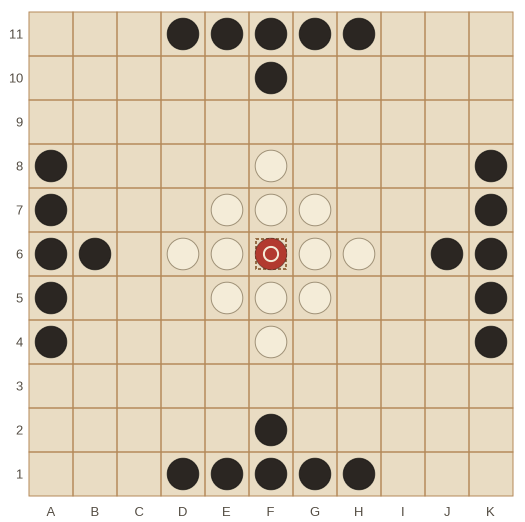
Legend: K = king · D = defender · A = attacker · . = empty square.
- King
- Defender
- Attacker
- Throne (central square)
The king stands on the central throne, surrounded by 12 defenders in a cross shape. 24 attackers stand in four groups at the midpoints of the edges. The attackers move first.
Pieces
| Piece | Side | Number | Special feature |
|---|---|---|---|
| King | Defenders | 1 | Armed (takes part in captures, also in the shieldwall); only escape piece |
| Defender | Defenders | 12 | Ordinary piece |
| Attacker | Attackers | 24 | Ordinary piece |
4. Objective
The defenders win when:
- the king reaches a corner square (escape), or
- the king builds a so-called exit fort on the board edge: the king stands on the edge, can still move, and the attackers can no longer break up this position (details: the bundled program documentation).
The attackers win when:
- they capture the king, or
- they enclose all remaining defenders together with the king in a closed ring (encirclement; details: the bundled program documentation).
5. Rules of play
5.1 Movement
All pieces may move any number of unobstructed squares horizontally or vertically. Pieces may not jump over other pieces.
5.2 Capturing ordinary pieces
A piece (except the king) is captured when it is flanked on two opposite sides (horizontally or vertically, not diagonally) by two opposing pieces, or by one opposing piece and a hostile royal square. A capture only occurs if the flanking side actively closes the trap with its own move – moving voluntarily in between two opposing pieces is safe. The king may take part in captures.
5.3 Shieldwall capture
A row of two or more pieces on the board edge can be captured together if the whole group is bracketed at both ends and, in addition, every single piece of the row has an enemy piece directly opposite it. A corner square can replace one of the bracketing pieces at one end of the row. The king may take part, either as part of the captured row or as a bracketing piece; if a row of king and defenders is attacked, only the defenders are captured. Detailed explanation with ASCII examples: the bundled program documentation.
5.4 King squares
The throne and the four corner squares are king squares (restricted squares). Only the king may occupy them. Any piece may pass through the empty throne, and the king may return to it.
King squares count as hostile, that is, when capturing they can take the role of one of the two flanking pieces:
- The throne is always hostile to attackers, but to defenders only when it is empty.
- The corner squares are always hostile to both sides.
The board edge itself is not hostile.
5.5 Capturing the king
The king is captured when he is surrounded on four sides (orthogonally) by attackers. If the king stands directly next to the throne, it suffices that the three remaining sides around him are occupied – the throne itself already counts as the fourth, hostile side. The king cannot be captured on the board edge.
5.6 Repetition of moves
If the same position occurs for the third time, the defenders lose in every case.
5.7 Further cases
If a side can no longer make a legal move, it loses the game. If a game can no longer be decided in the regular way because too few pieces remain on both sides, it ends in a draw.
6. Good to know
- Copenhagen is an internationally widespread modern tournament rule set for 11×11; statements on a ranking of its spread are not documented here.
- The secondary source Cyningstan (Damian Walker) describes the repetition rule differently: on a threefold repetition of positions the controlling side must vary [cyningstan-cph, rule 13]. The original source in section 8, by contrast, words it more generally: continued repetition always leads to the defenders' loss, regardless of a fixed number of repetitions. In case of doubt the original version applies.
7. Related variants
Copenhagen was designed to remedy weaknesses of the older Fetlar Hnefatafl rules (see section 2, "History and origin"). Both rule sets share the same basic idea (armed king, corner escape), but differ in their shieldwall, exit fort and encirclement rules.
8. Rules of play (original) with source attribution
Source note: Nielsen, Aage; Bartley, Adam; Millar, Tim: Rules of Copenhagen Hnefatafl 11x11. Rules drawn up in 2012 (Aage Nielsen, Adam Bartley, Tim Millar); text as published on aagenielsen.dk on 2026-07-18. English text and diagrams: Adam Bartley. Original page: https://aagenielsen.dk/copenhagen_rules.php The authoritative, possibly updated version of the rules can be found at https://aagenielsen.dk/copenhagen_rules.php.
Notice of rights: This text originates from Aage Nielsen, Adam Bartley and Tim Millar (rules drawn up in 2012; text as published on aagenielsen.dk on 2026-07-18). It is reproduced with the permission of the rights holders and is not covered by the CC BY 4.0 licence of this documentation; the rights remain with the authors.
© Aage Nielsen, Adam Bartley, Tim Millar; reproduced with permission; not covered by the CC BY 4.0 licence of this documentation.
The text under "Original text (status of 2026-07-18)" reproduces the English text as published on aagenielsen.dk on 2026-07-18 unchanged, so that the preceding, linguistically adapted version can be compared with the source at any time. Own additions of this documentation are not part of the original text: the board diagram below and the heading levels (adapted to the embedding in this document).
Starting setup (own representation, not part of the original text):
11    . . . A A A A A . . .
10    . . . . . A . . . . .
 9    . . . . . . . . . . .
 8    A . . . . D . . . . A
 7    A . . . D D D . . . A
 6    A A . D D K D D . A A
 5    A . . . D D D . . . A
 4    A . . . . D . . . . A
 3    . . . . . . . . . . .
 2    . . . . . A . . . . .
 1    . . . A A A A A . . .

      A B C D E F G H I J K
Original text (status of 2026-07-18) – Beginning
Rules of Copenhagen Hnefatafl 11x11.
Short overview:
King armed, captured from 4 sides.
Exit fort. Shieldwall rule.
Objective
The dark pieces (attackers) lay seige, their goal, to capture the king. The light pieces (defenders) must break the seige and get their king to safety.
-
Two players, the king's side vs attackers. There are twice as many attackers as defenders.
-
The attackers' side moves first, the players then take turns.
-
All pieces move any number of vacant squares along a row or a column, like a rook in chess.
4a. Capture
All pieces except the king are captured if sandwiched between two enemy pieces, or between an enemy piece and a restricted square. The two enemy pieces should be on the square above and below or on the squares left and right of the attacked piece, i.e. not diagonally.
A piece is only captured if the trap is closed by the aggressor's move, it is therefore permitted to move in between two enemy pieces. The king may take part in captures.
4b. The shieldwall rule for capturing a row of pieces on the board edge: A row of two or more taflmen along the board edge may be captured together, by bracketing the whole group at both ends, as long as every member of the row has an enemy taflman directly in front of him. A corner square may stand in for one of the bracketing pieces at one end of the row. The king may take part in the capture, either as part of the shieldwall or as a bracketing piece. If the king plus one or more defenders are attacked with a shieldwall, the attack will capture the defenders but not the king.
5. Restricted squares
Restricted squares may only be occupied by the king. The central restricted square is called the throne. It is allowed for the king to re-enter the throne, and all pieces may pass through the throne when it is empty.
Restricted squares are hostile, which means they can replace one of the two pieces taking part in a capture. The throne is always hostile to the attackers, but only hostile to the defenders when it is empty. The four corner squares are also restricted and hostile, just like the throne. The board edge is NOT hostile.
6a. King's side win
If the king reaches any corner square, the king has escaped and his side wins.
6b. Exit forts: The defenders also win if the king has contact with the board edge, is able to move, and it is impossible for the attackers to break the fort.
7a. Attackers win
The attackers win if they can capture the king.
The king is captured when the attackers surround him on all four cardinal points, except when he is next to the throne.
If on a square next to the throne, the attackers must occupy the three remaining squares around him.
The king cannot be captured on the board edge.
7b. If the attackers surround the king and ALL remaining defenders with an unbroken ring, then they win, as they have prevented the king from escaping.
8. Perpetual repetitions
Perpetual repetitions are forbidden. Any perpetual repetition results in a loss for white.
-
If a player cannot move, he loses the game.
-
If it is not possible to end the game, fx. because both sides have too few pieces left, it is a draw.
The Copenhagen rules were outlined 2012 by Aage Nielsen (Denmark), Adam Bartley (Norway) and Tim Millar (UK). English text and diagrams: Adam Bartley (Norway).
Original text (status of 2026-07-18) – End
Figures, captions, references and examples of the original page are not reproduced here; see the original page.
9. Sources
- [Nielsen-cph] Nielsen, Aage; Bartley, Adam; Millar, Tim: Rules of Copenhagen Hnefatafl 11x11; rules drawn up in 2012, text as published on 2026-07-18; the current page is authoritative. — https://aagenielsen.dk/copenhagen_rules.php (English text and diagrams: Adam Bartley; © Aage Nielsen, Adam Bartley, Tim Millar, reproduced with permission, not covered by CC BY 4.0)
- [cyningstan-cph] Walker, Damian: Copenhagen Hnefatafl Rules. — http://tafl.cyningstan.com/page/768/copenhagen-hnefatafl-rules
- [Millar-cph] Millar, Tim: Introduction to the Copenhagen rules. — https://aagenielsen.dk/TheCopenhagenRules.pdf
10. State of the evidence & classification
Modern variant without historical evidence. The primary source [Nielsen-cph] is the authoritative version and easily accessible; the secondary sources [cyningstan-cph] and [Millar-cph] largely confirm the rules but differ in details of wording (see section 6, "Good to know"). For this rules guide the primary source was consistently treated as authoritative.