Coppergate Hnefatafl
A 15×15 variant whose board size is based on the archaeological find from Coppergate, York (c. AD 950–1025). No historical rules survive for this board. The rules described here, including a central throne, an armed, weak king and edge escape, are a modern reconstruction.
Short description: A 15×15 variant whose board size is based on the archaeological find from Coppergate, York (c. AD 950–1025). No historical rules survive for this board. The rules described here, including a central throne, an armed, weak king and edge escape, are a modern reconstruction.
1. Basic data
| Name | Coppergate Hnefatafl (after the find site Coppergate, York) |
|---|---|
| Game family | Hnefatafl (Nordic tafl game) |
| Category | Board size historically attested (archaeological find); rules modernly reconstructed |
| Origin / region | Coppergate, York (England); find of the York Archaeological Trust |
| Dating of the find | Viking Age, approx. AD 950–1025 |
| Board size | 15×15 squares (reconstructed from the find) |
| Throne | Yes, central king square |
| Escape goal | Edge of the board (edge escape) |
| King | Armed, weak (can be captured from 2 sides, except on or next to the throne) |
| Piece ratio | 20 defenders + king against 40 attackers (1:2) |
2. History and origin
During excavations by the York Archaeological Trust (1976–1981) at the Coppergate site in York, the only known archaeological example of a 15×15 tafl board, according to Walker (Cyningstan) [cyningstan-otherlayouts], was discovered (now in the Jorvik Centre). The find dates to approx. AD 950–1025. Handed down is thus exclusively the board size – neither a starting setup nor a rule set is known from the find itself.
The starting setup used here follows a 61-piece serif cross proposed by Damian Walker for the Coppergate board. For the rules of play there likewise exists no historical evidence specifically for this board; the "York Hnefatafl" (published in 1980 by David Brown / York Archaeological Trust) is a publisher's product inspired by the find, but it is not a rule tradition of this board and provides for a weaponless king and a four-sided king capture. The rules described here do not follow this York rule set, but use an armed, weak king with edge escape – a more modern, Tablut-like model. The historical basis of this variant is thus limited to the board size (see section 10).
3. Starting position and pieces
Legend: K = king · D = defender · A = attacker · . = empty square.
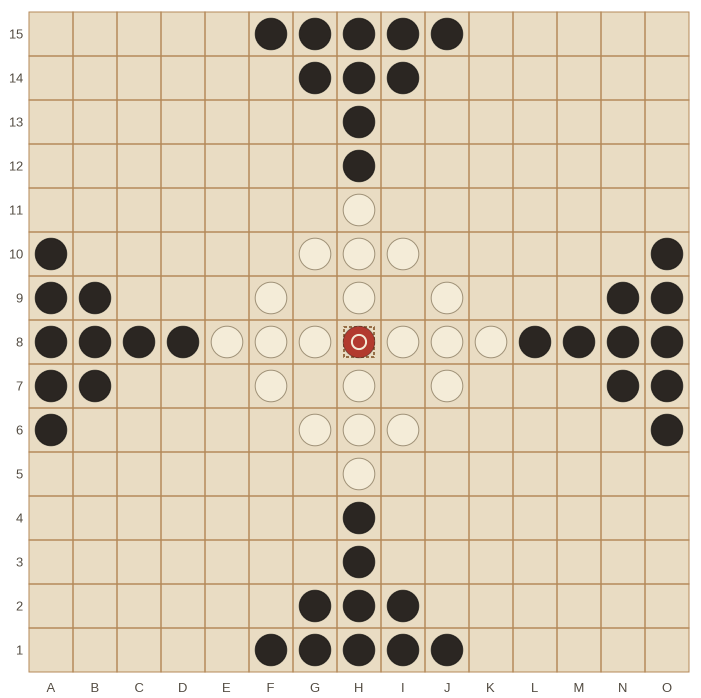
- King
- Defender
- Attacker
- Throne (central square)
The king stands on the central throne. 20 defenders surround him in a serif cross, 40 attackers stand in four T-shaped groups at the middle of the sides of the edge. The attackers move first.
Pieces
| Piece | Side | Count | Special feature |
|---|---|---|---|
| King | White | 1 | Armed (takes part in captures); the only escape piece |
| Defender | White | 20 | Ordinary piece |
| Attacker | Black | 40 | Ordinary piece |
There are no special pieces.
4. Objective
White (defenders) win when:
- the king reaches the edge of the board.
Black (attackers) win when:
- the king is captured, or
- White (king and all remaining defenders) is completely surrounded and no longer has access to the board edge (no complete attacker ring required, see section 5.5).
5. Rules of play
5.1 Movement
All pieces move orthogonally (horizontally or vertically) any distance over empty squares.
5.2 Capturing ordinary pieces
A piece is captured when it is flanked on two opposite sides by an enemy piece.
5.3 The throne as a king square
The throne in the centre may only be entered by the king. The empty throne counts as a hostile square for all pieces and can take the role of one of the two flanking sides when capturing.
5.4 King capture
The king is captured from two opposite sides by enemy pieces or squares – he counts as a "weak" king. On or next to his throne this two-sided rule expressly does not apply.
Note on the source situation: The available source states that the two-sided capture rule applies "except on or next to his throne", but does not specify which capture condition applies instead in that case (e.g. four sides or three sides plus throne, as usual in other tafl variants). This gap is deliberately documented openly here instead of inventing a rule (see section 10). The program fills the gap with the condition usual in tafl variants: on the throne four sides are needed, next to the throne three sides plus the throne.
5.5 Encirclement victory of the attackers
If king and defenders are completely surrounded and thereby no longer have access to the board edge, the attackers win – an unbroken attacker ring is not required for this, cutting them off from the edge is enough (see the bundled program documentation). The original text (section 8) formulates this as "complete surrounding without edge access".
5.6 Move repetition
If a threefold move repetition occurs, the party that caused it loses.
5.7 Further cases
A player with no legal move loses the game.
6. Good to know
- The Coppergate find provides only the board size (15×15); starting setup and rules of this rules guide are modern additions that are not historically attested.
- The publisher's product "York Hnefatafl" (1980; not to be attributed to the archaeological board), inspired by the find, uses a different rule set: weaponless king, capture on four sides, no edge escape in the narrower sense (victory by reaching the edge yes, but without an armed king). This variant deliberately follows a different, more modern model.
- The exact capture condition of the king near the throne is not specified in the available source (see 5.4).
7. Related variants
York Hnefatafl (1980) is a publisher's product inspired by the Coppergate find, on an 11×11 board with a different rule set (weaponless king who can be captured on four sides; see section 2); its rules are not to be attributed to the archaeological board. Comparable in board size is also Alea Evangelii (19×19), likewise a large tafl board with reconstructed rules. In its basic model of an armed, weak king and edge escape, Coppergate Hnefatafl most resembles the Tawlbwrdd and Tablut variants.
8. Rules of play (original) with source reference
For the Coppergate board itself no rules have survived, and there is no verbatim quotation of an external source for the rules played here (only a paraphrase of the different York rule set). The following section therefore reproduces unchanged the rule set actually implemented; it is thus itself the "original text" of this variant (see section 10 for the classification). Original in German.
Source: Rule description of the Fellhuhn app.
Notice of rights: This text originates from Fellhuhn (Philippe Schober). It is reproduced with the permission of the developer and is not covered by the CC BY 4.0 licence of this documentation; the rights remain with the authors.
Rule set (Fellhuhn app)
- Schwarz macht den ersten Zug
- Der König ist bewaffnet
- Ein Spieler verliert, wenn er keinen gültigen Zug hat
- Der König wird von zwei feindlichen Figuren oder Feldern geschlagen – außer auf oder neben seinem Thron
- Der leere Thron gilt als feindlich für alle Figuren
- Weiß gewinnt, wenn der König den Rand des Spielfelds erreicht
- Weiß verliert bei vollständiger Umstellung ohne Randzugang
- Dreifache Zugwiederholung → Niederlage des Verursachers
9. Sources
- [cyningstan-york] Walker, Damian: York Hnefatafl. — http://tafl.cyningstan.com/page/245/york-hnefatafl (context of the Coppergate find; rule version York Archaeological Trust 1980)
- [cyningstan-otherlayouts] Walker, Damian: Other Board Layouts, section "A Serif Cross Layout for the Coppergate Board". — http://tafl.cyningstan.com/page/238/other-board-layouts
- [Walker2014] Walker, Damian: Reconstructing Hnefatafl, revised edition 2014 (board sizes and piece formula p = 6w − 29).
- [Fellhuhn-App] Fellhuhn (Philippe Schober): Hnefatafl (Android app, Google Play), rule description of the variant, used with the express permission of the developer. — https://play.google.com/store/apps/details?id=com.fellhuhn.hnefatafl&hl=de
10. State of the evidence and classification
Board size historically attested, rules modern. The Coppergate find (excavation by the York Archaeological Trust 1976–1981, now in the Jorvik Centre) is the only known archaeological example of a 15×15 tafl board [cyningstan-otherlayouts]. No historical rules have survived for this board or for the board size in general; the rule set used is therefore a modern stipulation. As an external context source serves the "York Hnefatafl" (York Archaeological Trust, 1980), which, however, uses an unarmed king and four-sided capture and thus deviates from the weak armed king rule implemented here [cyningstan-york]. In addition, on board size and piece count see [Walker2014, ch. 4] (piece formula p = 6w − 29, giving 61 for 15×15).