Ealdfaeder Taefl
A 9×9 rule set used by the Ealdfaeder re-enactment group (UK), with 25 pieces and corner escape. A streamlined, practical version for re-enactment, with clear and complete core rules but no historical evidence for those rules.
Short description: A 9×9 rule set used by the Ealdfaeder re-enactment group (UK), with 25 pieces and corner escape. A streamlined, practical version for re-enactment, with clear and complete core rules but no historical evidence for those rules.
1. Basic data
| Name | Ealdfaeder Taefl |
|---|---|
| Game family | Hnefatafl (Nordic tafl game) |
| Category | Modern (reenactment house rules) |
| Origin / author | Ealdfaeder Re-enactment Group (UK) |
| Dating | Modern (reenactment practice, documented at Cyningstan) |
| Board size | 9×9 squares |
| King's square | Yes, central square – exclusive to the king |
| Escape goal | Corner square |
| King | Capture from 4 sides (at the edge or next to the central square: 3 sides); whether he is armed is not expressly stated |
| Piece ratio | 8 defenders + king against 16 attackers (1:2); 25 pieces in total |
2. History and origin
Ealdfaeder Taefl is the house rule set used by the British Ealdfaeder Re-enactment Group and documented by Damian Walker (Cyningstan). It is a modern re-enactment variant rather than a historically attested rule set. Its combination of a 9×9 board and corner escape contrasts with the edge escape used in Linnaeus Tablut and Historical Tablut.
3. Starting setup and pieces
Legend: K = king · D = defender · A = attacker · . = empty square.
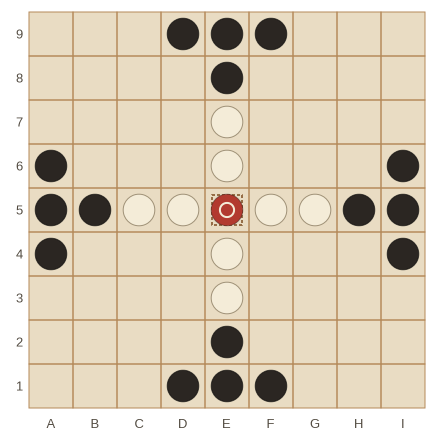
- King
- Defender
- Attacker
- Throne (central square)
The king stands on the central king's square, surrounded by 8 defenders. 16 attackers stand at the edges. In total 25 pieces are used. The attackers move first.
Pieces
| Piece | Side | Count | Special feature |
|---|---|---|---|
| King | Defenders | 1 | The only escape piece; capture from 4 sides (at the edge/next to the central square: 3 sides) |
| Defender | Defenders | 8 | Ordinary piece |
| Attacker | Attackers | 16 | Ordinary piece |
Whether the king may take part in captures (is armed) is not expressly stated by the source; elsewhere it emphasises that it wants to mark an unarmed king separately in each case, which rather suggests an armed king in this variant – but this remains unconfirmed (see section 10).
4. Objective
The defenders win when:
- the king reaches one of the four marked corner squares.
The attackers win when:
- the king is captured (see section 5.4).
5. Rules of play
5.1 First move
The attackers move first.
5.2 Movement
All pieces move orthogonally any distance over empty squares. Landing on or jumping over another piece is not allowed.
5.3 King's squares
The marked squares in the centre and in the four corners are exclusive to the king: only he may end a move on them. Other pieces may pass through the empty central square, but may not land on it.
5.4 Capturing ordinary pieces
A piece is captured when it is flanked on two opposite sides (row or column) by two enemy pieces. The captured piece is removed immediately. Moving voluntarily between two opposing pieces is safe – a capture must be brought about by the active move of the flanking side.
5.5 Capturing the king
The king is captured when he is enclosed on four sides. If he stands at the board edge or directly next to the central king's square, enclosure on the remaining three sides suffices.
5.6 No legal move
If the side to move has no legal move, the game ends in a draw. This is a stipulation of tafl; the source says nothing on the point.
6. Good to know
- Ealdfaeder Taefl combines a 9×9 board with corner escape and the classic four-sided king capture – a combination that occurs less often among 9×9 tafl games than the historical edge escape.
- Whether the king is armed is left open by the source; in the accompanying commentary on the rules the author merely notes that an unarmed king is to be marked separately in each case, which indirectly suggests an armed king in this variant without expressly confirming it.
7. Related variants
Ealdfaeder Taefl shares board size and piece count with the other 9×9 variants of this documentation (among others "Linnaeus Tablut", "Historical Tablut"), but differs from them through corner escape instead of the historical edge escape and through the weak king of those versions. "Market Hnefatafl" is a further modern 9×9 version, there however with edge escape and without restricted squares. Ealdfaeder Taefl shares the combination of corner escape and four-sided king capture with Copenhagen Hnefatafl and Berserk Hnefatafl, which however implement the same basic principle on an 11×11 board and with further special rules.
8. Rules of play with source reference
For this variant there is neither a verbatim quoted external original text nor a rule set of the Fellhuhn app. What exists is a German paraphrase, provided with rule numbers, of the rule set of the Ealdfaeder Re-enactment Group. The following section reproduces this paraphrase as close to the wording as possible; it is not a verbatim translation of the English original. The paraphrase below was rendered into English from the German paraphrase of this documentation.
Source (paraphrased): Walker, Damian: Ealdfaeder Taefl Rules. — http://tafl.cyningstan.com/page/689/ealdfaeder-taefl-rules
Own summary after Walker, Damian: Ealdfaeder Taefl Rules, not the original text.
- King in the centre, 8 defenders around him, 16 attackers at the edges; 25 pieces in total. (Rules 1, 2)
- The attackers move first. (Rule 4)
- The king reaches one of the four marked corner squares → defenders win; the king is captured → attackers win. (Rule 3)
- All pieces move orthogonally, any distance; no landing on and no jumping over other pieces. (Rule 5)
- The marked squares in the centre and corners are exclusive to the king; other pieces may not land there, but may pass through the empty central square. (Rule 6)
- Ordinary pieces are captured by flanking on two opposite sides; the captured piece is removed immediately. Moving voluntarily between two enemies is safe – a capture must be brought about actively. (Rules 7, 8)
- The king is captured from four sides; if he stands at the edge or next to the central square, the remaining three sides suffice. (Rule 9)
9. Sources
- [cyningstan-eald] Walker, Damian: Ealdfaeder Taefl Rules (house rules of the Ealdfaeder Re-enactment Group). — http://tafl.cyningstan.com/page/689/ealdfaeder-taefl-rules
- [eald-leaflet] Ealdfaeder Taefl Leaflet. — http://tafl.cyningstan.com/download/1006/ealdfaeder-taefl-leaflet
10. State of the evidence & classification
This is a modern, practically played reenactment rule set without historical evidence, documented at Cyningstan. The rules on movement, capturing, king's squares and king capture are available completely and unambiguously. What remains open is whether the king is armed – the source does not say this expressly but only suggests it indirectly. On repetition of moves and on further special cases (e.g. inability to move) the source makes no statement.