Fetlar Hnefatafl
Modern tournament rule set (2007) for Hnefatafl on 11×11 with a strong king (captured on 4 sides) and corner escape. According to Cyningstan, for years the most widespread tournament rule set, later replaced by Copenhagen Hnefatafl [cyningstan-fetlar] (the source gives no more precise dates). The repetition rule deliberately deviates from the source (see section 6).
Short description: Modern tournament rule set (2007) for Hnefatafl on 11×11 with a strong king (captured on 4 sides) and corner escape. According to Cyningstan, for years the most widespread tournament rule set, later replaced by Copenhagen Hnefatafl [cyningstan-fetlar] (the source gives no more precise dates). The repetition rule deliberately deviates from the source (see section 6).
1. Basic data
| Name | Fetlar Hnefatafl |
|---|---|
| Game family | Hnefatafl (Nordic tafl game) |
| Category | Modern tournament rule set (no historical evidence) |
| Origin / author | Fetlar Hnefatafl Panel, Fetlar/Shetland (UK) |
| Dating | 2007 |
| Board size | 11×11 squares |
| Throne | Yes, central king square |
| Escape goal | Corner square |
| King | Armed (takes part in captures); "strong" (captured on 4 sides) |
| Piece ratio | 12 defenders + king against 24 attackers (1:2) |
2. History and origin
In 2007 the Fetlar Hnefatafl Panel (founded by the late Peter Kelly) on the Shetland island of Fetlar formulated a tournament rule set of its own for Hnefatafl on 11×11, in order to create a uniform standard worldwide. Fetlar – unlike the historical reconstructions with a weak king who can be captured on two sides – relies on a strong king who is captured on four sides, and on corner escape instead of edge escape.
According to Cyningstan, the rule set was for years the most widespread tournament rule set [cyningstan-fetlar]; because of its tendency towards undecided "draw fort" positions (impregnable edge formations of the king that let the game end in a draw) it was later replaced by Copenhagen Hnefatafl (see section 7). The source gives no more precise dates.
3. Starting setup and pieces
Legend: K = king · D = defender · A = attacker · . = empty square.
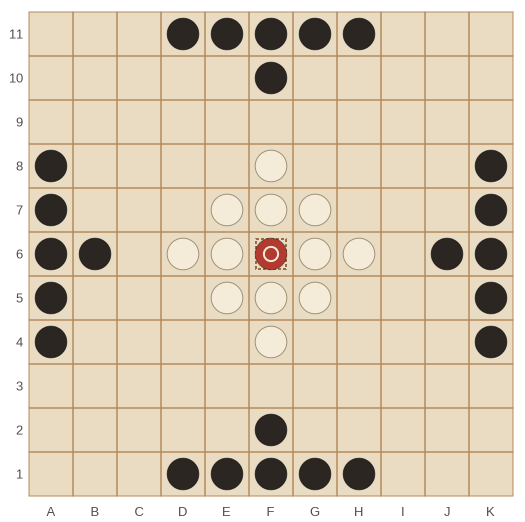
- King
- Defender
- Attacker
- Throne (central square)
The king stands on the central throne, surrounded by 12 defenders in a cross shape. 24 attackers stand in four groups at the midpoints of the edges. The attackers move first.
Pieces
| Piece | Side | Number | Special feature |
|---|---|---|---|
| King | Defenders | 1 | "Strong" (captured on 4 sides); armed, takes part in captures; only escape piece |
| Defender | Defenders | 12 | Ordinary piece |
| Attacker | Attackers | 24 | Ordinary piece |
This variant has no special pieces (commander, knight, mercenary).
4. Objective
The defenders win when:
- the king reaches a corner square.
The attackers win when:
- they capture the king, or
- they enclose the king and all remaining defenders in a closed ring.
5. Rules of play
5.1 Movement
All pieces may move any number of unobstructed squares horizontally or vertically. Pieces may not jump over other pieces.
5.2 Capturing ordinary pieces
A piece is captured when it is flanked on two opposite sides by two opposing pieces, or by one opposing piece and a hostile royal square. A capture only occurs if the flanking side actively closes the trap with its own move.
5.3 King squares
King squares are the throne and the four corner squares; they may only be entered by the king. The throne is always hostile to attackers, but to defenders only when it is empty. The corner squares are always hostile to both sides. The king may also re-enter the throne after leaving it; all other pieces may merely pass through the empty throne. The board edge itself is not hostile.
5.4 Capturing the king
The king is armed and may participate in captures. He is captured on four sides, or on three sides when adjacent to the throne, which acts as the fourth hostile side. The king cannot be captured on the board edge. The attackers may nevertheless win by encirclement (see section 5.5).
5.5 Encirclement victory of the attackers
If the king and all remaining defenders are enclosed by a closed ring of attackers, the attackers win – even if the king formally stands on the board edge. Details: the bundled program documentation.
5.6 Repetition of moves
If the same position occurs for the third time, the defenders lose (the attackers win), regardless of which side brought the repetition about.
5.7 Further cases
A player with no legal move loses the game.
6. Good to know
- The source (Fetlar Hnefatafl Panel / Nielsen) provides for an armed king who takes part in captures; tafl accordingly uses an armed king. The rule description of the Fellhuhn app reproduced in section 8, by contrast, says "The king is unarmed" – a known difference between this rule description and the behaviour of tafl (see section 10).
- According to the source, perpetual repetitions and draw forts expressly end in a draw – a core feature that distinguishes Fetlar from Copenhagen [Nielsen-fetlar, rule 9]. tafl, by contrast, scores the third occurrence of the same position as a loss for the defenders and thus breaks with the draw principle characteristic of Fetlar. The rule text of the Fellhuhn app (section 8) names a loss for the player who caused it.
- According to Cyningstan, Fetlar was for years the most widespread tournament rule set, but was replaced by Copenhagen Hnefatafl because of its tendency towards draw forts [cyningstan-fetlar].
7. Related variants
Copenhagen Hnefatafl builds directly on Fetlar and adds shieldwall capture, exit fort and encirclement victory in order to remedy Fetlar's draw fort problem (see the rules guide "Copenhagen Hnefatafl"). Old Hnefatafl takes over the Fetlar rules completely and only adds a king who can additionally be captured on the edge as well as a ban on draw forts and repetitions (see the rules guide "Old Hnefatafl"). Berserk Hnefatafl shares the strong king on the 11×11 board with Fetlar, but differs fundamentally through special pieces (knight, commanders) and the berserker rule (see the rules guide "Berserk Hnefatafl").
8. Rules of play (original) with source attribution
A verbatim original text of the source is not available, only a German summary with rule references. The rule set of the Fellhuhn app is therefore reproduced as the "original" for comparison with the source. Wording and order are unchanged. Original in German.
Source: Rule description of the Fellhuhn app.
Notice of rights: This text originates from Fellhuhn (Philippe Schober). It is reproduced with the permission of the developer and is not covered by the CC BY 4.0 licence of this documentation; the rights remain with the authors.
- Schwarz macht den ersten Zug
- Der König ist unbewaffnet
- Ein Spieler verliert, wenn er keinen gültigen Zug hat
- Der König wird von vier feindlichen Figuren oder Feldern geschlagen
- Der leere Thron gilt als feindlich für alle Figuren
- Eckfelder gelten für alle als feindlich
- Weiß gewinnt, wenn der König ein Eckfeld erreicht
- Der König kann am Rand nicht geschlagen werden
- Weiß verliert bei vollständiger Umstellung ohne Randzugang
- Dreifache Zugwiederholung → Niederlage des Verursachers
Note: The bullet point quoted verbatim above, "Der König ist unbewaffnet" ("The king is unarmed"), deviates from the actual behaviour of tafl (armed king, see sections 5.4/6) – the rule description of the Fellhuhn app contains this bullet point unchanged. The wording of the quotation nevertheless remains unchanged here (see the introduction to this section).
9. Sources
- [Fellhuhn-App] Fellhuhn (Philippe Schober): Hnefatafl (Android app, Google Play), rule description of the variant, used with the express permission of the developer. — https://play.google.com/store/apps/details?id=com.fellhuhn.hnefatafl&hl=de
- [Nielsen-fetlar] Nielsen, Aage: Rules of Fetlar Hnefatafl 11x11. — https://aagenielsen.dk/fetlar_rules_en.php (2007 rule set of the Fetlar Hnefatafl Panel; English text: Adam Bartley)
- [cyningstan-fetlar] Walker, Damian: Fetlar Hnefatafl. — http://tafl.cyningstan.com/page/88/fetlar-hnefatafl
- [Nielsen-rules] Nielsen, Aage: Hnefatafl Rules (overview, section "Strong King / Fetlar"). — https://aagenielsen.dk/tafl_rules.php
10. State of the evidence & classification
Modern tournament rule set (2007) without historical evidence, well documented by the primary source [Nielsen-fetlar]. A verbatim English original text is not available, only a German summary with rule references as well as the verbatim rule set of the Fellhuhn app, which is used here as the "original" for section 8. The rule description of the Fellhuhn app still says "Der König ist unbewaffnet" ("The king is unarmed"), whereas tafl uses an armed king (see section 6).