Historical Hnefatafl
The Fellhuhn app's version of Icelandic 11×11 Hnefatafl, based on Aage Nielsen's Tablut-based reconstruction of Nordic tafl. The name and board size are historically attested, but no original rules survive. The king is armed but weak (captured on two sides) and may escape anywhere along the board edge, not just at the corners.
Short description: The Fellhuhn app's version of Icelandic 11×11 Hnefatafl, based on Aage Nielsen's Tablut-based reconstruction of Nordic tafl. The name and board size are historically attested, but no original rules survive. The king is armed but weak (captured on two sides) and may escape anywhere along the board edge, not just at the corners.
Evidence status: Name and board are historically attested; the rules of play are not preserved and a modern reconstruction (Aage Nielsen). The addition "Historical" in the name denotes board and name, not the rules.
1. Basic data
| Name | Historical Hnefatafl (Old Icelandic hnefatafl, "fist board game") |
|---|---|
| Game family | Hnefatafl (Nordic tafl game) |
| Category | Name and board historically attested, rules of play reconstructed (after Aage Nielsen) |
| Origin / region | Scandinavia / Iceland |
| Dating | Viking Age / early Middle Ages (name attested in Old Icelandic sources) |
| Board size | 11×11 squares |
| Throne | Yes, central king square |
| Escape goal | Board edge (edge escape) |
| King | Armed (takes part in captures); captured on 2 sides (3 next to, 4 on the throne) |
| Piece ratio | 12 defenders + king against 24 attackers (1:2) |
2. History and origin
The name hnefatafl and the board size 11×11 are historically attested for this variant: the term appears in Old Icelandic sources from the Viking Age and the early Middle Ages. Complete original rules of play, by contrast, have not survived.
Aage Nielsen based this reconstruction on Tablut. In his classification, Hnefatafl is the Icelandic version of a shared Nordic tafl game that also includes Brandubh, Ard Ri, Tablut and Tawlbwrdd. The reconstruction adapts the better-documented Tablut rules to an 11×11 board.
It is not known whether historical Hnefatafl used edge escape (reaching any square on the board edge) or corner escape. This guide follows Nielsen's reconstruction and the tafl implementation in using edge escape.
3. Starting setup and pieces
Legend: K = king · D = defender · A = attacker · . = empty square.
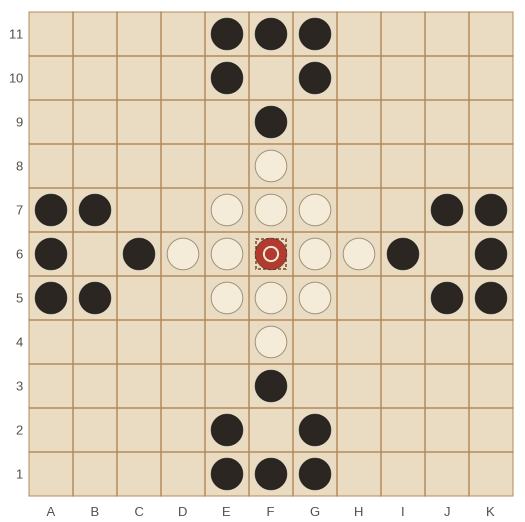
- King
- Defender
- Attacker
- Throne (central square)
The king stands on the central throne, surrounded by 12 defenders. The 24 attackers stand in four groups that are spread further across the board than in the other 11×11 Hnefatafl variants. The attackers move first.
Pieces
| Piece | Side | Number | Special feature |
|---|---|---|---|
| King | Defenders | 1 | Armed (takes part in captures); only escape piece |
| Defender | Defenders | 12 | Ordinary piece |
| Attacker | Attackers | 24 | Ordinary piece |
This variant has no special pieces.
4. Objective
The defenders win when:
- the king reaches any square on the board edge (edge escape).
The attackers win when:
- they capture the king (surround him), or
- they completely surround the defenders so that these no longer have access to the board edge.
5. Rules of play
5.1 Movement
All pieces may move any number of unobstructed squares horizontally or vertically. Pieces may not jump over other pieces.
5.2 Capturing ordinary pieces
A piece is captured when it is flanked on two opposite sides (horizontally or vertically, not diagonally) by an enemy piece or a hostile square. A capture only occurs if the flanking side actively closes the trap with its own move; moving voluntarily in between two opposing pieces is safe.
5.3 The throne (king square)
The throne in the middle of the board is a king square: it may only be entered by the king. For the attackers the throne is always hostile; for the defenders only when it is empty – it can then take the role of one of the two flanking squares when capturing. The board edge itself is not hostile.
5.4 Capturing the king
The king is armed and takes part in captures, but is captured under heightened requirements near the throne:
- Away from the throne the king is already captured on two opposite sides.
- If the king stands directly next to the throne, the three remaining sides around him must be occupied – the throne itself counts as the fourth, hostile side.
- If the king stands on the throne, all four sides must be occupied.
5.5 Repetition of moves
If the same position occurs for the third time, the defenders lose (the attackers win), regardless of which side brought the repetition about.
5.6 Further cases
A player with no legal move loses the game.
6. Good to know
- In his reconstruction Aage Nielsen treats the king as armed, that is, he takes part in captures; tafl accordingly uses an armed king. The rule description of the Fellhuhn app reproduced in section 8, by contrast, says "Der König ist unbewaffnet" ("The king is unarmed") – a known difference between this rule description and the behaviour of tafl (see section 10).
- The repetition rule is worded more generally in Nielsen's reconstruction: any continued repetition leads to the defenders' loss, regardless of a fixed number of repetitions. tafl, by contrast, scores the third occurrence of the same position as a loss for the defenders. The rule text of the Fellhuhn app (section 8) names a loss for the player who caused it.
- According to Nielsen's classification, Hnefatafl is closely related to Tablut, Brandubh, Ard Ri and Tawlbwrdd – all are regarded as versions of the same common tafl game on boards of different sizes.
7. Related variants
Historical Tablut (9×9), Historical Brandubh (7×7) and Historical Ard Ri (7×7) are, according to Nielsen's classification, versions of the same common tafl game on smaller boards. Tawlbwrdd (11×11) is the Welsh version on the same board format, but is treated in this documentation as a variant group of its own. Copenhagen, Berserk and Fetlar Hnefatafl (11×11) are modern, historically unattested tournament or rule variants with a strong king and/or corner escape on the same board (see the respective rules guides); Legacy Hnefatafl is the corresponding rule variant of the Fellhuhn app without an armed king and with corner escape instead of edge escape. According to the current state of research, Linnaeus Tablut is regarded as the only actually handed-down original rule source of the whole tafl family, on which Nielsen's reconstruction for Hnefatafl ultimately builds.
8. Rules of play (original) with source attribution
For this variant no external original text (for example from Nielsen's website) is available verbatim, only a German summary with rule references. The rule set of the Fellhuhn app is therefore reproduced as the "original" for comparison with the source. Wording and order are unchanged. Original in German.
Source: Rule description of the Fellhuhn app.
Notice of rights: This text originates from Fellhuhn (Philippe Schober). It is reproduced with the permission of the developer and is not covered by the CC BY 4.0 licence of this documentation; the rights remain with the authors.
- Schwarz macht den ersten Zug
- Der König ist unbewaffnet
- Ein Spieler verliert, wenn er keinen gültigen Zug tätigen kann
- Der König wird von zwei feindlichen Figuren/Feldern geschlagen – außer auf oder neben seinem Thron
- Der leere Thron gilt als feindlich für alle Figuren
- Der weiße Spieler gewinnt, wenn der König den Rand des Spielfelds erreicht
- Der weiße Spieler hat verloren, wenn er komplett umstellt wird und keinen Randzugang mehr hat
- Dreifache Zugwiederholung durch beide Spieler → Niederlage des Spielers, der damit begonnen hat
Note: The bullet point quoted verbatim above, "Der König ist unbewaffnet" ("The king is unarmed"), deviates from the actual behaviour of tafl (armed king, see sections 5.4/6) – the rule description of the Fellhuhn app contains this bullet point unchanged. The wording of the quotation nevertheless remains unchanged here (see the introduction to this section).
9. Sources
- [Fellhuhn-App] Fellhuhn (Philippe Schober): Hnefatafl (Android app, Google Play), rule description of the variant, used with the express permission of the developer. — https://play.google.com/store/apps/details?id=com.fellhuhn.hnefatafl&hl=de
- [Nielsen-hist] Nielsen, Aage: Historical Hnefatafl Rules. — https://aagenielsen.dk/historical_hnefatafl_rules.php
- [Nielsen-rules] Nielsen, Aage: Hnefatafl Rules (overview). — https://aagenielsen.dk/tafl_rules.php
- [cyningstan-hnefatafl] Walker, Damian: Hnefatafl. — http://tafl.cyningstan.com/page/172/hnefatafl
- [Murray1952] Murray, H. J. R.: A History of Board-Games other than Chess. Oxford: Clarendon Press, 1952.
10. State of the evidence & classification
Name and board size (11×11) of this variant are historically attested, but complete original rules of play have not survived. The rules reproduced here follow Aage Nielsen's Tablut-based reconstruction [Nielsen-hist]. The rule description of the Fellhuhn app still says "Der König ist unbewaffnet" ("The king is unarmed"), whereas tafl uses an armed king (see section 6).