Imperial Contest
According to the secondary source consulted, the first commercially sold Hnefatafl edition, produced by Jaques of London in 1855. Themed as a Crimean War scenario: the Russian emperor must escape from the board with 8 defenders while 16 attackers – divided among four allied nations – want to capture him. Features are a movement limit on the escape piece that is unusual among tafl games and an equally rare single-capture rule.
Short description: According to the secondary source consulted, the first commercially sold Hnefatafl edition, produced by Jaques of London in 1855. Themed as a Crimean War scenario: the Russian emperor must escape from the board with 8 defenders while 16 attackers – divided among four allied nations – want to capture him. Features are a movement limit on the escape piece that is unusual among tafl games and an equally rare single-capture rule.
1. Basic data
| Name | Imperial Contest |
|---|---|
| Game family | Hnefatafl (Nordic tafl game) |
| Category | Historically attested as a commercial product (1855); detailed rules preserved via a secondary source |
| Origin / manufacturer | Jaques of London (United Kingdom) |
| Dating | 1855 |
| Board size | 9×9 squares |
| Restricted squares | No special restricted squares; no special status for the central square in the handed-down rules |
| Escape goal | Edge of the playing field (edge escape) |
| King / emperor | Escape piece (Russian emperor); capture from 4 sides; move distance limited to at most four squares; does not take part in captures |
| Piece ratio | 8 defenders + emperor against 16 attackers (1:2) |
2. History and origin
According to the secondary source consulted, Imperial Contest is regarded as the first commercially sold Hnefatafl edition. It was produced in 1855 by the London game manufacturer Jaques of London and themed on the then ongoing Crimean War: a Russian emperor must escape from the board with his imperial armies while 16 attackers – divided among the four allies England, France, Turkey and Sardinia – try to capture him. All 16 attackers are controlled by a single player; the division among four nations is purely thematic.
In 1855 Jaques knew only Smith's faulty English Tablut translation (1811, see "Linnaeus Tablut") and took over parts of it verbatim. Since the king had become too strong in it – practically uncapturable – through the translation error, Jaques deliberately changed the rules for balance: he limited the emperor's move distance to four squares and introduced a single-capture rule which, according to the source, is unique among tafl games.
The product was not commercially long-lived. In 1863 a copy appeared in the USA under the title "Freedom's Contest" with a Civil War theme (rebel leader and 8 Confederates against 16 Union soldiers). The Hnefatafl researcher H. J. R. Murray did not yet know Jaques' commercial edition in 1913. In the 21st century Imperial Contest was tried out again on aagenielsen.dk and assessed as a balanced rule set.
3. Starting setup and pieces
Legend: K = emperor · D = defender · A = attacker · . = empty square.
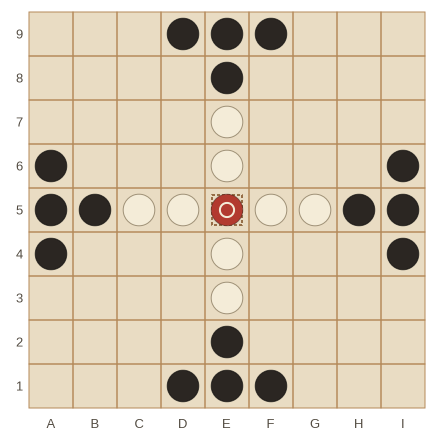
- King
- Defender
- Attacker
- Throne (central square)
The emperor stands in the centre, surrounded by 8 defenders (the imperial army). 16 attackers stand at the edges, thematically distributed four each among England, France, Turkey and Sardinia. The first player is chosen by drawing lots.
Pieces
| Piece | Side | Count | Special feature |
|---|---|---|---|
| Emperor | Defenders | 1 | The only escape piece; move distance limited to at most four squares; capture from 4 sides; does not take part in captures |
| Defender (imperial army) | Defenders | 8 | Ordinary piece |
| Attacker (allies) | Attackers | 16 | Ordinary piece; thematically distributed 4 each among four nations, in game mechanics a single party |
4. Objective
The defenders win when:
- the emperor reaches a square on the board edge.
The attackers win when:
- the emperor is captured on all four sides.
5. Rules of play
5.1 First move
The first player is chosen by drawing lots.
5.2 Movement
All pieces move orthogonally any distance over empty squares; no jumping over, no landing on occupied squares. Exception: the emperor may move at most four squares.
5.3 Capturing the emperor
The emperor is captured when he is enclosed on all four sides (row and column) by attackers.
5.4 Capturing other pieces
A piece is captured when it is flanked on two opposite sides by two enemy pieces.
5.5 Single-capture rule
If a single move flanks several opposing pieces at once, separately, still only one of them is captured – the moving side must decide on one victim. According to the source this rule is unique among the known tafl games.
5.6 The emperor does not take part in captures
An attacker who moves between the emperor and an imperial army piece is not captured: the emperor cannot participate in captures of ordinary pieces.
5.7 No legal move
If the side to move has no legal move, the game ends in a draw. This is a stipulation of tafl; the source says nothing on the point.
6. Good to know
- According to the secondary source consulted, Imperial Contest is the first commercially sold Hnefatafl edition and is based on Smith's faulty Tablut translation of 1811 (see "Linnaeus Tablut", section 6). Because this translation wrongly made the king uncapturable, Jaques introduced the movement limit of the emperor and the single-capture rule for balance.
- According to the source, the single-capture rule (section 5.5) occurs in no other known tafl variant in this form.
- In 1863 a thematic copy appeared in the USA under the title "Freedom's Contest" with a Civil War theme.
7. Related variants
Imperial Contest draws on the same original Tablut source as "Linnaeus Tablut" (via the faulty Smith translation of 1811), but deliberately deviates from it through the emperor's movement limit and the single-capture rule. "Sea Battle Tafl 9×9" – the modern 9×9 variant of the same type of game (proposed by Adam Bartley, documented by Aage Nielsen) – resembles the basic form sold by Jaques in 1855 in game mechanics without being identical to it (see its own document).
8. Rules of play with source reference
For this variant there is neither a verbatim quoted block of the original text of 1855 nor a rule set of the Fellhuhn app. What exists is a German paraphrase, provided with rule numbers, of Cyningstan's presentation of the original Jaques rules. An actual transcription of the original text is offered at Cyningstan at an address of its own [cyningstan-imp-orig], but is not available as full text and is therefore not reproduced here as a supposed quotation. The following section reproduces the existing paraphrase as close to the wording as possible. The paraphrase below was rendered into English from the German paraphrase of this documentation.
Source (paraphrased): Walker, Damian: Imperial Contest. — http://tafl.cyningstan.com/page/1331/imperial-contest
Own summary after Walker, Damian: Imperial Contest, not the original text.
- The first player is chosen by drawing lots. (Rule 2)
- All pieces move orthogonally, any distance; exception: the emperor may move at most four squares. No jumping over, no landing on occupied squares. (Rules 3, 4, 5)
- Capture of the emperor by enclosure on all four sides. (Rule 6)
- Other pieces are captured by flanking on two opposite sides. (Rule 7)
- If several pieces are flanked at once, separately, one victim must be chosen (single capture). (Rule 8)
- An ally is not captured if he comes between the emperor and an imperial army piece; the emperor may not be used for capturing. (Rule 9)
- The defenders win when the emperor reaches an edge square. (Rule 10)
- The attackers win when the emperor is captured on all four sides. (Rule 11)
9. Sources
- [cyningstan-imp] Walker, Damian: Imperial Contest. — http://tafl.cyningstan.com/page/1331/imperial-contest
- [cyningstan-imp-orig] Walker, Damian: Imperial Contest: Jaques' Original Rules (transcription of the original rules and contemporary reviews). — http://tafl.cyningstan.com/page/180/imperial-contest-jaques-original-rules
10. State of the evidence & classification
As a commercial product, Imperial Contest is historically well attested (Jaques of London, 1855, according to the secondary source the first commercial Hnefatafl edition). For the detailed rules this documentation relies on the German paraphrase of Cyningstan's presentation; a transcription of the actual original text of 1855 is offered by Cyningstan at an address of its own [cyningstan-imp-orig], but was not available as full text. Section 8 of this document is therefore marked as a paraphrase, not as a verbatim quotation.