Legacy Ard Ri
The Fellhuhn app's rule set for a 7×7 board under the modern name "Ard Ri". Unlike other Legacy variants, White moves first, the king is armed and each piece may move only one square per turn.
Short description: The Fellhuhn app's rule set for a 7×7 board under the modern name "Ard Ri". Unlike other Legacy variants, White moves first, the king is armed and each piece may move only one square per turn.
Evidence status: Rule set of the Fellhuhn app under a modern name, without an external or historical source.
1. Basic data
| Name | Legacy Ard Ri |
|---|---|
| Game family | Hnefatafl (Nordic tafl game) |
| Category | Rule set of the Fellhuhn app; name modern (no historical source known) [cyningstan-ardri; Parlett1999] |
| Origin / region | Rule set modern (implementation of the Fellhuhn app); board reference: Scotland (small 7×7 boards attested) |
| Dating | Rule set modern; name "Ard Ri" traceable in the sources consulted only from 1999 [cyningstan-ardri; Parlett1999] |
| Board size | 7×7 squares |
| Throne | Yes, central square |
| Escape goal | Corner square |
| King | Armed (takes part in captures); captured on 4 sides |
| Piece ratio | 8 defenders + king against 16 attackers (1:2) |
2. History and origin
The name "Ard Ri" is not attested in the sources consulted before David Parlett (1999) [cyningstan-ardri; Parlett1999]; no archaeological find linking it to a particular setup is known – according to Walker the documentary evidence is "non-existent". The existence of small, 7×7 tafl boards in Scotland is stated here without a source reference – in any case, name, piece count or rules of the version described here are not attested.
The present rule set is an independent, modern implementation of the Fellhuhn app ("Legacy") for which no external source exists. It does adopt the setup popularised by Parlett (king + 8 defenders against 16 attackers on 7×7), but – unlike the historically oriented "Historical Ard Ri" – uses a throne with restricted squares as well as its own movement and capture rules.
3. Starting setup and pieces
Legend: K = king · D = defender · A = attacker · . = empty square.
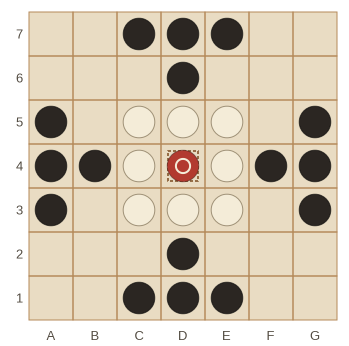
- King
- Defender
- Attacker
- Throne (central square)
The king stands on the central throne, surrounded by 8 defenders in a diamond shape. 16 attackers occupy the edge areas. White (defenders) moves first.
Pieces
| Piece | Side | Count | Special feature |
|---|---|---|---|
| King | Defenders | 1 | Armed (takes part in captures); moves only 1 square per move; only escaping piece |
| Defender | Defenders | 8 | Ordinary piece; moves only 1 square per move |
| Attacker | Attackers | 16 | Ordinary piece; moves only 1 square per move |
4. Objective
The defenders win when:
- the king reaches a corner square.
The attackers win when:
- they capture the king, or
- they enclose the defenders completely so that these have no access to the board edge any more.
5. Rules of play
5.1 Movement
All pieces – including the king – move orthogonally (horizontally or vertically), but exactly one square per move. A longer move is not allowed.
5.2 Capturing ordinary pieces
A piece is captured when it is flanked on two opposite sides (horizontally or vertically, not diagonally) by an enemy piece or an enemy restricted square.
5.3 Restricted squares
The empty throne (central square) counts as hostile to all pieces. The four corner squares count as hostile to all pieces. Both types of square can thus take the role of one of the two flanking sides when capturing.
5.4 Capturing the king
The king is armed and may take part in captures. He is captured when he is enclosed on all four sides (orthogonally) by enemy pieces or enemy squares. For the king the board edge additionally counts as hostile and can thus form one of the four enclosing sides.
5.5 Encirclement of the defenders
The attackers win if the defenders are completely surrounded and no longer have access to the board edge, regardless of whether the king has been captured.
5.6 Repetition of moves
If the same position occurs for the third time, the side whose move brought the repetition about loses.
5.7 Further cases
If a side can no longer make a legal move, it loses the game.
6. Good to know
- Legacy Ard Ri differs markedly from the other Legacy variants: here White moves first (instead of Black), the king is armed, and all pieces may move only one square per move instead of any distance – a noticeably different playing character.
- The name "Ard Ri" itself is modern and, in the sources consulted, not attested before Parlett (1999) (a missing attestation is not proof of non-existence) [Parlett1999]. Damian Walker (Cyningstan) expressly describes the documentary evidence for Ard Ri as "non-existent" [cyningstan-ardri].
7. Related variants
Legacy Brandubh also uses a 7×7 board, but with an unarmed king, Black's first move and moves of any distance (rook move) instead of the one-square movement range that applies here (own guide). To be distinguished from it is historically attested Brandub itself: an actually handed-down 7×7 variant with a historical name, unlike the name "Ard Ri" used here, which is attested only in modern times. Legacy Tablut adopts the same piece count as Legacy Ard Ri (king + 8 against 16), but implements it on a 9×9 board and uses the rook move instead of the one-square restriction.
8. Rules of play (original) with source reference
There is no external historical primary source for Legacy Ard Ri – the name itself is not historically attested. The following text is the complete rule set of the Fellhuhn app, reproduced unchanged (original in German):
Source: Rule description of the Fellhuhn app.
Notice of rights: This text originates from Fellhuhn (Philippe Schober). It is reproduced with the permission of the developer and is not covered by the CC BY 4.0 licence of this documentation; the rights remain with the authors.
- Weiß macht den ersten Zug
- Der König ist bewaffnet
- Ein Spieler verliert, wenn er keinen gültigen Zug tätigen kann
- Der König wird von vier feindlichen Figuren oder feindlichen Feldern geschlagen
- Der Rand des Spielfelds gilt als feindlich für den König
- Der leere Thron gilt als feindlich für alle Figuren
- Eckfelder gelten für alle als feindlich
- Figuren können nur ein Feld weit ziehen
- Der weiße Spieler gewinnt, wenn der König ein Eckfeld erreicht
- Der weiße Spieler hat verloren, wenn er komplett umstellt wird und keinen Randzugang mehr hat
- Wenn beide Spieler den gleichen Zug jeweils dreimal wiederholen, führt dies zur Niederlage des Spielers, der damit angefangen hat
9. Sources
- [Fellhuhn-App] Fellhuhn (Philippe Schober): Hnefatafl (Android app, Google Play), rule description of the variant, used with the express permission of the developer. — https://play.google.com/store/apps/details?id=com.fellhuhn.hnefatafl&hl=de
- [Parlett1999] Parlett, David: The Oxford History of Board Games. Oxford University Press, 1999 (origin of the Ard Ri standard setup; cited without page number).
- [cyningstan-ardri] Walker, Damian: Ard Ri: Historic or Modern? (web article, Cyningstan). — http://tafl.cyningstan.com/post/663/ard-ri-historic-or-modern (notes that documentary evidence for Ard Ri is lacking; name not before 1999)
10. State of the evidence and classification
For Legacy Ard Ri there is no external or historical source; it is an independent implementation of the Fellhuhn app. In addition, the name "Ard Ri" itself is modern and, in the sources consulted, not attested before Parlett (1999) (a missing attestation is not proof of non-existence) [cyningstan-ardri; Parlett1999]; no archaeological find linking a 7×7 board with this name or precisely this setup is known. The existence of small (7×7) tafl boards in Scotland is stated here without a source reference. The piece ratio (king + 8 against 16) is taken from the Parlett convention and is not historically secure.