Magpie
A modern 7×7 variant designed by Nigel Suckling (from *The Leprechaun Companion*), with a thematic story – a leprechaun rescues a sack of gold – and a strong but slow king who may move only one square per move.
Short description: A modern 7×7 variant designed by Nigel Suckling (from The Leprechaun Companion), with a thematic story – a leprechaun rescues a sack of gold – and a strong but slow king who may move only one square per move.
1. Basic data
| Name | Magpie (Magpie Brandub layout) |
|---|---|
| Game family | Hnefatafl (Nordic tafl game) |
| Category | Modern design variant |
| Origin / author | Nigel Suckling, The Leprechaun Companion |
| Dating | Modern (20th/21st century) |
| Board size | 7×7 squares |
| Throne | Yes, central square |
| Escape goal | Corner square |
| King | Armed, "strong" (captured on 4 sides), but moves only 1 square per move |
| Piece ratio | 4 defenders + king against 8 attackers (1:2) |
2. History and origin
Magpie goes back to Nigel Suckling's book The Leprechaun Companion, which combines this setup and rule layout with a story of its own: the king embodies a leprechaun rescuing a heavy sack of gold, the defenders are his companions, the attackers thieves. This theme explains the central peculiarity of the variant – the king is "strong" (captured on four sides and allowed to take part in captures), but limited by the heavy gold to a move of only one square.
Damian Walker (Cyningstan) describes Magpie as "probably the most attractive" layout for thirteen pieces [cyningstan-magpie]. It is a modern design, not a historical reconstruction.
3. Starting setup and pieces
Legend: K = king · D = defender · A = attacker · x = restricted square (corner) · . = empty square.
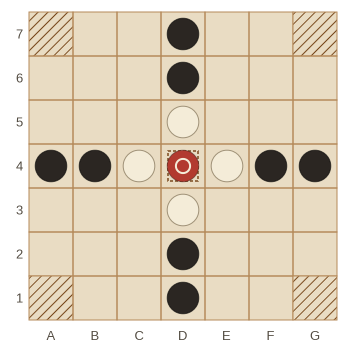
- King
- Defender
- Attacker
- Throne (central square)
- Restricted square (corner)
The king (thematically the leprechaun with the sack of gold) stands on the central throne, surrounded by 4 defenders (companions) in a cross shape. 8 attackers (thieves) stand in pairs at the four side centres of the edge. The attackers move first.
Pieces
| Piece | Side | Count | Special feature |
|---|---|---|---|
| King (leprechaun) | Defenders | 1 | Armed, "strong" (captured on 4 sides); moves only 1 square per move (heavy gold); only escaping piece |
| Defender (companions) | Defenders | 4 | Ordinary piece |
| Attacker (thieves) | Attackers | 8 | Ordinary piece |
4. Objective
The defenders win when:
- the king reaches a corner square.
The attackers win when:
- they capture the king.
5. Rules of play
5.1 Movement
Defenders and attackers move orthogonally (horizontally or vertically) any distance over empty squares. The king, by contrast, may move exactly one square per move. Jumping over other pieces is not allowed for any piece.
5.2 Capturing ordinary pieces
A piece (except the king) is captured when it is flanked on two opposite sides (horizontally or vertically, not diagonally) by an enemy piece or an enemy restricted square.
5.3 Restricted squares
Restricted squares are the throne (central square) and the four corner squares; only the king may enter them. The empty throne counts as hostile to all pieces, the corner squares count as hostile to all pieces and can thus take the role of one of the two flanking sides when capturing.
5.4 Capturing the king
The king is strong: he is captured when surrounded on all four orthogonal sides by hostile pieces or squares. The board edge also counts as hostile to the king. He may participate in captures, but his movement remains limited to one square at a time.
5.5 Repetition of moves
If the same position occurs for the third time, the side whose move brought the repetition about loses.
5.6 Further cases
If a side can no longer make a legal move, it loses the game.
6. Good to know
- The characteristic restriction "king only 1 square per move" is thematically justified (heavy gold) and makes Magpie markedly slower for the defenders in terms of play than comparable 7×7 variants with a freely moving king.
- The primary source (Suckling/Cyningstan) mainly describes layout and king character (strong, but slow); detailed rules on the hostility of board edge, throne and corners are not expressly specified there and are, in the present version, a matter of the respective implementation.
7. Related variants
Magpie shares the starting layout (7×7, 4 defenders + king against 8 attackers) with the other Brandubh-like variants of this series of guides such as Federation Brandubh, which, in contrast to Magpie, have a faster-moving (rook-move) king, but differs from them through the king's move limited to one square and the thematic framework (leprechaun and sack of gold), which does not occur in this form in any other variant in this series. Legacy Ard Ri uses a markedly denser starting setup on the same 7×7 board (king + 8 defenders against 16 attackers).
8. Rules of play (original) with source reference
There is no verbatim quotable, complete original rule source – the primary source (Suckling, The Leprechaun Companion) is not available as quotable full text, but only in summarised form via Cyningstan. The following text is therefore the complete rule set of the Fellhuhn app, reproduced unchanged (original in German):
Source: Rule description of the Fellhuhn app, based on the Magpie layout after Nigel Suckling as summarised by Damian Walker (Cyningstan).
Notice of rights: This text originates from Fellhuhn (Philippe Schober). It is reproduced with the permission of the developer and is not covered by the CC BY 4.0 licence of this documentation; the rights remain with the authors.
- Schwarz macht den ersten Zug
- Der König ist bewaffnet
- Ein Spieler verliert, wenn er keinen gültigen Zug hat
- Der König wird von vier feindlichen Figuren oder Feldern geschlagen
- Der Rand des Spielfelds gilt als feindlich für den König
- Der leere Thron gilt als feindlich für alle Figuren
- Eckfelder gelten für alle als feindlich
- Der König kann nur ein Feld weit ziehen
- Weiß gewinnt, wenn der König ein Eckfeld erreicht
- Dreifache Zugwiederholung → Niederlage des Verursachers
9. Sources
- [Fellhuhn-App] Fellhuhn (Philippe Schober): Hnefatafl (Android app, Google Play), rule description of the variant, used with the express permission of the developer. — https://play.google.com/store/apps/details?id=com.fellhuhn.hnefatafl&hl=de
- [cyningstan-magpie] Walker, Damian: Magpie / Magpie Brandub Layout (after Nigel Suckling, The Leprechaun Companion). — http://tafl.cyningstan.com/page/238/other-board-layouts ; Print-and-play: http://tafl.cyningstan.com/download/867/magpie-print-and-play ; Leaflet: http://tafl.cyningstan.com/download/968/magpie-leaflet
- [Suckling] Suckling, Nigel: The Leprechaun Companion (origin of the Magpie layout and theme).
10. State of the evidence and classification
Magpie goes back to Nigel Suckling's The Leprechaun Companion and is described by Damian Walker (Cyningstan) as probably the most attractive layout for thirteen pieces on the small board [cyningstan-magpie]; no information on adoption by tournaments or commercial sets is available. It is not a historical reconstruction but a modern design with a clearly named originator. The implementation of the Fellhuhn app adds detailed rules (hostility of edge, throne and corners) that the primary source does not expressly specify; these additions are stipulations of the Fellhuhn app and are marked accordingly in section 6.