Odin 11×11
Sibling variant of Tyr, designed by Luk Martens ("MasterLuke", Belgium) on the basis of Tyr. Takes over the berserker rule and commanders from Berserk Hnefatafl and additionally adds Variegated Men. Weak, armed king, edge escape, no restricted squares, scattered starting setup.
Short description: Sibling variant of Tyr, designed by Luk Martens ("MasterLuke", Belgium) on the basis of Tyr. Takes over the berserker rule and commanders from Berserk Hnefatafl and additionally adds Variegated Men. Weak, armed king, edge escape, no restricted squares, scattered starting setup.
Evidence status: Modern new design (Luk Martens), no historical evidence. The special pieces (commanders with a jump, Variegated Men) are a reproduction in tafl of the modern model; the sibling variants Thor and Loki are not implemented.
1. Basic data
| Name | Odin 11×11 (sibling variant of the base variant Tyr) |
|---|---|
| Game family | Hnefatafl (Nordic tafl game), Tyr family |
| Category | Modern new design (date of publication not attested, no historical evidence) |
| Origin / author | Luk Martens ("MasterLuke", Belgium); published via Aage Nielsen's website |
| Dating | Date of publication not attested |
| Board size | 11×11 squares |
| Throne / restricted squares | None (as in Simple Tafl / Sea Battle) |
| Escape goal | Edge of the board (edge escape) |
| King | Armed, but weak – is already captured from 2 sides |
| Piece ratio | 12 defenders + king against 24 attackers (1:2) |
2. History and origin
Odin is one of three sibling variants that build on one another (Thor, Odin, Loki), which the Belgian game designer Luk Martens ("MasterLuke") designed on the common basis of Tyr. From Berserk Hnefatafl, Odin takes over the berserker rule (a piece may continue moving after a capture as long as it keeps capturing) as well as the commanders, and additionally adds Variegated Men ("Variegated"). The rules were published via Aage Nielsen's website.
The base variant Tyr itself (without special pieces) is covered in its own rules guides for Tyr 11×11 and Tyr 15×15. Odin additionally exists in a larger 15×15 version (see the rules page).
3. Starting setup and pieces
Legend: K = king · D = defender · A = attacker · B = commander (defender) · C = commander (attacker) · N = Variegated Man (defender) · V = Variegated Man (attacker) · . = empty square.
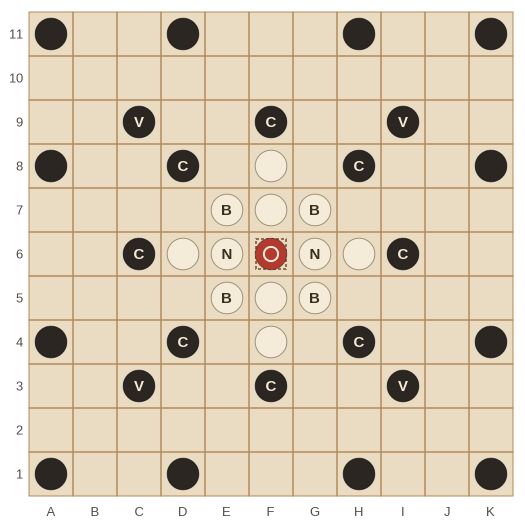
- King
- Defender
- Attacker
- B
- C
- N
- V
- Throne (central square)
Unlike the classic siege setup with a central throne, king and defenders here stand scattered across the board (battlefield theme instead of siege); the attackers, twice as numerous, surround them. There is no throne and no other restricted squares. The attackers move first.
Not attested (state of review 2026-07-09): - Thor and Loki: For these two sibling variants there is neither a rules guide nor a starting setup – from the Nielsen overview only the piece equipment is known (Thor: commanders with a jump also over own pieces; Loki: commanders + Variegated Men + guards). Both are therefore not set up as their own rules guides and not implemented in the engine. - 17×17 board: For none of the four variants (Tyr/Thor/Odin/Loki) is there any information or setup for the 17×17 board. - These gaps are deliberately documented openly here; there is no speculation. See also section 10.
Pieces
| Piece | Side | Count | Special feature |
|---|---|---|---|
| King | Defender | 1 | Armed (takes part in captures); weak – is already captured from 2 sides; only escaping piece; may end a berserker run with his escape to the edge |
| Defender | Defender | 6 | Ordinary piece |
| Commander | Defender | 4 | May additionally perform a short orthogonal jump over an ordinary opposing piece onto a free square; captures in doing so only if he wedges the jumped piece between himself and a piece of his own; may not jump over the king or other commanders |
| Variegated Man | Defender | 2 | Is not removed from the board when flanked, but changes sides; can be turned over several times in the course of the game |
| Attacker | Attacker | 12 | Ordinary piece |
| Commander | Attacker | 8 | As above |
| Variegated Man | Attacker | 4 | As above |
4. Objective
The defenders win when:
- the king reaches an edge square (also possible as the end of a berserker run).
The attackers win when:
- the king is captured – like any other piece, but from just two sides (weak king).
5. Rules of play
5.1 First move and movement
The attackers move first, and the players then take turns. All pieces move any distance horizontally or vertically through empty squares.
5.2 Capturing
All pieces – the king too – are captured when they end up orthogonally between two enemies. A capture only occurs if the active move closes the trap; moving voluntarily between two enemy pieces is safe. Multiple captures (two or three pieces at the same time) are possible. The king may help capture.
5.3 Berserker rule
After a capture, the same piece may continue moving as long as it keeps capturing; the king may also end such a berserker run by reaching the edge (and thus the defenders' victory). Detailed explanation with ASCII examples: the bundled program documentation.
5.4 No restricted squares
As in Simple Tafl or Sea Battle, there is no throne and there are no special corner squares.
5.5 Move repetition and no legal move
Continued repetition of positions is forbidden. In tafl, the side whose move brings about the same position for the third time loses. If the side to move has no legal move, the game ends in a draw. This is a stipulation of tafl; the source says nothing on the point.
5.6 Commander jump
Commanders may additionally perform a short orthogonal jump over an ordinary opposing piece onto a free square directly behind it; in doing so they capture only if they wedge the jumped opponent between themselves and a stone of their own. Jumping over the king or other commanders is not allowed. Detailed explanation with ASCII examples: the bundled program documentation, section 3.
5.7 Variegated Men / "Variegated"
If a Variegated Man is flanked, it is not removed from the board but changes sides – from then on it plays for the former opponent. This change of sides can happen several times in the further course of the game. Detailed explanation with ASCII examples: the bundled program documentation, section 5.
6. Good to know
- The available rule source by Luk Martens documents Tyr and Odin in detail. Thor (commanders with a jump over own pieces) and Loki (additional guards), on the other hand, are only named briefly on Nielsen's overview page, without detailed rules or setups – see the side note in section 3.
- Martens designed Thor, Odin and Loki because he found the large Hnefatafl variants – such as Alea Evangelii – too slow; the scattered starting setup (battlefield instead of siege) and the additional special mechanics were meant to counteract this.
7. Related variants
Odin builds on the base variant Tyr (see the own rules guides for Tyr 11×11 and Tyr 15×15) and additionally exists in a larger 15×15 version (see the rules page). From Berserk Hnefatafl, Odin takes over the berserker rule and the commanders; Berserk Hnefatafl itself, however, relies on a strong king (captured from 4 sides), corner escape, restricted squares (throne and corners) and an additional knight instead of Variegated Men. Odin also shares the absence of restricted squares and the edge escape with Simple Tafl and Sea Battle Tafl. Thor (precursor, commanders only) and Loki (additionally guards) are related by name, but not documented as their own rules guides for lack of sources (see section 10).
8. Rules of play (original) with source reference
For Odin there is no rule set of the Fellhuhn app. The external primary source is Luk Martens' rules PDF (Rules 'Tyr' Variant and Extra Pieces/Rules 'Odin' Variant); its wording is not available in full text, however, only as a paraphrased summary with rule-number references. An authentic, verbatim original text therefore cannot be reproduced at this point without inventing it – see section 10 for the complete classification. The rules in section 5 follow this paraphrase in content.
Source (paraphrased, not verbatim): Martens, Luk ("MasterLuke"): Rules 'Tyr' Variant and Extra Pieces/Rules 'Odin' Variant. https://aagenielsen.dk/tyr_odin_rules.pdf — as well as Nielsen, Aage: Hnefatafl Rules (overview), section "Tyr, Thor, Odin and Loki Hnefatafl". https://aagenielsen.dk/tafl_rules.php
Own summary after Martens, Luk ("MasterLuke"): Rules 'Tyr' Variant, Extra Pieces/Rules 'Odin' Variant and Nielsen, Aage: Hnefatafl Rules (overview), not the original text.
9. Sources
- [Martens-tyr] / [Martens-odin] Martens, Luk ("MasterLuke"): Rules 'Tyr' Variant and Extra Pieces/Rules 'Odin' Variant (Tyr–Odin Tafl game variants). — https://aagenielsen.dk/tyr_odin_rules.pdf
- [Nielsen-rules] Nielsen, Aage: Hnefatafl Rules (overview), section "Tyr, Thor, Odin and Loki Hnefatafl". — https://aagenielsen.dk/tafl_rules.php
10. State of the evidence and classification
Modern variant without historical evidence, designed by Luk Martens. The external primary source [Martens-tyr]/[Martens-odin] is available only as a paraphrased summary with rule-number references, not as a full-text quotation; section 8 documents this gap honestly instead of inventing an original text.
In addition, the following documented knowledge gaps exist, which are deliberately kept open:
- Thor and Loki are only mentioned by name on the Nielsen overview page, without detailed rules or starting setups – hence no rules guides of their own and no engine implementation.
- For the 17×17 board there is no information or setup for any of the four variants (Tyr, Thor, Odin, Loki).
- The exact movement and capture rules of the guards (Loki only) are not spelled out in the available sources.
These gaps are deliberately documented openly here and not resolved by speculation.