Sea Battle Tafl 9×9
Modern 9×9 variant (also "Longship Tafl"), proposed by Adam Bartley (2011), with the 9×9 reference setup documented by Aage Nielsen and, according to Nielsen, particularly balanced, themed as a sea battle: instead of a king, an unarmed cargo ship must reach the edge of the board. Features: no restricted squares, diamond setup of the defenders, additional encirclement rule for the attackers.
Short description: Modern 9×9 variant (also "Longship Tafl"), proposed by Adam Bartley (2011), with the 9×9 reference setup documented by Aage Nielsen and, according to Nielsen, particularly balanced, themed as a sea battle: instead of a king, an unarmed cargo ship must reach the edge of the board. Features: no restricted squares, diamond setup of the defenders, additional encirclement rule for the attackers.
1. Basic data
| Name | Sea Battle Tafl 9×9 (also "Longship Tafl") |
|---|---|
| Game family | Hnefatafl (Nordic tafl game) |
| Category | Modern (new design, 2011) |
| Origin / authors | Proposed by Adam Bartley (Norway, September 2011; English rule text); 9×9 reference setup documented by Aage Nielsen (Denmark); according to the sources an adaptation of a Tablut game by BrainKing |
| Dating | September 2011 (presented publicly in 2012 at the exhibition "Vikinger i Krig", Midgard, Borre) |
| Board size | 9×9 squares (reference size of this document); the same basic idea also exists on 11×11, 13×13 and 15×15 |
| Restricted squares | None; the central square has no special function |
| Escape goal | Edge of the board (edge escape) |
| Escape piece | Cargo ship, unarmed (does not capture); captured on 4 sides |
| Piece ratio | 8 defenders + cargo ship against 16 attackers (1:2) |
2. History and origin
Adam Bartley proposed this variant in September 2011 (according to the sources as an adaptation of a "Tablut" game by BrainKing); the 9×9 reference setup was documented by Aage Nielsen and published via his website, and the English rule text is by Bartley. The game was presented publicly in 2012 at the exhibition "Vikinger i Krig" at the Viking museum Midgard in Borre, Norway. Thematically the variant is designed as a sea battle: instead of a king, an unarmed cargo ship, accompanied by 8 defending longships, must reach the edge of the board while 16 attacking pirate longships try to intercept it.
Nielsen describes the 9×9 version as particularly balanced; larger versions on 11×11 are said, according to him, to give the attackers too much of an advantage. As early as 1855, the commercial product "Imperial Contest" with a similar basic idea (unarmed escape piece instead of a king) was sold on the same board format (see separate document).
3. Starting setup and pieces
Legend: K = cargo ship · D = defender (longship) · A = attacker (pirate longship) · . = empty square.
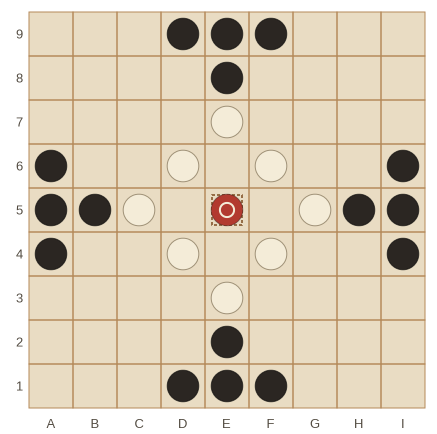
- King
- Defender
- Attacker
- Throne (central square)
The cargo ship stands in the centre. The 8 defending longships stand – unlike in the other 9×9 variants of this documentation – in a diamond formation around the centre, not in a cross shape. 16 attacking pirate longships stand in four groups at the midpoints of the sides of the edge.
On the order of play, the sources contradict each other: Nielsen's own rules page generally names the attackers as the side to begin, while the Cyningstan version states for the 9×9 game that the defender moves first. Which statement applies to the 9×9 reference version cannot be settled conclusively from the sources available (see section 10).
Pieces
| Piece | Side | Count | Special feature |
|---|---|---|---|
| Cargo ship | Defenders | 1 | Unarmed (does not capture); the only escape piece; captured on 4 sides |
| Longship (defender) | Defenders | 8 | Ordinary piece |
| Pirate longship (attacker) | Attackers | 16 | Ordinary piece |
4. Objective
The defenders win when:
- the cargo ship reaches a square on the board edge.
The attackers win when:
- the cargo ship is captured on all four sides, or
- all remaining defenders together with the cargo ship are completely encircled (encirclement rule).
5. Rules of play
5.1 Movement
All pieces move orthogonally any distance over empty squares; diagonal moves and jumping over other pieces are not allowed. Since there are no restricted squares, any piece may enter and pass through the central square.
5.2 Capturing ordinary pieces
A piece is captured when it is flanked on two opposite sides by two enemy pieces, provided the trap arises through the active move of the flanking side. Moving voluntarily between two enemy pieces is safe.
5.3 The cargo ship does not capture
The cargo ship is unarmed and cannot act as a partner when capturing another piece.
5.4 Capture of the cargo ship
The cargo ship is captured when it is enclosed from all four cardinal directions.
5.5 Encirclement rule
If the cargo ship and all remaining defenders are completely enclosed together, the attackers win, even if the cargo ship itself was not captured in the narrower sense. Details: the bundled program documentation.
5.6 Move repetition
If the same position occurs for the third time, the defenders lose.
5.7 Other cases
If a side can no longer make a legal move, it loses the game. If a position can no longer be decided through normal play because too few pieces remain, the game ends in a draw.
6. Good to know
- Alongside Market Hnefatafl, Sea Battle Tafl is one of the few tafl variants entirely without a throne or other restricted squares.
- The diamond formation of the defenders visually distinguishes this variant from the cross formation otherwise usual for 9×9 games.
- The variant can also be played on 11×11, 13×13 and 15×15; these larger versions are listed in this documentation as variants of their own. According to Nielsen, the 9×9 version is the most balanced size.
- Historical footnote: as early as 1855, Jaques of London sold, with "Imperial Contest", a commercial 9×9 product with a very similar basic idea (unarmed escape piece instead of a king; see separate document).
7. Related variants
The larger versions on 11×11 and 13×13 (Sea Battle 11×11 (Seeschlacht) and Sea Battle 13×13 (Seeschlacht)) follow the same basic idea; the 9×9 version is regarded as Nielsen's reference canon. "Imperial Contest" (1855) is an independently arisen early commercial form of the same 9×9 game type; Sea Battle was proposed in 2011 by Adam Bartley and documented by Aage Nielsen [Nielsen-sea]; there is no derivation from one another (Cyningstan describes Sea Battle only as "similar" [cyningstan-sea]). "York Hnefatafl" likewise uses an unarmed escape piece, but on an 11×11 board with a throne and a corner-escape variant. "Market Hnefatafl" and Simple Tafl are likewise 9×9 versions without restricted squares, but there with an armed king and two-side capture.
8. Rules of play with source reference
For this variant there is neither a verbatim external original text nor a rule set of the Fellhuhn app. What exists is a German paraphrase, provided with rule numbers, of the rules pages by Nielsen and Cyningstan. The following section reproduces this paraphrase as close to the wording as possible (here in English translation of the German paraphrase).
Source (paraphrased): Nielsen, Aage; Bartley, Adam: Rules of Sea battle tafl (2011). — https://aagenielsen.dk/seabattle_rules.php; Walker, Damian: Sea Battle Tafl (Longship Tafl). — http://tafl.cyningstan.com/page/762/sea-battle-tafl
Own summary after Nielsen, Aage; Bartley, Adam: Rules of Sea battle tafl (2011), not the original text.
- Cargo ship in the centre, 8 defending longships in diamond formation, 16 attacking pirate longships at the edges. (Rule 1)
- On the order of play the two sources contradict each other (see sections 3 and 10). (Rule 2)
- All pieces move orthogonally, any distance; no landing on and no jumping over other pieces. Since there are no restricted squares, any piece may enter and pass through the central square. (Rule 3)
- Ordinary pieces are captured by flanking on two opposite sides, only if the trap is closed by the active move. Moving voluntarily between two enemies is safe. (Rule 4)
- The unarmed cargo ship cannot help with capturing. (Rule 4)
- Capture of the cargo ship by enclosure from all four cardinal directions. (Rule 6a)
- If the cargo ship and all remaining defenders are enclosed, the attackers win. (Rule 6b)
- Perpetual repetition is forbidden and leads to a loss for the defenders. (Rule 7)
- Whoever cannot move loses; a position that cannot be ended results in a draw. (Rules 8–9)
9. Sources
- [Nielsen-sea] Nielsen, Aage; Bartley, Adam: Rules of Sea battle tafl (2011). — https://aagenielsen.dk/seabattle_rules.php
- [cyningstan-sea] Walker, Damian: Sea Battle Tafl (Longship Tafl). — http://tafl.cyningstan.com/page/762/sea-battle-tafl
10. State of the evidence and classification
This is a modern variant without historical evidence (proposed in 2011 by Adam Bartley, 9×9 reference setup documented by Aage Nielsen); the 9×9 version is Nielsen's canon and is described by him as particularly balanced. One discrepancy between the two sources remains unresolved: Nielsen's own rules page generally names the attackers as the side to begin, while the Cyningstan version names the defender as the side to begin for the specific 9×9 game. This documentation makes no determination of its own on this but documents the contradiction openly (see section 3). For neither the Nielsen nor the Cyningstan text is a verbatim quotation available, only a German paraphrase with rule numbers; section 8 is marked accordingly.