Sea Battle 13×13 (Seeschlacht)
A larger-board version of Sea Battle Tafl (Adam Bartley / Aage Nielsen, 2011), with an unarmed cargo ship captured on four sides, edge escape and no restricted squares. It has no canonical reference setup of its own. The repetition rule deliberately deviates from the external source (see section 6).
Short description: A larger-board version of Sea Battle Tafl (Adam Bartley / Aage Nielsen, 2011), with an unarmed cargo ship captured on four sides, edge escape and no restricted squares. It has no canonical reference setup of its own. The repetition rule deliberately deviates from the external source (see section 6).
1. Basic data
| Name | Sea Battle 13×13 (Seeschlacht) |
|---|---|
| Game family | Hnefatafl (Nordic tafl game) |
| Category | Modern board-size extension of the Sea Battle principle (no historical evidence) |
| Origin / author | Sea Battle principle: Adam Bartley (Norway, 2011); published via Aage Nielsen (Denmark) |
| Dating | Sea Battle basic principle: 2011 |
| Board size | 13×13 squares |
| Throne | No – no restricted squares |
| Escape goal | Edge of the board (edge escape) |
| King ("cargo ship") | Unarmed; captured on 4 sides |
| Piece ratio | 16 defenders + king against 32 attackers (1:2) |
2. History and origin
Sea Battle 13×13 (Seeschlacht) is a board-size extension of Sea Battle Tafl, which Adam Bartley (Norway) proposed in September 2011 and which was published via Aage Nielsen's website (see Sea Battle 11×11 (Seeschlacht) for the history of the basic principle). Nielsen's overview page names 9×9, 11×11, 13×13 and 15×15 as possible board sizes for Sea Battle. A canonical starting setup documented specifically for 13×13 ("Nielsen setup") does not exist, however – such reference setups are stored by Nielsen only for 9×9 and 11×11. The 13×13 setup shown here is thus a board-size extension without an external reference source of its own.
3. Starting setup and pieces
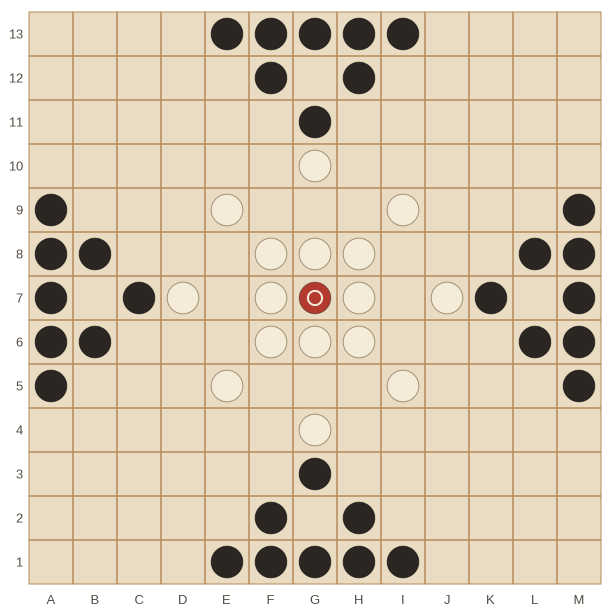
Legend: K = king (cargo ship) · D = defender · A = attacker · . = empty square.
- King
- Defender
- Attacker
- Throne (central square)
The cargo ship stands in the centre, the 16 defenders in a loosened diamond around it, the 32 attackers in staggered groups along the four sides. There is no throne and there are no other restricted squares. The attackers move first.
Note: This setup is a size extension without a canonical external reference setup (see section 2).
Pieces
| Piece | Side | Count | Special feature |
|---|---|---|---|
| King (cargo ship) | Defenders | 1 | Unarmed (does not take part in captures); captured on 4 sides; the only escape piece |
| Defender | Defenders | 16 | Ordinary piece |
| Attacker | Attackers | 32 | Ordinary piece |
No special pieces; no restricted squares (no throne, no special corner squares).
4. Objective
The defenders win when:
- the cargo ship (the king) reaches the board edge.
The attackers win when:
- they enclose the cargo ship on all four sides (capture), or
- they enclose the cargo ship and all remaining defenders with a closed ring (encirclement; details: the bundled program documentation).
5. Rules of play
5.1 Movement
All pieces move orthogonally (horizontally or vertically) any distance over empty squares. Jumping over or passing other pieces is not allowed.
5.2 Capturing ordinary pieces
An ordinary piece is captured when two opposing pieces flank it on opposite sides as a result of their side's move. Moving voluntarily between two opposing pieces does not result in capture.
5.3 The cargo ship (king)
The cargo ship may not help capture. It is itself captured when it is enclosed on all four sides (orthogonally) by attackers.
5.4 Restricted squares
There are no restricted squares: neither the central square nor the corners have any special status.
5.5 Move repetition
If the same position occurs for the third time, the side whose move brought the repetition about loses.
5.6 Other cases
If a side can no longer make a legal move, it loses the game. If a game can no longer be decided through normal play, it ends in a draw.
6. Good to know
- Unlike 9×9 and 11×11, for the 13×13 version there is no specifically documented, canonical starting setup at Nielsen; the setup shown in section 3 is a board-size extension without an external reference source of its own.
- For move repetition, this software deviates slightly from the original: instead of "perpetual repetition forbidden, loss for the defenders" it uses a fixed rule on the third occurrence of the same position; the side whose move brings it about loses.
7. Related variants
Sea Battle 13×13 (Seeschlacht) is the larger board variant of Sea Battle 11×11 (Seeschlacht) (see there for the history of the Sea Battle principle by Adam Bartley, 2011). Both follow the same rule set; only board size and piece count differ. Like Sea Battle 11×11 (Seeschlacht), this size also belongs, according to Nielsen's classification, to the group of games with an unarmed king ("Unarmed King").
8. Rules of play (rule set of the Fellhuhn app) with source reference
For Sea Battle 13×13 (Seeschlacht) there is no verbatim quotation of the external original source – the source is available only as a paraphrase with rule-number references, and for 13×13 there is in any case no reference setup documented as a "Nielsen setup". The following list instead reproduces the rule set of the Fellhuhn app. It largely agrees in content with the general Sea Battle rule set (only deviation: move repetition, see section 6) and is openly labelled here as the rule set of the Fellhuhn app, not as a verbatim external original text. (Original in German.)
Source: rule description of the Fellhuhn app, compared in content with Nielsen, Aage / Bartley, Adam: Rules of Sea battle tafl. https://aagenielsen.dk/seabattle_rules.php
Notice of rights: This text originates from Fellhuhn (Philippe Schober). It is reproduced with the permission of the developer and is not covered by the CC BY 4.0 licence of this documentation; the rights remain with the authors.
- Schwarz macht den ersten Zug.
- Der König ist unbewaffnet.
- Ein Spieler verliert, wenn er keinen gültigen Zug hat.
- Der König wird von vier feindlichen Figuren oder Feldern geschlagen.
- Weiß gewinnt, wenn der König den Rand erreicht.
- Weiß verliert bei vollständiger Umstellung.
- Dreifache Zugwiederholung führt zur Niederlage des Verursachers.
9. Sources
- [Fellhuhn-App] Fellhuhn (Philippe Schober): Hnefatafl (Android app, Google Play), rule description of the variant, used with the express permission of the developer. — https://play.google.com/store/apps/details?id=com.fellhuhn.hnefatafl&hl=de
- [Nielsen-seabattle] Nielsen, Aage / Bartley, Adam: Rules of Sea battle tafl. — https://aagenielsen.dk/seabattle_rules.php (names 9×9, 11×11, 13×13, 15×15 as board sizes)
- [Nielsen-rules] Nielsen, Aage: Hnefatafl Rules (overview; reference setups "Nielsen setup" only for 9×9 and 11×11). — https://aagenielsen.dk/tafl_rules.php
10. State of the evidence and classification
Modern board-size extension without historical evidence. The external primary source [Nielsen-seabattle] is reachable but is not available as a verbatim quotation. In addition, for 13×13 – unlike for 9×9/11×11 – a canonical reference setup at Nielsen is missing; the setup shown in section 3 is therefore marked as a size extension without an external model of its own. Section 8 openly documents the rule set of the Fellhuhn app instead of an external original wording.