Foteviken Tablut
A 9×9 version from the Foteviken Viking Museum (Sweden), reconstructed in 1972 from Linné's account of Sámi Tablut. Attackers cannot re-enter their "base camps", and no piece may move across the empty throne.
Short description: A 9×9 version from the Foteviken Viking Museum (Sweden), reconstructed in 1972 from Linné's account of Sámi Tablut. Attackers cannot re-enter their "base camps", and no piece may move across the empty throne.
1. Basic data
| Name | Foteviken Tablut |
|---|---|
| Game family | Hnefatafl (Nordic tafl game) |
| Category | Modern reconstructed museum rule set, based on historical Tablut |
| Origin / author | Fotevikens Museum, Sweden; reconstruction based on a Swedish travelling exhibition of 1972 |
| Dating | Reconstruction modern (museum version); underlying game: Sámi Tablut (Linné, 1732) |
| Board size | 9×9 squares |
| Throne ("The Castle") | Yes, central square; when empty it completely blocks every movement across the square |
| Escape goal | Edge of the playing field (edge escape) |
| King | Armed; capture from 4 sides (3 next to the throne, in part 2 next to a two-part base camp corner) |
| Piece ratio | 8 defenders + king against 16 attackers (1:2) |
2. History and origin
Fotevikens Museum in Sweden developed this rule set as a museum-educational reconstruction of Sámi Tablut. According to the account of Sten Helmfrid, the rules go back to a Swedish travelling exhibition (Riksutställningar) of 1972 that tried to reconstruct the game directly from Linné's Latin original diary. Aage Nielsen translated the museum's rules into English and thereby made them accessible to an international audience.
Characteristic of the Foteviken version are additions that do not occur in Linné's original (the ban on the king returning goes back to rule 11 of the rules of Fotevikens Museum and is a modern museum reconstruction, not a historically attested Linné rule; the Linné version of tafl allows the return): the division of the attackers' starting squares into fixed "base camps" as well as a stricter throne rule under which an empty throne is impassable not only for the king but for every piece.
3. Starting setup and pieces
Legend: K = king · D = defender (soldiers) · A = attacker (Muscovites) · . = empty square.
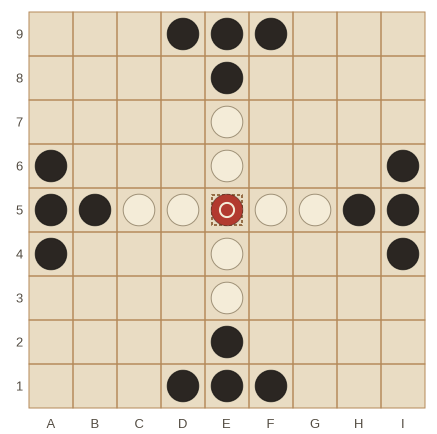
- King
- Defender
- Attacker
- Throne (central square)
The king stands on the central throne ("Castle"), surrounded by 8 soldiers in a cross shape. The 16 Muscovites stand four each in four T-shaped base camps at the middles of the edges. White (the defenders) moves first.
Pieces
| Piece | Side | Count | Special feature |
|---|---|---|---|
| King | Defenders | 1 | Armed; the only escape piece; cannot return after leaving the throne |
| Defender (soldiers) | Defenders | 8 | Ordinary piece |
| Attacker (Muscovites) | Attackers | 16 | Starts in one of the four base camps; a vacated camp square may no longer be entered by anyone |
4. Objective
The defenders win when:
- the king finds a free path to the board edge and reaches it.
The attackers win when:
- the king is surrounded on four sides (see section 5.3).
5. Rules of play
5.1 Movement
All pieces move orthogonally any distance over empty squares; diagonal moves and jumping over other pieces are not allowed.
5.2 Capturing ordinary pieces
A piece is captured when it is flanked on two opposite sides by enemy pieces. Moving voluntarily between two opposing pieces is safe; a capture occurs only when a player completes the enclosure with their own move.
5.3 Capturing the king
The king is captured from four sides. If he stands directly next to the throne, three Muscovites on the remaining sides suffice, since the throne acts as the fourth, hostile side. If he stands next to a base camp with two camp squares adjacent to him, two Muscovites may suffice for the capture, since the camp squares also act as hostile in this position.
5.4 The throne ("Castle")
Only the king may enter the throne. If he leaves it, he can no longer return to it – the vacated castle henceforth counts as a hostile square for the king. As long as the throne is empty, it also blocks every movement completely: no piece, of whichever side, may enter it or even pass through it.
5.5 Base camps
Each of the four side midpoints consists of a T-shaped base camp with four squares. A Muscovite may move within his camp and leave it, but a camp square once vacated may not subsequently be entered or passed through by anyone – neither by another Muscovite nor by a Swede. An empty camp square additionally counts as hostile to the king; for the defenders it does not. The base camps thus deliberately prevent the king from escaping to the edge through a cleared camp.
5.6 Repetition of moves
If the same position occurs for the third time, the side whose move brought the repetition about loses (see also section 8).
5.7 Further cases
If a side can no longer make a legal move, it loses the game.
6. Good to know
- The base camps are a modern addition by the museum without evidence in historical Tablut; they change the escape dynamics considerably, since the king cannot simply escape through an emptied attacker square.
- The stricter throne rule (empty throne blocks every movement completely, not only entering) likewise goes beyond Linné's original rules, which only describe the throne as a possible capture square.
7. Related variants
"Linnaeus Tablut" contains the underlying historical original source from which, according to the museum's account, the Foteviken rules were reconstructed in 1972. "Historical Tablut" is a different, independent reconstruction (by Nielsen) of the same original source. "Legacy Tablut" uses the same board but an entirely different rule scheme (corner escape, unarmed king). According to Aage Nielsen's classification, Foteviken Tablut with its armed king and edge escape basically belongs to the group of "weak king" games, but deviates through the four-sided capture from the two-sided capture rule otherwise typical of this group.
8. Rules of play (rule set of the Fellhuhn app) with source reference
A verbatim quoted block of the English original text of the Foteviken museum rules is not available, only a German paraphrase with rule-number quotations as well as the rule set of the Fellhuhn app implemented in tafl. The following section therefore reproduces the rule set of the Fellhuhn app unchanged; it is the only verbatim available rule list for this variant. Original in German.
Source: Rule description of the Fellhuhn app, based on Fotevikens Museum, Sweden: Reconstructed rules for Foteviken Tablut (English translation by Aage Nielsen).
Notice of rights: This text originates from Fellhuhn (Philippe Schober). It is reproduced with the permission of the developer and is not covered by the CC BY 4.0 licence of this documentation; the rights remain with the authors.
- Weiß macht den ersten Zug
- Der König ist bewaffnet
- Ein Spieler verliert, wenn er keinen gültigen Zug hat
- Basislager können nicht erneut betreten werden
- Basislager gelten als feindlich für den König
- Der König wird von vier feindlichen Figuren oder Feldern geschlagen
- Weiß gewinnt, wenn der König den Rand erreicht
- Der leere Thron blockiert sämtliche Bewegungen
- Der König kann nicht auf den Thron zurückkehren
- Weiß verliert bei vollständiger Umstellung ohne Randzugang
- Dreifache Zugwiederholung → Niederlage des Verursachers
9. Sources
- [Foteviken-rules] Fotevikens Museum, Sweden: Reconstructed rules for Foteviken Tablut (English translation by Aage Nielsen; Swedish original: https://www.fotevikensmuseum.se/d/vikingar/hur/spel/regler). — https://aagenielsen.dk/foteviken_rules_english.php
- [Helmfrid-context] Hnefatafl forum / Sten Helmfrid: derivation of the Foteviken rules from the Riksutställningar exhibition of 1972. — http://aagenielsen.dk/hnefataflforum/phpBB3/viewtopic.php?t=14
- [Fellhuhn-App] Fellhuhn (Philippe Schober): Hnefatafl (Android app, Google Play), rule description of the variant, used with the express permission of the developer. — https://play.google.com/store/apps/details?id=com.fellhuhn.hnefatafl&hl=de
10. State of the evidence & classification
For Foteviken Tablut there is an attested external source (the rule description of Fotevikens Museum, translated into English by Aage Nielsen) which, according to Sten Helmfrid, goes back to a Swedish travelling exhibition of 1972 that reconstructed Sámi Tablut directly from Linné's Latin original. This English original text is, however, not available verbatim, only a German paraphrase with references to numbered rules; section 8 of this document therefore relies on the rule set of the Fellhuhn app as the only verbatim available rule list. The base camps characteristic of this variant are a modern addition without historical evidence in the original Tablut.