Vingólf Hnefatafl
Developed by Vingólf – Haus der Freundschaft e. V. as a simpler 11×11 version of Copenhagen Hnefatafl, with the same starting setup but without shieldwall capture or exit fort victory. Rather than forming a complete Copenhagen-style ring, the attackers need only cut the king and defenders off from the board edge (escape-route cut-off victory, EdgeDisconnected).
Short description: Developed by Vingólf – Haus der Freundschaft e. V. as a simpler 11×11 version of Copenhagen Hnefatafl, with the same starting setup but without shieldwall capture or exit fort victory. Rather than forming a complete Copenhagen-style ring, the attackers need only cut the king and defenders off from the board edge (escape-route cut-off victory, EdgeDisconnected).
1. Basic data
| Name | Vingólf Hnefatafl |
|---|---|
| Game family | Hnefatafl (Nordic tafl game) |
| Category | Modern in-house development (no historical evidence) |
| Origin / authors | Vingólf – Haus der Freundschaft e. V. (https://www.haus-vingolf.de) |
| Dating | Modern, exact date not given |
| Board size | 11×11 squares |
| Throne | Yes, central king square |
| Escape goal | Corner square |
| King | Armed (takes part in captures); captured on 4 sides (3 sides on the edge or next to the throne) |
| Piece ratio | 12 defenders + king against 24 attackers (1:2) |
2. History and origin
Vingólf Hnefatafl is an in-house development of the club Vingólf – Haus der Freundschaft e. V. The club itself describes its rule set as derived from the rules of Linné's Tablut, though starting from a faulty translation. A plausible explanation is the first English translation by James Edward Smith (1811, Lachesis Lapponica), which wrongly renders a central rule of Linné and thereby makes the king more robust than the Latin original provides (see "Historical note on Linné's Tablut", section 6 there) – the exact connection between this known translation error and the concrete Vingólf rules is, however, not further documented and is not asserted here, but only named as a plausible background.
Starting setup, board size and piece count of Vingólf Hnefatafl are identical to those of Copenhagen Hnefatafl. Compared to Copenhagen, Vingólf dispenses with the shieldwall capture and the exit fort. An encirclement victory, by contrast, still exists, though not in Copenhagen's form (complete attacker ring away from the edge): it is already enough to cut the king and defenders off completely from the board edge (see section 4). Vingólf can thus still be understood as Copenhagen's simpler variant intended for getting started.
3. Starting setup and pieces
Legend: K = king · D = defender · A = attacker · . = empty square.
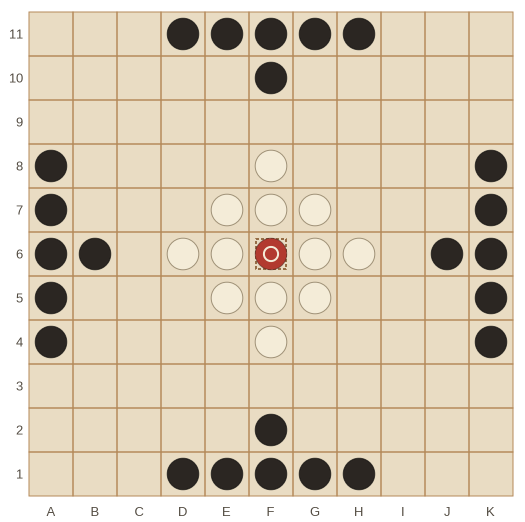
- King
- Defender
- Attacker
- Throne (central square)
The king stands on the central throne, surrounded by 12 defenders ("knights") in a cross shape. 24 attackers stand in four groups at the midpoints of the edges, depicted as four attacking ships. The attackers move first.
Pieces
| Piece | Side | Number | Special feature |
|---|---|---|---|
| King | Defenders | 1 | Armed (takes part in captures); only escape piece |
| Defender ("knight") | Defenders | 12 | Ordinary piece |
| Attacker | Attackers | 24 | Ordinary piece |
4. Objective
The defenders win when:
- the king safely reaches one of the four corner squares.
The attackers win when:
- they capture the king by surrounding him, or
- they cut off all escape routes to the board edge for the king and all remaining defenders (escape-route cut-off victory – no complete attacker ring as in Copenhagen required, see the bundled program documentation).
5. Rules of play
5.1 Movement
All pieces – including the king – move orthogonally (horizontally or vertically) any distance over empty squares. Pieces may not jump over other pieces.
5.2 Capturing ordinary pieces
A piece is captured when it is flanked on two opposite sides (horizontally or vertically) by an enemy piece. A capture only occurs if the flanking side actively creates the trap with its own move – if a piece moves voluntarily between two opposing pieces already facing each other, it remains unharmed. The king may take part in captures, but cannot himself be captured this way.
5.3 King squares
The four corner squares and the central square (throne) are king squares and may only be entered by the king. In tafl other pieces may only pass through the empty throne, but not stop on it; the corner squares, by contrast, are completely closed to all other pieces – even merely passing through is not possible there (deviating from rule 1 of the club guide in section 8, which speaks generally of "crossing" for "the central king square" and does not mention the corner squares separately).
The corner squares additionally act like an opposing piece: if a piece stands next to a corner square and an enemy piece moves to the opposite side, the enclosed piece counts as captured.
5.4 Capturing the king
The king is captured when surrounded on four sides. When immediately adjacent to the throne or on the board edge, three surrounding attackers suffice.
5.5 Further cases
The attackers move first. On the case that a side can no longer make a legal move, the club guide says nothing (see section 10); in the program the affected side loses in this case. The club guide is likewise silent on repetition of moves, but tafl adds a concrete rule for it: if the same position occurs for the third time, the defenders lose.
6. Good to know
- Vingólf Hnefatafl uses the same starting setup as Copenhagen Hnefatafl, but dispenses with its shieldwall capture and exit fort – it can be understood as a simplified variant of Copenhagen for getting started.
- The encirclement victory itself exists, but in a weaker form than in Copenhagen: instead of a complete attacker ring away from the edge (Copenhagen ring), it is already enough to cut the king and defenders off completely from the board edge (escape-route cut-off victory, "EdgeDisconnected" in the code) – see the bundled program documentation.
- The club guide assigns the defenders the role image of "knights" and the attackers the image of plundering Vikings on longships; this is mere embellishment without effect on the rules of play.
- The club guide expressly explains only the hostile effect of the corner squares (rule 6 in the original, section 8); whether the throne has the same hostile effect is not mentioned separately. This guide does not add that by analogy with other variants, but records the gap here openly.
7. Related variants
Vingólf Hnefatafl shares its starting setup with Copenhagen Hnefatafl and can be understood as its simplified variant (see section 2). The club itself also traces its rule set back to Linné's Tablut, albeit via a faulty translation (see section 2 and "Linnaeus Tablut", section 6 there).
8. Rules of play (original) with source attribution
The following section reproduces the original text of the club guide unchanged, so that the preceding, linguistically adapted version can be compared with the source at any time. Only the heading levels were adapted to the embedding in this document; the text was originally written in German (no translation). Original in German. An internal author's note contained in the original document ("Punkt 2. besser beschreiben" – "describe point 2 better") was not taken over as an editorial remark without rule content; this is expressly disclosed here.
Source: Vingólf – Haus der Freundschaft e. V.: Regeln des Vingólf Hnefatafl 11x11. https://www.haus-vingolf.de
Notice of rights: This text originates from Vingólf – Haus der Freundschaft e. V. It is reproduced with the permission of the association (declaration of 2026-11-20) and is not covered by the CC BY 4.0 licence of this documentation; the rights remain with the association.
Regeln des Vingólf Hnefatafl 11x11.
Eigenentwicklung des Vereins Vingólf – Haus der Freundschaft e. V. (https://www.haus-vingolf.de) – Abgeleitet von den Spielregeln des Lianneus Tablut mit Übersetzungsfehler.
Startaufstellung
11    . . . A A A A A . . .
10    . . . . . A . . . . .
 9    . . . . . . . . . . .
 8    A . . . . D . . . . A
 7    A . . . D D D . . . A
 6    A A . D D K D D . A A
 5    A . . . D D D . . . A
 4    A . . . . D . . . . A
 3    . . . . . . . . . . .
 2    . . . . . A . . . . .
 1    . . . A A A A A . . .

      A B C D E F G H I J K
Geschichte
Tablut beziehungsweise Hnefatafl taucht in etlichen alten Schriften auf – so etwa in der Edda, der Friedthjofssaga und der Orkneyingasaga. Man geht davon aus, dass bereits um 400 n. Chr. Hnefatafl gespielt wurde. Im Zuge ihrer Eroberungen trugen die Wikinger das Spiel im frühen Mittelalter durch ganz Nordeuropa; dort wurde es vermutlich ab dem 11./12. Jahrhundert nach und nach vom Schach verdrängt. Dass die Regeln bis heute überliefert sind, ist dem Botaniker Carl von Linné (1707–1778) zu verdanken: Er lernte Tablut auf seiner Reise durch Lappland kennen und hielt die Spielregeln schriftlich fest.
Vielen ist das Bild der Wikinger als kampferprobtes, streitlustiges Volk vertraut: Mit ihren Langschiffen zogen diese erfahrenen Seefahrer aus, um fremde Kulturen zu überfallen – während sich Könige mitsamt ihrem treuen Gefolge zur Wehr setzten.
Genau dieses Motiv findet sich in Hnefatafl wieder: 24 Wikinger brechen auf, um ein fernes Land zu überfallen und sich an dessen Schätzen zu bedienen. Der König gerät darüber in Angst und befiehlt seinen Rittern, ihn sicher zu einer seiner Schutzburgen zu geleiten. Auf dem Weg dorthin kommt es zu spannenden Kämpfen und Auseinandersetzungen. Erreicht der König die Burg lebend und trägt den Sieg davon? Gelingt es den Rittern, die Angreifer zu vertreiben und zu besiegen? Oder werden am Ende die Wikinger triumphieren?
Dies ist ein Spiel von Angriff und Verteidigung, bei dem jede Seite aggressiv oder defensiv spielen oder ihre Taktik plötzlich ändern kann. Da jede Seite ihre eigenen Vor- und Nachteile hat, empfiehlt es sich, abwechselnd beide Seiten zu spielen und herauszufinden, wer die meisten Spiele gewinnt.
Short overview
König bewaffnet, Gefangennahme von 4 Seiten, am Rand und Thron von drei.
Objectives
Die Aufgabe der Verteidiger ist es, den König sicher auf eines der vier Eckfelder zu bringen.
Die Aufgabe der Angreifer ist es, den König durch Einkesseln gefangen zu nehmen oder alle Fluchtwege abzuschneiden.
Rules
- Die Eckfelder sowie das zentrale Feld in der Mitte (der Thron) sind Königsfelder. Diese Felder dürfen nur vom König besetzt werden. Andere Figuren dürfen das zentrale Königsfeld zwar überqueren, aber nicht besetzen.
- Der König wird auf das zentrale Königsfeld des Spielbretts gestellt. Seine 12 treuen Ritter (helle Figuren) werden auf die Felder um ihn herum gestellt. Die 24 Angreifer (dunkle Figuren) werden auf die jeweils 6 schraffierten Felder der vier Schiffe gestellt.
- Alle Figuren (auch der König) ziehen senkrecht oder waagerecht eine Feldreihe entlang, jedoch nicht diagonal. In einem Zug dürfen beliebig viele Felder in eine Richtung gezogen werden. Dabei dürfen keine anderen Figuren übersprungen werden.
- Eine Figur kann durch Einkesseln gefangen (vom Spielbrett entfernt) werden. Dazu muss die Figur von zwei gegenüberliegenden Seiten eingekeilt werden. Auch der König kann an der Gefangennahme beteiligt sein, aber nicht selbst auf diese Weise gefangen werden.
- Wenn sich bereits zwei Figuren gegenüberstehen und eine weitere Figur dazwischen kommt, passiert dieser Figur nichts.
- Die Königsfelder in den Ecken haben ebenfalls die Funktion einer Figur. Steht eine Figur neben einem Königsfeld und zieht eine andere Figur auf die andere Seite, so gilt die eingekesselte Figur als geschlagen.
- Der König selbst kann durch Einkesseln von vier Seiten gefangen genommen werden.
- Steht der König neben seinem zentralen Feld oder direkt am Rand, genügt es, ihn von drei Seiten einzukesseln. Diese Regel gilt nur für den König.
- Die Angreifer haben den ersten Zug.
9. Sources
- [Vingolf-regeln] Vingólf – Haus der Freundschaft e. V.: Regeln des Vingólf Hnefatafl 11x11. — https://www.haus-vingolf.de The club, as rights holder, permits the use of the rules under the licence terms of this project (declaration of 2026-11-20).
10. State of the evidence & classification
Modern in-house development without historical evidence. The only source is the club guide itself [Vingolf-regeln]; there is no independent second source and no separate comparison with the rule set of the Fellhuhn app, since Vingólf Hnefatafl is not documented outside this project.
The club guide remains incomplete in several places: it regulates neither repetition of moves nor the case that a side can no longer make a legal move, and says nothing on whether the throne – unlike the corner squares – also has a hostile effect when capturing. These gaps are named openly in sections 5 and 6. In the program two supplementary rules apply that do not come from the club guide: if the same position occurs for the third time, the defenders lose, and a side without a legal move loses (see section 5); likewise tafl deviates from the club guide on the corner squares by not allowing mere passing through when empty – unlike with the throne (see section 5.3). The club's own derivation "abgeleitet von den Spielregeln des Lianneus Tablut mit Übersetzungsfehler" ("derived from the rules of Lianneus Tablut with a translation error") is quoted unchanged; the obvious connection to Smith's well-known translation error of 1811 (see section 2) is a plausible classification of this statement, not a fact documented by the source itself.