York Hnefatafl
An 11×11 variant published in 1980 by the York Archaeological Trust (game design: David Brown, Oxbow Games). It features an unarmed king captured on four sides, edge escape and an early version of the encirclement rule.
Short description: An 11×11 variant published in 1980 by the York Archaeological Trust (game design: David Brown, Oxbow Games). It features an unarmed king captured on four sides, edge escape and an early version of the encirclement rule.
1. Basic data
| Name | York Hnefatafl (originally simply "Hnefatafl") |
|---|---|
| Game family | Hnefatafl (Nordic tafl game) |
| Category | Modern publisher's rule set (1980; no historical evidence for the rule text itself) |
| Origin / authors | York Archaeological Trust (publisher); game design David Brown (Oxbow Games, Oxford) |
| Dating | 1980 |
| Board size | 11×11 squares |
| Throne | Yes, central king square (only the king may enter it) |
| Escape goal | Edge of the board (edge escape); optionally only a corner square (see section 5.7) |
| King | Unarmed (does not take part in captures); captured on 4 sides (or 3 sides + throne) |
| Piece ratio | 12 defenders + king against 24 attackers (1:2) |
2. History and origin
York Hnefatafl was published in 1980 by the York Archaeological Trust; the game design is by David Brown (Oxbow Games, Oxford). The occasion was a Hnefatafl board found during excavations at Coppergate (York, 1976–1981), which inspired the Trust to publish a game of its own; the design was additionally influenced by the double-sided game board from Gokstad (Norway).
The archaeological find provides only the impetus and the thematic framework – the actual rules of play are a modern elaboration by the publisher, not a surviving historical rule set. York is regarded as an early example of the unarmed king and introduced an early version of the encirclement rule that was later adopted many times (all defenders enclosed → defeat of the defenders).
3. Starting position and pieces
Legend: K = king · D = defender · A = attacker · . = empty square.
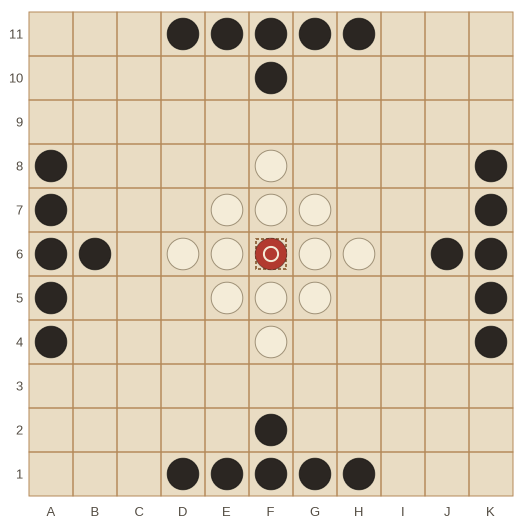
- King
- Defender
- Attacker
- Throne (central square)
The king stands on the central throne, surrounded by 12 defenders. 24 attackers stand in four groups at the sides of the board. The attackers move first.
Note: In the original 1980 edition the defenders are the dark pieces and the attackers the light pieces – the reverse of the otherwise usual colour convention.
Pieces
| Piece | Side | Count | Special feature |
|---|---|---|---|
| King | Defenders | 1 | Unarmed (does not help capture); captured on 4 sides (3 sides + throne when the king stands next to the throne); the only escape piece |
| Defender | Defenders | 12 | Ordinary piece |
| Attacker | Attackers | 24 | Ordinary piece |
No special pieces.
4. Objective
The defenders win when:
- the king reaches the edge of the board.
The attackers win when:
- the king is enclosed (captured) on all four sides, or
- all remaining defenders together with the king are encircled.
5. Rules of play
5.1 Movement
All pieces move orthogonally, any distance; no landing on and no jumping over other pieces.
5.2 King square (throne)
Only the king may enter the central square (the throne).
5.3 Capturing ordinary pieces
A piece is captured when it is flanked on two opposite sides (row or column) by an enemy piece.
5.4 The king does not help capture
The unarmed king does not take part in captures.
5.5 King capture
The king is captured when he is enclosed on all four sides. If one of the four sides is the throne, the king already counts as completely enclosed as soon as the three remaining sides are occupied. If a defender stands on the fourth side instead of an attacker while the three remaining sides are occupied by attackers, this defender can be captured between the king and an attacker.
Note on implementation: This rule is currently not implemented in tafl. The defender on the fourth side of the king cannot be captured in this way in tafl.
5.6 Encirclement rule
If the king and all remaining defenders are completely enclosed, the attackers win – since an escape is then impossible.
If the side to move has no legal move, it loses the game. If the same position occurs for the third time, the defenders lose. Both are stipulations of tafl.
5.7 Optional additional rules (according to the original leaflet)
The leaflet names several optional variants that can supplement or modify the basic rules:
- The king may help capture (either in general, or only when he himself makes the decisive, active move).
- Victory only by reaching a corner square: the corners are then reserved exclusively for the king; an attacker standing next to a corner can be captured by a defender.
- A 5-point match with hidden edge cards as a bluff element.
- A double game with a change of sides between the players.
6. Good to know
- In the original edition the defenders are the dark pieces, the attackers the light pieces – the reverse of the otherwise usual colour convention in many other Hnefatafl variants.
- Whether the king is unarmed by default is not stated explicitly as such in the source text; the accompanying strategy analysis, however, speaks clearly of the "weaponless king", and the king's helping to capture appears only as an optional additional rule (see section 5.7). For this guide the unarmed king therefore applies as the default.
- York includes an early form of the encirclement rule, which also appears in later variants such as Copenhagen Hnefatafl.
7. Related variants
York shares the unarmed king and edge escape with many modern 11×11 variants (compare Sea Battle 11×11 (Seeschlacht)). The encirclement rule introduced here was later adopted by numerous other rule sets, among them Copenhagen Hnefatafl; this, however – like Fetlar Hnefatafl – relies on an armed, strong king and corner escape instead of edge escape. Berserk Hnefatafl is also an 11×11 relative, but differs from York through an armed king, special pieces and corner escape.
8. Rules of play (original) with source reference
For York Hnefatafl there is neither a rule set of the Fellhuhn app nor a verbatim quotation of the original leaflet (York Archaeological Trust, 1980). The presentation rests exclusively on Damian Walker's (Cyningstan) paraphrased summary of the leaflet, not on its wording. An authentic, verbatim original text can therefore not be reproduced here without inventing it – see section 10 for the full classification. The rules reproduced in section 5 follow this paraphrase in content, including its references to individual rule numbers of the original leaflet.
Source (paraphrased, not verbatim): Walker, Damian: York Hnefatafl. http://tafl.cyningstan.com/page/245/york-hnefatafl — as well as the original leaflet (not available in full text): York Hnefatafl Leaflet, York Archaeological Trust / Oxbow Games (1980). http://tafl.cyningstan.com/download/1056/york-hnefatafl-leaflet
Own summary after Walker, Damian: York Hnefatafl, not the original text.
9. Sources
- [cyningstan-york] Walker, Damian: York Hnefatafl (paraphrase of the leaflet of the York Archaeological Trust edition 1980; game design David Brown, Oxbow Games). — http://tafl.cyningstan.com/page/245/york-hnefatafl
- [york-leaflet] York Hnefatafl Leaflet. — http://tafl.cyningstan.com/download/1056/york-hnefatafl-leaflet
10. State of the evidence and classification
Modern variant without historical evidence for the rule text itself (for the archaeological find context see section 2). The only available source is Damian Walker's (Cyningstan) paraphrase of the original leaflet [cyningstan-york]; a full-text quotation of the leaflet itself [york-leaflet] is not available. Section 8 therefore honestly does not reproduce a verbatim original text but documents this source gap. The content presentation in sections 2–7 follows Walker's paraphrase throughout; should the original leaflet become available in full text in future, a comparison is advisable.