Linnaeus Tablut
A historical Sámi tafl game (9×9) recorded by Carl von Linné in Lapland in 1732. According to current research, it is the only tafl variant for which a nearly complete original account of the rules survives. Features include an armed king, edge escape, two-sided capture on ordinary squares, stricter capture requirements on and next to the throne, and the throne's distinctive "anvil" rule.
Short description: A historical Sámi tafl game (9×9) recorded by Carl von Linné in Lapland in 1732. According to current research, it is the only tafl variant for which a nearly complete original account of the rules survives. Features include an armed king, edge escape, two-sided capture on ordinary squares, stricter capture requirements on and next to the throne, and the throne's distinctive "anvil" rule.
1. Basic data
| Name | Tablut (Sámi); here: "Linnaeus Tablut" – the handed-down original rule version |
|---|---|
| Game family | Hnefatafl (Nordic tafl game) |
| Category | Historically attested – according to the current state of research the only tafl variant with a handed-down original rule source |
| Origin / region | Sápmi / Lapland (Sámi) |
| Dating | Recorded in 1732, first (faulty) English translation printed in 1811, Latin printed edition in 1913 |
| Board size | 9×9 squares |
| Throne (konakis) | Yes, central square |
| Escape goal | Edge of the playing field (edge escape) |
| King | Armed (takes part in captures); capture from 2 sides in the open, 3 sides next to the throne, 4 sides on the throne |
| Piece ratio | 8 defenders + king against 16 attackers (1:2) |
2. History and origin
The Swedish naturalist Carl von Linné recorded the game "Tablut" in 1732 during his journey to Lapland, where he observed the Sámi playing. His notes – including the starting setup, a diagram legend and fourteen numbered rules in Latin – survived as part of his travel diary Iter Lapponicum.
The first printed version appeared in 1811 in an English translation by James Edward Smith under the title Lachesis Lapponica. This translation contains a consequential error in rule 9: where the Latin original writes "etiam Rex" ("also the king"), Smith translates "except the king" – and thereby wrongly makes the king uncapturable outside the throne. The authoritative Latin version only became accessible in 1913 in a scholarly printed edition.
According to the current state of research, Tablut is regarded as the only tafl variant whose original rules are almost completely preserved, and is thus the central source for the reconstruction of all other historical tafl games.
3. Starting setup and pieces
Legend: K = king · D = defender · A = attacker · . = empty square.
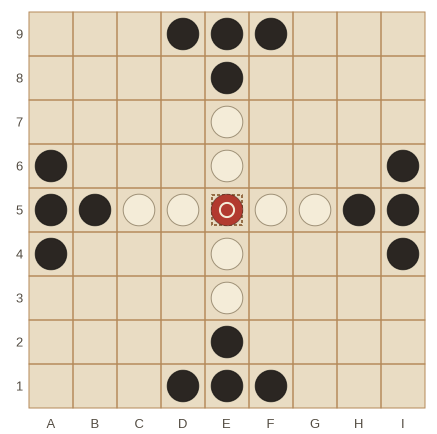
- King
- Defender
- Attacker
- Throne (central square)
The king stands on the central throne, surrounded by 8 defenders in a cross shape. 16 attackers stand in four groups of four pieces each at the midpoints of the four sides.
Pieces
| Piece | Side | Count | Special feature |
|---|---|---|---|
| King | Defenders | 1 | Armed (takes part in captures); the only escape piece |
| Defender | Defenders | 8 | Ordinary piece |
| Attacker | Attackers | 16 | Ordinary piece |
4. Objective
Defenders (Swedes) win when:
- the king has an open path to the edge of the board and reaches it.
Attackers (Muscovites) win when:
- the king is captured (enclosure according to section 5.3).
5. Rules of play
5.1 Movement
All pieces move orthogonally (horizontally or vertically) any distance over empty squares, also across several empty squares. Diagonal moves are not allowed, nor is jumping over another piece.
5.2 Capturing ordinary pieces
A piece is captured when it is flanked on two opposite sides (horizontally or vertically) by two enemy pieces. A piece that moves voluntarily between two opposing pieces is not captured in doing so – the capture only occurs if the flanking side actively closes the trap by its own move.
5.3 Capturing the king
The capture of the king depends on where he stands:
- On an open square: The king is captured like an ordinary piece, on two opposite sides.
- On the throne: All four sides around the king must be occupied by attackers.
- Directly next to the throne: The three remaining sides (not facing the throne) suffice – the throne itself already counts as the fourth, hostile side.
5.4 The throne as an anvil
The throne (the castle) can act like an enemy stone when capturing (rule 14): if a stone stands on one of the four squares adjacent to the throne and an enemy on the opposite square, the stone enclosed between them is captured.
Direction in tafl – convention, not source evidence: Rule 14 is marked at one point as an uncertain reading ("[?]") in the 1913 print and does not let the direction be recognised unambiguously. tafl therefore follows the common Nielsen/Copenhagen convention:
- Against attackers: The throne always acts as hostile. An attacker standing between a defender and the throne is captured (
throne.hostile_to_attackers = Always). - Against defenders: The throne only acts as hostile when it is empty (
throne.hostile_to_defenders = OnlyWhenEmpty). The occupied royal throne therefore does not help the attackers capture their own defenders.
The capture of the king on and next to the throne (four or three sides, rules 9–11) is independent of this and attested.
5.5 Returning to the throne
The king may return to the throne after leaving it (a deliberate decision; throne.king_may_occupy = true). Linné's fourteen handed-down rules do not exclude a return; the source situation is ambiguous (the description of the throne "cui nullus succedere potest" is read differently, another reading calls empty squares freely occupiable, also by the king, except the castle). tafl therefore follows the reading without a ban on returning.
Note: Earlier versions of tafl contained a house rule here under which the king was no longer allowed to return to the throne after leaving it. It was an implementation decision, not an attested part of the original text, and was deliberately removed. Games and measured values from the time before are not rule-identical. The Foteviken version (the rules page) keeps the ban on returning as part of the modern museum reconstruction.
5.6 Escape of the king
If the king finds a free, unobstructed path from the throne to a square on the board edge, he can use this path on the next move, provided the attackers do not block the path again beforehand. According to the original rules, the moving player announces such an open escape path with the call "Raicki"; if two escape paths are open, the call is "Tuicku". If the king actually reaches the edge, the game ends immediately and the defenders have won.
5.7 Move order
Swedes (defenders) and Muscovites (attackers) move alternately. Who makes the first move is not explicitly specified in the original text (see section 10).
5.8 Further cases
If the king is captured or completely enclosed, the game ends immediately in favour of the attackers. The Muscovites (attackers) play without a king of their own; they consist of sixteen stones that are set up in four divisions.
If the side to move has no legal move, it loses the game. If the same position occurs for the third time, the defenders lose. Both are stipulations of tafl.
6. Good to know
- Smith's decisive translation error (1811) concerns rule 9: the Latin original reads "Si quis hostem unum inter duos sibi hostes collocare possit, est occisus et ejici debet, etiam Rex" ("…then he is captured, also the king"). Smith wrongly translated this as "except the king" and thereby mistakenly made the king uncapturable outside the throne and its surroundings [Smith1811]. Only the Latin printed edition of 1913 restored the correct wording [Linné1913].
- The calls "Raicki" (one open escape path) and "Tuicku" (two open escape paths) are a Sámi peculiarity that appears in this form in no other handed-down tafl source.
- Tablut forms the basis on which Aage Nielsen and other researchers reconstructed the rules of all other, less completely attested historical tafl variants.
7. Related variants
According to Aage Nielsen's classification, Linnaeus Tablut belongs to the group of "weak king" games: games with an armed king who can already be captured on two opposite sides on an open square – outside the throne and its surroundings. On the same 9×9 board and with a comparable piece set are based the Fellhuhn app versions described separately in this documentation, Historical Tablut, Foteviken Tablut and Legacy Tablut, which each use deviating detail rules. Further simplified 9×9 versions after Aage Nielsen are Market Hnefatafl and Simple Tafl. All details on the respective deviations can be found in the corresponding separate documents.
8. Rules of play (original) with source reference
The following section reproduces the Latin original text of Linné's fourteen rules unchanged, together with an English translation, so that the preceding, linguistically adapted version can be compared with the source at any time. Only the heading levels were adapted to the embedding in this document; wording and order remain unchanged. The original text is in Latin; the translation below is rendered from the German translation of this documentation and is for orientation only – the Latin text is authoritative.
Source: Linné, Carl von: Iter Lapponicum, Andra upplagan, med bilagor och noter, ed. by Th. M. Fries (series Skrifter af Carl von Linné). Uppsala: Almqvist & Wiksell, 1913, pp. 155–156 (Latin original text).
Notice of rights: Text by Linné, 1732, public domain; edition: Almqvist & Wiksell, 1913, ed. by Th. M. Fries – public domain (editor Th. M. Fries, died 1913). The English rendering of the German translation is a text of this documentation and is licensed under CC BY 4.0.
Original text by Linné (Latin) – original in Latin
Original illustration as ASCII art with algebraic notation (the note below the figure is in German in this documentation):
9    o n m 4 4 4 M N O
8    l k i h 4 H I K L
7    g f e d 3 D E F G
6    4 c b a 2 A B C 4
5    4 4 3 2 1 2 3 4 4
4    4 c b a 2 A B C 4
3    g f e d 3 D E F G
2    l k i h 4 H I K L
1    o n m 4 4 4 M N O

     A B C D E F G H I

Die Buchstaben in den Reihen 1-4 müssten eigentlich kursiv gedruckt werden.
Das lässt sich aber mit reinem ASCII leider nicht abbilden.
- Alla få occupera et mutare loca per lineam rectam, non vero transversam, ut a ad c, non vero a ad e.
- Nulli licitum sit locum per lineam rectam alium supersalire, occupare, ut a b ad m, alio aliquo in i constituto.
- Si Rex occuparet locum b et nullus in e, i et m positus esset, possit exire, nisi mox muscovita aliquod ex locis nominatis occupat, et Regi exitum praecludit.
- Si Rex tali modo exit, est praelium finitum.
- Si Rex in e collocaretur, nec ullus sui, sive hostis miles esset in f g sive i m, tum aditus non potest claudi.
- Ut Rex aditum apertum vidit, clamet Raicki; si duae viae apertae sunt, tuicku.
- Licitum est loca dissita occupare per lineam rectam, ut a c ad n, nullo intercludente.
- Svecus et muscovita in gressibus alternant.
- Si quis hostem unum inter duos sibi hostes collocare possit, est occisus et ejici debet, etiam Rex.
- Si Rex in arce uno et hostes in tribus ex numero duo, tum abire potest per quartum; et si ejus miles quartum locum occupare potest, si ita cinctus et miles in tribus collocatur, est inter regem et militem qui stat occisus; si quatuor hostes in numero duo, tum rex captus est.
- Si Rex in numero duo, tum hostes tres, scilicet in a α et tres erunt, si capiatur.
- Rege capto vel intercluso finitur bellum et victor retinet svecos, devictus muscovitas, et ludus incipiatur.
- Muscovitae sine rege erunt, suntque sedecim in quattuor phalangibus disponendi.
- Arx potest intercludere, aeque ac trio [?], ut si miles in duo et hostis in tres est, occidat.
English translation of Linné's Tablut rules
- All stones may move along straight lines, but not diagonally. For example, a move from a to c is allowed, but not from a to e.
- No stone may jump over another. For example, one may not move from b to m if a stone already stands on i.
- If the king is on square b and squares e, i and m are unoccupied, he can escape, unless immediately afterwards a Muscovite occupies one of these squares and blocks the king's way.
- If the king succeeds in such an escape, the game is over.
- If the king is on square e and neither a stone of his own nor an enemy stone stands on squares f, g, i or m, then this access can no longer be blocked.
- If the player recognises an open escape path for the king, he shall call "Raicki"; if two escape paths are open, he shall call "Tuicku".
- It is allowed to occupy more distant squares along a straight line, for example from c to n, provided no stone blocks the way.
- Swedes and Muscovites move alternately.
- If a stone is enclosed between two enemy stones, it is captured and must be removed from the board. This also applies to the king.
- If the king is on the throne square 1 and enemies stand on three of the four adjacent squares 2, he can still escape via the fourth side. However, if this fourth side is also occupied so that the king is surrounded on all four sides, he is captured. If, instead of the king, an ordinary stone stands next to a king enclosed in this way, this ordinary stone is captured.
- If the king is on a square of type 2 (one of the four squares adjacent to the throne), three enemy stones on the remaining adjacent sides suffice to capture him.
- If the king is captured or completely enclosed, the game ends. The winner takes over the Swedes, the loser the Muscovites, and a new game begins.
- The Muscovites have no king and consist of sixteen stones that are to be set up in four rows or divisions.
- The throne (the castle) can act like an enemy stone when capturing. For example, if a stone stands on a square of type 2 and an enemy on the opposite square of type 3, the stone enclosed between them is captured.
9. Sources
- [Linné1913] Linné, Carl von: Iter Lapponicum, Andra upplagan, med bilagor och noter, ed. by Th. M. Fries (series Skrifter af Carl von Linné). Uppsala: Almqvist & Wiksell, 1913 (Latin), pp. 155–156. — Original: https://archive.org/details/iterlapponicumvlinn
- [Smith1811] Linné/Smith (transl.): Lachesis Lapponica, vol. 2. London: White and Cochrane, 1811, pp. 55–58.
- [Nielsen-hist] Nielsen, Aage: Historical Hnefatafl / Tablut Rules. — https://aagenielsen.dk/historical_hnefatafl_rules.php (setup "Saami Tablut 9×9 (Linné)")
- [cyningstan-tablut] Walker, Damian: Tablut. — http://tafl.cyningstan.com/page/170/tablut
10. State of the evidence & classification
Historically attested: according to the current state of research, Tablut is the only variant with an almost completely handed-down original rule source (Linné, 1732). The authoritative text is the Latin text of the 1913 printed edition [Linné1913]; the first English translation [Smith1811] contains the error described in section 6 in rule 9 and must not be used as a basis.
Three points remain open even in the Latin original and are documented here candidly as a gap instead of being invented: first, it is not explicitly specified which side makes the first move (rule 8 only mentions the alternating change of moves). Second, the wording of rule 14 is transmitted unclearly at one point (the word "trio" is itself marked with a question mark in the original text) – the exact reach of the anvil rule beyond the squares adjacent to the throne cannot be derived from it with ultimate certainty. The direction described in section 5.4 (hostile against attackers always, against defenders only when the throne is empty) is therefore a convention (Nielsen/Copenhagen), not hard evidence from Linné. Third, the original text does not expressly say whether the king may return to the throne after he has left it (see section 5.5) – tafl allows it; earlier versions of tafl forbade it by house rule. Likewise not expressly regulated is whether ordinary pieces may enter the throne when it is empty; the fourteen rules describe the throne only in its function as a capture square (rules 10, 14), not as a square closed to other pieces.